The papers below are referenced in the ongoing FAQ forum about the MIREC/fluoride/iodine studies conducted by Till (York), Lanphear (SFU), and others at York University.
Unfortunately, it has become necessary to address these studies in greater detail due to the volume of incorrect and misleading information they present.
We intend no malice toward the authors. Our concern lies with their methods and interpretations.
This page will be updated as time allows and will include all studies referenced in the FAQ. - WS
SYNOPSIS: Data from the MIREC cohort suggest that the reported IQ loss in the York studies is more likely attributable to iodine-induced thyroid dysfunction than to fluoride exposure. Mean iodine intake among participants was 452 μg/day (Krzeczkowski et al., 2023) - nearly double the WHO’s recommended 250 μg/day for pregnancy and lactation. Notably, 88% of pregnant women took prenatal supplements, which in Canada typically contain 220 μg of potassium iodide.
At rapidly elevated chronic iodine intake levels such as these - and with fluoride concentrations as low as those documented - iodine toxicity is the more plausible driver of thyroid dysfunction and associated neurodevelopmental outcomes (i.e. Teng et al., 2008, 2011). (Elevated iodine intake may also affect urinary fluoride levels, further complicating interpretation of the results.)
Across multiple publications, the authors repeatedly relied on inappropriate reference ranges for iodine sufficiency during pregnancy and failed to adequately account for the cohort’s high iodine intake (Goodman et al., 2022; Hall et al., 2023, 2024; Berghuis et al., 2025).
- See also: Commentary on the latest 2024 York/MIREC fluoride study: viewtopic.php?p=6643#p6643
- UPDATE November 2025: Another study by the Till/Lanphear team was published on November 11, 2025, in this case on fluoride and autism (Carty et al., 2025). Once again, they did not account for iodine (it is not even mentioned), despite extensive evidence for iodine and thyroid involvement in ASD and well established fluoride-iodine interactions. This is especially troubling because iodine and thyroid data for this cohort already exist. The authors again claim that specific gravity and creatinine corrections for urinary fluoride are “interchangeable,” but they do not show basic MUF/Cr distributions or address Hall 2024, where creatinine adjustment shifted iodine from being higher in fluoridated cities to higher in non-fluoridated cities. They also repeat the same methodological problems as in their earlier papers, such as averaging trimester specific MUF values, assuming a simple linear dose response, and making no serious attempt to examine critical windows or nonlinearity.
UPDATE September 2025: Yet another study by Till/Lanphear was published in August, this time on the effects of prenatal exposure to phthalates and preschool children’s IQ (Goodman et al., 2025). In spite of the well-documented adverse effects of phthalates on thyroid function, and the clear evidence that these effects are strongly modified by iodine/thyroid status, the authors made no mention of it, nor of the high iodine intake documented among the MIREC mothers.
UPDATE February 2025: A new study by the Till/Lanphear team on iodine intake and neurodevelopment in the MIREC cohort (Berghuis et al., 2025) has been published. Unfortunately, it is as deeply flawed as the previous work - perpetuating a pattern of methodological errors, scientific ignorance, and misinterpretation of the literature.
REFERENCES
Aakre I, Strand TA, Moubarek K, Barikmo I, Henjum S - "Associations between thyroid dysfunction and developmental status in children with excessive iodine status" PLoS One 12(11):e0187241 (2017) doi: 10.1371/journal.pone.0187241
https://journals.plos.org/plosone/artic ... ne.0187241
"We found an association between thyroid dysfunction and poorer developmental status among children with excessive iodine intake...With iodine excess being an increasing problem globally, this subject should be further explored."
(NOTE: In Canada, more than half of the children 3-5 years old are consuming too much iodine. 40% are consuming "excessive" amounts.)
Aakre I, Bjøro T, Norheim I, Strand TA, Barikmo I, Henjum S - "Development of thyroid dysfunction among women with excessive iodine intake--A 3-year follow-up" J Trace Elem Med Biol 31:61-6 (2015) doi: 10.1016/j.jtemb.2015.03.004
https://www.sciencedirect.com/science/a ... 2X15000346
Aakre I, Bjøro T, Norheim I, Strand TA, Barikmo I, Henjum S - "Excessive iodine intake and thyroid dysfunction among lactating Saharawi women" J Trace Elem Med Biol 31:279-84 (2015) doi: 10.1016/j.jtemb.2014.09.009.
"The median iodine intake was 407 µg/day, and almost twice as high in VHI (552 µg/day) areas as in HI (305 µg/day) areas. In both areas, the iodine intake was much higher than the recommended daily intake of 250 µg/day set by the WHO/ICCIDD/UNICEF."
NOTE: MIREC data shows a mean iodine intake of 452 μg/day - median 391 μg/day (Krzeczkowski et al., 2023).
Abbassi-Ghanavati M, Greer LG, Cunningham FG - “Pregnancy and Laboratory Studies” Obstetrics & Gynecology 114(6):1326–1331 (2009) doi:10.1097/aog.0b013e3181c2bde8
Abel MH, Korevaar TIM, Erlund I, Villanger GD, Caspersen IH, Arohonka P, Alexander J, Meltzer HM, Brantsæter AL - "Iodine Intake is Associated with Thyroid Function in Mild to Moderately Iodine Deficient Pregnant Women" Thyroid 28(10):1359-1371 (2018) doi: 10.1089/thy.2018.0305. MoBa
https://www.ncbi.nlm.nih.gov/pmc/articles/PMC6157349/
Abel MH, Caspersen IH, Meltzer HM, Haugen M, Brandlistuen RE, Aase H, Alexander J, Torheim LE, Brantsæter AL - "Suboptimal Maternal Iodine Intake Is Associated with Impaired Child Neurodevelopment at 3 Years of Age in the Norwegian Mother and Child Cohort Study" J Nutr 147(7):1314-1324 (2014) MoBa
https://pubmed.ncbi.nlm.nih.gov/28515161/
"Maternal iodine intake below the Estimated Average Requirement during pregnancy was associated with symptoms of child language delay, behavior problems, and reduced fine motor skills at 3 y of age. The results showed no evidence of a protective effect of iodine supplementation during pregnancy."
Abel MH, Ystrom E, Caspersen IH, Meltzer HM, Aase H, Torheim LE, Askeland RB, Reichborn-Kjennerud T, Brantsæter AL - "Maternal Iodine Intake and Offspring Attention-Deficit/Hyperactivity Disorder: Results from a Large Prospective Cohort Study" Nutrients 9(11):1239 (2017) doi: 10.3390/nu9111239 MoBa
https://www.ncbi.nlm.nih.gov/pmc/articles/PMC5707711/
"The maternal use of supplemental iodine was associated with an increased risk of child ADHD diagnosis and a higher mean ADHD symptom score...Initiating iodine supplement use in the first trimester was associated with an increased risk of ADHD diagnosis, whereas use before pregnancy was associated with increased child ADHD symptom scores."
Aboutorabi R, Rajaban R, Keykhaei N - "Relation of hyperthyroidism with urine volume and Specific Gravity" Medical Journal of Mashad University of Medical Sciences 47(83):57-61 (2004)
"We found significant increase in urine volume (p<0.001) and decrease in specific gravity in patients with hyperthyroidism (p<0.001)."
Ahmad S, Bailey EH, Arshad M, Ahmed S, Watts MJ, Stewart AG, Young SD - "Environmental and human iodine and selenium status: lessons from Gilgit-Baltistan, North-East Pakistan" Environ Geochem Health 43(11):4665-4686 (2021) doi: 10.1007/s10653-021-00943-w
https://link.springer.com/article/10.10 ... 21-00943-w
"The hydration correction with creatinine significantly influenced the rate of I deficiency or sufficiency in different age groups, which is concerning since UICuncor and UICsg remained consistent across age groups...we do not recommend the use of creatinine as a corrective factor in UIC surveys."
Akdader-Oudahmane S, Hamouli-Saïd Z, Zimmermann MB, Kherrab H, Azzoug S, Meskine D - "High prevalence of TPO-Abs and subclinical hypothyroidism in iodine-sufficient pregnant women in Northern Algeria" J Trace Elem Med Biol 61:126533 (2020). doi: 10.1016/j.jtemb.2020.126533.
https://www.sciencedirect.com/science/a ... 2X20300985
"In northern Algeria, median UICs in PW [pregnant women] indicate iodine sufficiency, and in WRA [women of reproductive age] indicate more than adequate intakes. About 75% of PW are TPO-Ab + and the prevalence of subclinical hypothyroidism is high. Monitoring and surveillance of iodine fortification programs is vital to avoid both iodine deficiency and excess."
Akinkugbe AA, Chiu YM, Kannan S, Bergink V, Wright RJ - "Prenatal Iodine Intake and Maternal Pregnancy and Postpartum Depressive and Anhedonia Symptoms: Findings from a Multiethnic US Cohort" Nutrients 16(11):1771 (2004). doi: 10.3390/nu16111771
https://pmc.ncbi.nlm.nih.gov/articles/PMC11174687/
"Prenatal iodine intake, whether below or above the recommended levels for pregnant women, was most strongly associated with greater anhedonia symptoms, particularly in the 6-month postpartum period."
Al Ghali R, El-Mallah C, Obeid O, El-Saleh O, Smail L, Haroun D - "Urinary minerals excretion among primary schoolchildren in Dubai-United Arab Emirates" PLoS One 16(8):e0255195 (2021) doi: 10.1371/journal.pone.0255195
https://journals.plos.org/plosone/artic ... ne.0255195
NOTE: Strong UIC and UF correlation ((r = 0.73). Note age factor!
Alampi JD, Lanphear BP, MacFarlane AJ, Braun JM, Oulhote Y, Ashley-Martin J, Arbuckle TE, Chen A, Muckle G, McCandless LC - "Association between gestational environmental chemical mixtures and folate exposures with autistic behaviors in a Canadian birth cohort" Environ Epidemiol 9(4):e402 (2025) MIREC
https://doi.org/10.1097/EE9.0000000000000402
"Our results suggest that the metal mixture is more strongly associated with autistic-like behaviors among participants with higher folate exposure, and the PFAS, PCB, and POP mixtures are more strongly associated with autistic-like behaviors among participants with low FA supplementation."
NOTE: As expected, no iodine supplement/thyroid consideration, although all data available.
Alsayed A, Gad AM, Abdel-Baset H, Abdel-Fattah A, Ahmed A, Azab A - "Excess urinary iodine is associated with autoimmune subclinical hypothyroidism among Egyptian women" Endocr J 55(3):601-5 (2008) doi: 10.1507/endocrj.k07e-165
https://www.jstage.jst.go.jp/article/en ... 5/_article
Althubaiti A - "Information bias in health research: definition, pitfalls, and adjustment methods" J Multidiscip Healthc 9:211-7 (2016) doi: 10.2147/JMDH.S104807
https://www.ncbi.nlm.nih.gov/pmc/articles/PMC4862344/
Amano I, Takatsuru Y, Haijima A, Haraguchi S, Koibuchi N - "The Impact of Chronic Excess Iodine Intake in Adult Mice Behavior "Journal of the Endocrine Society 4(S1)SAT–442 (2020) https://doi.org/10.1210/jendso/bvaa046.1180
https://academic.oup.com/jes/article/4/ ... 42/5833533
"In the behavioral analysis, female mice showed an increase in learning ability. In summary, although the chronic overdose of iodine does not affect thyroid hormone levels, it may affect cognitive learning function."
An D, Yang R, Du Y, Wang X, Ying Yang Y, Guo W, Yang J, Meng D, Gao W, Zhang J, Chen W, Wanqi Zhang W - "Variations in the Urinary Iodine Concentration and UrinaryIodine/Creatinine Ratio among Preschool Children" International Journal of Endocrinology 779094 (2023) https://doi.org/10.1155/2023/6779094
"We found that the interindividual variations in the UI/Cr ratio were higher than those in the UIC, which means that using the creatinine-corrected UIC to define iodine nutrition does not apply to all individuals and may even be counterproductive. Many previous studies have indicated that UCr can be affected by many factors, such as age, sex, and physical conditions. Based on observations in Chinese school-age children, UCr was not stable in repeated spot urine samples and increased with age; preschool children develop relatively rapidly, which may therefore lead to unstable creatinine levels."
Andersen SL, Sørensen LK, Krejbjerg A, Møller M, Laurberg P - "Challenges in the evaluation of urinary iodine status in pregnancy: the importance of iodine supplement intake and time of sampling" Eur Thyroid J 3(3):179-88 (2014)https://pubmed.ncbi.nlm.nih.gov/25538900/
"Time of spot urine sampling and time span from iodine supplement intake to spot urine sampling should be considered when evaluating urinary iodine status in pregnancy."
Andersen SL, Laurberg P - “Iodine Supplementation in Pregnancy and the Dilemma of Ambiguous Recommendations” Eur Thyroid J 5(1):35-43 (2016) doi: 10.1159/000444254
https://etj.bioscientifica.com/view/jou ... 444254.xml
"Women living in a population with a median urinary iodine concentration (UIC) at or above 100 µg/l are not in need of iodine supplementation in pregnancy." [See WHO 2007]
Andersen S, Waagepetersen R, Laurberg P - "Misclassification of iodine intake level from morning spot urine samples with high iodine excretion among Inuit and non-Inuit in Greenland" Br J Nutr 113(9):1433-40 (2015). doi: 10.1017/S0007114515000653
https://www.cambridge.org/core/journals ... D3632C5B8B
"Iodine excretion was lower in morning spot urine samples than in 24 h urine samples (P< 0.001). This difference was associated with iodine intake levels (P< 0.001), and was statistically significant when the iodine excretion level was above 150 μg/24 h. In conclusion, the iodine intake level was underestimated from morning spot urine samples if iodine excretion was above the recommended level."
Andersen SL, Andersen S, Liew Z, Vestergaard P, Olsen J - "Maternal Thyroid Function in Early Pregnancy and Neuropsychological Performance of the Child at 5 Years of Age" J Clin Endocrinol Metab 103(2):660-670 (2018). doi: 10.1210/jc.2017-02171
https://academic.oup.com/jcem/article/103/2/660/4693941
"High maternal TSH and low fT4 were associated with lower child verbal intelligence quotient...maternal thyroid hormone abnormalities were associated with adverse neuropsychological function of the child at 5 years of age. For intelligence, marked hypothyroidism was important, whereas for motor function and executive and behavior problems, maternal hypothyroxinemia was predominant." [Maternal hypothyroxinemia (low FT4) and hyperthyrotropinemia (elevated TSH) are associated with more-than-adequate iodine intake from iodine supplements during pregnancy (Rebagliato et al, 2010). In Gipuzkoa (Ibarluzea/INMA), nearly all women took a specific iodine supplement -> 45% of pregnant women had hypothyroxinemia].
Andersen MS, Jensen TK, Dreyer AF, Madsen JB, Christesen HT, Brandslund I, Bilenberg N, Glintborg D - "Free thyroxine in early pregnancy is an independent negative predictor of 3rd trimester HbA1c. Odense child cohort" Clin Endocrinol (Oxf) 95(3):508-519 (2021). doi: 10.1111/cen.14492
https://onlinelibrary.wiley.com/doi/10.1111/cen.14492. ODENSE - OCC
Arbuckle TE, Fraser WD, Fisher M, et al. - “Cohort profile: the maternal-infant research on environmental chemicals research platform” Paediatr Perinat Epidemiol 27(4):415-25 (2013) doi: 10.1111/ppe.12061 MIREC
https://onlinelibrary.wiley.com/doi/10.1111/ppe.12061
Arbuckle TE, Davis K, Marro L, Fisher M, Legrand M, LeBlanc A, Gaudreau E, Foster WG, Choeurng V, Fraser WD; MIREC Study Group - "Phthalate and bisphenol A exposure among pregnant women in Canada--results from the MIREC study" Environ Int 68:55-65 (2014) doi: 10.1016/j.envint.2014.02.010 MIREC
https://www.sciencedirect.com/science/a ... 2014000609
Asvold BO, Bjøro T, Vatten LJ - "Association of thyroid function with estimated glomerular filtration rate in a population-based study: the HUNT study" Eur J Endocrinol 164(1):101-5 (2011) doi: 10.1530/EJE-10-0705
https://eje.bioscientifica.com/view/jou ... /1/101.xml
"These findings suggest that low thyroid function, also within the clinically normal range, is associated with reduced GFR."
See many other studies on thyroid function/TSH and GFR/creatinine excretion (PFPC Members): viewtopic.php?p=5105#p5105
Ba Y, Ren LJ, Yin G, et al. - "Effect of different fluoride and iodine concentrations in drinking water on children's dental fluorosis and thyroid function" Chinese Journal of Public Health 25(8):942-943 (2009)
https://10.3321/j.issn:1001-0580.2009.08.017
http://poisonfluoride.com/phpBB3/viewtopic.php?p=1197
"High iodine increases the concentration of FT4. Fluoride can increase the concentration of FT4 under high iodine conditions."
Bailote HB, Linhares D, Carvalho C, Prazeres S, Rodrigues AS, Garcia P - "Iodine Intake and Related Cognitive Function Impairments in Elementary Schoolchildren" Biology (Basel) 11(10):1507 (2022) doi: 10.3390/biology11101507
https://www.mdpi.com/2079-7737/11/10/1507
Baldi E, Bucherelli C - "The inverted 'u-shaped' dose-effect relationships in learning and memory: modulation of arousal and consolidation" Nonlinearity Biol Toxicol Med 3(1):9-21 (2005) doi: 10.2201/nonlin.003.01.002
https://www.ncbi.nlm.nih.gov/pmc/articles/PMC2657842/
Bashash M, Thomas D, Hu H, Martinez-Mier EA, Sanchez BN, Basu N, Peterson KE, Ettinger AS, Wright R, Zhang Z, Liu Y, Schnaas L, Mercado-García A, Téllez-Rojo MM, Hernández-Avila M - "Prenatal Fluoride Exposure and Cognitive Outcomes in Children at 4 and 6-12 Years of Age in Mexico" Environ Health Perspect 125(9):097017 (2017) doi: 10.1289/EHP655 ELEMENT
https://ehp.niehs.nih.gov/doi/10.1289/EHP655
NOTE: No consideration given to thyroid status and iodine intake in mothers or children. [Iodine intake is deemed excessive in at least a third of Mexican children at ages specified, as well as a third of healthy adults in Mexico City, home of the ELEMENT cohort (Flores-Rebollar et al., 2014; Gonzalez-Nunez et al., 2021).]
Bath SC, Steer CD, Golding J - "Effect of inadequate iodine status in UK pregnant women on cognitive outcomes on their children: results from the Avon Longitudinal Study of Parents and Children (ALSPAC)" Lancet 382: 331–337 (2013) ALSPAC
https://www.thelancet.com/journals/lanc ... 5/fulltext
Bath SC, Furmidge-Owen VL, Redman CW, Rayman MP - "Gestational changes in iodine status in a cohort study of pregnant women from the United Kingdom: season as an effect modifier" American Journal of Clinical Nutrition 101(6):1180-1187 (2015) doi: 10.3945/ajcn.114.105536
https://www.sciencedirect.com/science/a ... 6523274110
Bath SC, Pop VJ, Furmidge-Owen VL, Broeren MA, Rayman MP - "Thyroglobulin as a Functional Biomarker of Iodine Status in a Cohort Study of Pregnant Women in the United Kingdom" Thyroid 27(3):426-433 (2017) doi: 10.1089/thy.2016.0322
https://pmc.ncbi.nlm.nih.gov/articles/PMC5337401/
Bath SC, Sleeth ML, McKenna M, Walter A, Taylor A, Rayman MP - "Iodine intake and status of UK women of childbearing age recruited at the University of Surrey in the winter" Br J Nutr 112(10):1715-23 (2014) doi: 10.1017/S0007114514002797
https://pubmed.ncbi.nlm.nih.gov/25274294/
Bath SC, Furmidge-Owen VL, Redman CW, Rayman MP - "Gestational changes in iodine status in a cohort study of pregnant women from the United Kingdom: season as an effect modifier" Am J Clin Nutr 101(6):1180-7 (2015) doi: 10.3945/ajcn.114.105536
https://pubmed.ncbi.nlm.nih.gov/25948667/
The iodine-to-creatinine ratio increased with advancing gestation, and there was a significant interaction between gestational week and season (P = 0.026).
Beck IH, Bilenberg N, Möller S, Nielsen F, Grandjean P, Højsager FD, Halldorsson TI, Nielsen C, Jensen TK - "Association between prenatal and early postnatal exposure to perfluoroalkyl substances (PFAS) and IQ score in 7-year-old children from the Odense Child Cohort" Am J Epidemiol. 2023 Apr 29:kwad110. doi: 10.1093/aje/kwad110 ODENSE - OCC
https://academic.oup.com/aje/advance-ar ... 10/7146879
Berghuis SA, Hall M, Krzeczkowski JE, Goodman CV, Chevrier J, Ayotte P, Lanphear B, Till C - "Urinary Iodine Concentration and Thyroid Hormone Metabolism in Pregnant Women and Neurodevelopment in Their Children: A Longitudinal Canadian Birth Cohort" Nutrients 17(5):830 (2025) doi: 10.3390/nu17050830 MIREC
https://www.mdpi.com/2072-6643/17/5/830
This latest "iodine" study from the Till/York group (February 2025) again fails to address this issue appropriately. Although raw UIC data were available, the authors used creatinine-adjusted values and categorized them under WHO UIC guidelines as IF they were unadjusted UIC. Serious problems with creatinine adjustment were already evident in the Hall studies. The paper applies misleading reference ranges, misunderstands critical issues, misrepresents prior studies, and evaluates the data improperly. SEE: Forum viewforum.php?f=106
Bernal J - "Thyroid Hormones in Brain Development and Function", In: Feingold KR, Anawalt B, Blackman MR, Boyce A, Chrousos G, Corpas E, de Herder WW, Dhatariya K, Dungan K, Hofland J, Kalra S, Kaltsas G, Kapoor N, Koch C, Kopp P, Korbonits M, Kovacs CS, Kuohung W, Laferrère B, Levy M, McGee EA, McLachlan R, New M, Purnell J, Sahay R, Shah AS, Singer F, Sperling MA, Stratakis CA, Trence DL, Wilson DP, editors. Endotext [Internet]. South Dartmouth (MA): MDText.com, Inc.; 2000–. (May 2022)
https://www.ncbi.nlm.nih.gov/books/NBK285549/
Bertinato J, Gaudet J, De Silva N, Mohanty S, Qiao C, Herod M, Gharibeh N, Weiler H - "Iodine Status of Mother-Infant Dyads from Montréal, Canada: Secondary Analyses of a Vitamin D Supplementation Trial in Breastfed Infants" J Nutr 152(6):1459-1466 (2022) doi: 10.1093/jn/nxac047
https://academic.oup.com/jn/article/152/6/1459/6537410
"The percentages of mothers that used a multivitamin-mineral (MVM) supplement containing iodine were 90% in pregnancy and 79% and 59% at 1 and 6 months of lactation, respectively." - ->see formula study by Till et al. (2020)
Bertinato J, Qiao C, L'Abbé MR - “Iodine Status of Canadian Children, Adolescents, and Women of Childbearing Age” J Nutr 151(12):3710-3717 (2021) doi: 10.1093/jn/nxab268
https://jn.nutrition.org/article/S0022- ... 3/fulltext
Bliddal S, Boas M, Hilsted L, Friis-Hansen L, Juul A, Larsen T, Tabor A, Faber J, Precht DH, Feldt-Rasmussen U - "Increase in thyroglobulin antibody and thyroid peroxidase antibody levels, but not preterm birth-rate, in pregnant Danish women upon iodine fortification" Eur J Endocrinol 176(5):603-612 (2017) doi: 10.1530/EJE-16-0987
https://pubmed.ncbi.nlm.nih.gov/28348022/
(Increase in thyroglobulin antibody and thyroid peroxidase antibody levels in pregnant Danish women upon iodine fortification)
Bolfi F, Marum MB, Fonseca SEDS, Mazeto GMFS, Nogueira CR, Nunes-Nogueira VDS - "Association between individual urinary iodine concentrations in pregnant women and maternal/newborn outcomes" Endocr Connect 14(3):e240621 (2025) doi: 10.1530/EC-24-0621
https://ec.bioscientifica.com/view/jour ... 4-0621.xml
"In pregnant women, individual diagnosis of UIC <150 μg/L was not associated with adverse maternal and neonatal outcomes."
Borucki Castro SI, Berthiaume R, Laffey P, Fouquet A, Beraldin F, Robichaud A, Lacasse P - "Iodine concentration in milk sampled from Canadian farms" J Food Prot 73(9):1658-63 (2010) doi: 10.4315/0362-028x-73.9.1658.
https://www.sciencedirect.com/science/a ... 8X23047142
"In 2004 and 2005, the average iodine content in Canadian retail milk was 393 ± 150 μg/kg, compared with 302 ± 165 μg/kg in 1992."
Canadian milk is a major iodine source, often providing more than the daily requirement in a single serving - and in some cases approaching or exceeding tolerable upper intake levels for young children.
Bu Y, Cai Y, Ji C, Zhao C, Tian C, Pang B, Shi M, Li X, Liu Y, Sun D - “Evaluation of iodine nutritional status during pregnancy by estimated 24-h urinary iodine excretion: population variation range and individual accuracy” Public Health Nutr 25(2):237-247 (2022). doi: 10.1017/S1368980021003335
https://www.cambridge.org/core/journals ... C6BA9C9B7F
MIREC urine samples were predominantly non-fasting, and taken throughout the day (see Arbuckle, 2014 for details.) York/IQ studies never disclosed sampling times. Highly suspect, as is "correcting for creatinine" during pregnancy.
Especially during the first trimester, UIC/Cr may vary drastically between morning and afternoon/evening samples.
- Excerpt, Table 1 (Supplement, Bu et al., 2022)

https://academic.oup.com/jcem/article/8 ... 62/2846385
"The results of this prospective investigation of the incidence of overt hyper- and hypothyroidism suggest that iodine supplementation of a population may increase the incidence of overt hypothyroidism, even if the population is moderately iodine-deficient. In such a population, the increase in risk of hypothyroidism should be weighed against the risk of ID disorders such as hyperthyroidism due to multinodular toxic goiter."
Candido AC, Vieira AA, de Souza Ferreira E, Moreira TR, do Carmo Castro Franceschini S, Cotta RMM - "Prevalence of Excessive Iodine Intake in Pregnancy and Its Health Consequences: Systematic Review and Meta-analysis" Biol Trace Elem Res 201(6):2784-2794 (2023) doi: 10.1007/s12011-022-03401-5
https://link.springer.com/article/10.10 ... 22-03401-5
"The prevalence of excessive iodine intake in 10,736 pregnant women in different regions of the world was 52%...the farther the trimester of gestation and the lower the FT4, the higher the prevalence of iodine excess. The main implications for pregnant women were hypothyroxinemia, hypothyroidism, and hyperthyroidism. For the newborn, macrosomia and thyroid dysfunction."
Candido AC, Azevedo FM, Ribeiro SAV, Navarro AM, Macedo MS, Fontes EAF, Crispim SP, Carvalho CA, Pizato N, da Silva DG, Faria FR, Velásquez Meléndez JG, Míriam Carmo Rodrigues B, Sperandio N, Pereira RJ, Priore SE, Franceschini SDCC - "Iodine deficiency and excess in Brazilian pregnant women: a multicenter cross-sectional study (EMDI-Brazil)" Nutrients 17(17):2753 (2025) doi: 10.3390/nu17172753
https://pmc.ncbi.nlm.nih.gov/articles/PMC12430125/
In this study, the median UIC was 186.7 µg/L, which falls squarely in the WHO “adequate” range for pregnant women (150–249 µg/L). However, more than two thirds of the population fell outside the adequate range, despite the median appearing normal. 36.7% of women were iodine-deficient, and 28.7% were above requirement, with another 3.6% in the excess category.
Carvalho IP, Peixoto B, Caldas JC, Costa A, Silva S, Moreira B, Almeida A, Moreira-Rosário A, Guerra A, Delerue-Matos C, Sintra D, Pestana D, Pinto E, Mendes FC, Martins I, Leite JC, Fontoura M, Maia ML, Queirós P, Moreira R, Leal S, Norberto S, Costa V, Fernandes VC, Keating E, Azevedo L, Calhau C - "Association between Elevated Iodine Intake and IQ among School Children in Portugal" Nutrients 14(21):4493 (2022) doi: 10.3390/nu14214493
https://www.mdpi.com/2072-6643/14/21/4493 IoGeneration Project (one-spot, first-morning urine samples)
"A greater proportion of children in the ≥250 µg/g group had below-average IQs, compared to children with less than 250 µg/g (p = 0.037)...The proportion of below-average IQs increased with increasingly elevated iodine concentrations (p = 0.047). The association remained significant after the adjustment for confounders, with the elevated iodine group showing increased odds of having below-average IQs when compared with the non-elevated iodine group (OR 1.55; 95% CI 1.11–2.17; p = 0.011). Consistently, the former group presented a lower mean IQ than the latter (p = 0.006)." [--> see also: UIC levels in Xiang IQ studies]
Carty A, Green R, Goodman CV, McLaughlin JR, Hu H, Lanphear B, Martinez-Mier EA, MacFarlane AJ, Muckle G, Brook JR, Till C - "Prenatal fluoride exposure and autistic behaviors in preschool-aged children: the Maternal-Infant Research on Environmental Chemicals (MIREC) cohort study" Environ Health 24(1):87 (2025). MIREC
https://doi.org/10.1186/s12940-025-01237-9
NOTE: NO mention of iodine, let alone adjusting for it as confounder/modifier!
- SEE: Carty A, Green R, Goodman C, McLaughlin J, Hu H, Lanphear B, Till C - "Prenatal fluoride exposure and autism spectrum disorder-like behaviors in a sample of Canadian preschool aged children: the MIREC study" ISEE Conference Abstracts 2021(1):P-633 (2021) MIREC
https://doi.org/10.1289/isee.2021.P-633
https://www.ncbi.nlm.nih.gov/pmc/articles/PMC9032535/
This paper on fluoride metabolism in pregnant women by frequent MIREC/ELEMENT collaborator and Professor of Dentistry EA Martinez-Mier makes no mention - at all - of the long-known effects of iodine status on fluoride metabolism.
Chatzi L, Leventakou V, Vafeiadi M, Koutra K, Roumeliotaki T, Chalkiadaki G, Karachaliou M, Daraki V, Kyriklaki A, Kampouri M, Fthenou E, Sarri K, Vassilaki M, Fasoulaki M, Bitsios P, Koutis A, Stephanou EG, Kogevinas M - "Cohort Profile: The Mother-Child Cohort in Crete, Greece (Rhea Study)" Int J Epidemiol 46(5):1392-1393k (2017) doi: 10.1093/ije/dyx084. RHEA
https://academic.oup.com/ije/article/46/5/1392/3882695
Chen Diqun, Meng Fangang, Liu Lixiang, Zhao Rencheng, Du Yang, Jiao Lisha, Liu Shoujun, Liu Yuan, Huang Jumei, Wang Xin, Liang Na, Sun Guodong, Xi Jianguo - "A Typical Survey on Thyroid Nodules in Adults in Juye County, Shandong Province, China" Chin J Ctrl Endem Dis 29(1):5-8 (2014) PFPC Library
"Within the water iodine range of 200–300 μg/L, an increase in water fluoride from (0.99±0.29) mg/L to (1.67±0.19) mg/L led to a significant decrease in both thyroid nodule detection rates and TPOAb positivity rates."
Chen J, Zhu J, Huang X, Zhao S, Xiang H, Zhou P, Zhou T, Xu Z - "Subclinical Hypothyroidism with Negative for Thyroid Peroxidase Antibodies in Pregnancy: Intellectual Development of Offspring" Thyroid 32(4):449-458 (2022) doi: 10.1089/thy.2021.0374
https://www.liebertpub.com/doi/10.1089/thy.2021.0374
"The effects of the intellectual development of the offspring with SCH-TPOAb- are related to the level of TSH."
Chen W, Sang Z, Tan L, Zhang S, Dong F, Chu Z, Wei W, Zhao N, Zhang G, Yao Z, Shen J, Zhang W - "Neonatal thyroid function born to mothers living with long-term excessive iodine intake from drinking water" Clin Endocrinol (Oxf) 83(3):399-404 (2015)
https://pubmed.ncbi.nlm.nih.gov/25280177/
"Mothers living in HI areas (β = 0·296, 95% CI: 0·163, 0·255) and with subclinical hypothyroidism (β = 0·360, 95% CI: 0·034, 0·175) contributed to elevated cord blood TSH concentration in neonates, while male neonates were more likely to present with higher TSH concentration compared with female infants (β = -0·760, 95% CI: -0·119, -0·033). Conclusions: Excessive iodine intake during pregnancy was associated with an increased rate of hyperthyrotropinaemia in neonates and their mothers, especially in male neonates."
Chen W, Zhang Y, Hao Y, Wang W, Tan L, Bian J, Pearce EN, Zimmermann MB, Shen J, Zhang W - "Adverse effects on thyroid of Chinese children exposed to long-term iodine excess: optimal and safe Tolerable Upper Intake Levels of iodine for 7- to 14-y-old children" Am J Clin Nutr 107(5):780-788 (2018) doi: 10.1093/ajcn/nqy011
https://academic.oup.com/ajcn/article/107/5/780/4979665
"We recommend 250 and 300 μg/d as safe Tolerable Upper Intake Levels of iodine for children aged 7-10 y and 11-14 y, respectively."
Chen Y, Guo W, Pan Z, Zhang D, Gao M, Wu W, Wang C, Duan Y, Gu X, Pearce EN, Lai J, Zhang W - "Exploration of the optimal range of urinary iodine concentration in Chinese pregnant women in mildly iodine-deficient and -sufficient areas" Eur J Nutr 61(3):1221-1230 (2022) doi: 10.1007/s00394-021-02693-y.
https://link.springer.com/article/10.10 ... 21-02693-y
"In Tianjin, the TDR [thyroid dysfunction rate] increased with UIC and peaked at UIC ≥ 500 μg/L (P = 0.002), while in Wuqiang, the TDR showed a weak "U-shaped" relationship with UIC and the rate was lowest with UIC 100-149 μg/L...We suspected that the optimal UIC criteria recommended by WHO may be a little high for pregnant women in mild-to-moderate iodine-deficient countries."
Chen Y, Xiang Q, Wang N, Zhang W, Zhu C, Wang Y, Wan H, Cheng J, Zhang K, Cai Y, Lu Y - "Are ethnic differences, urinary iodine status, lead and cadmium exposure associated with thyroid autoimmunity and hypothyroid status? A cross-sectional study" BMJ Open 12(2):e056909 (2022) doi: 10.1136/bmjopen-2021-056909
https://bmjopen.bmj.com/content/12/2/e056909.long
"For urinary iodine-to-creatinine ratio (UI/Cr), compared with the level of 100.00-199.99 µg/g, the level of ≥300.00 µg/g had a 1.5-fold risk for ATA + and US+ (OR 1.455, p=0.041). The levels of 200.00-299.99 µg/g and ≥300.00 µg/g were positively associated with hypothyroid status (OR 1.509, p=0.002 and OR 1.338, p=0.043)."
Chen X, Yu J, Huang Y, Chen G - "Comparison of cognitive function in patients with hypothyroidism and subclinical hypothyroidism" Chinese Behavioral Medical Sciences 17(12):1078-1079 (2008)
https://qikan.cqvip.com/Qikan/Article/D ... d=28958907
Chen X, Wu C, Wang Z, Wu C, Guo Y, Zhu X, Hu YP, Shi Z, Song Q, Cui X, Su J, Zang J - "Iodine nutrition status and thyroid autoimmunity during pregnancy: a cross-sectional study of 4635 pregnant women" Nutr J 21(1):7 (2022) doi: 10.1186/s12937-022-00760-6 ISPOHC
https://nutritionj.biomedcentral.com/ar ... 22-00760-6
Cheung KL, Lafayette RA - "Renal physiology of pregnancy" Adv Chronic Kidney Dis 20(3):209-14 (2013) doi: 10.1053/j.ackd.2013.01.012
https://www.ncbi.nlm.nih.gov/pmc/articles/PMC4089195
"During pregnancy, the GFR increases 50% compared with prepregnancy levels."
Chiovato L, Tonacchera M, Lapi P, Fiore E, Vitti P, Pinchera A – “Thyroid autoimmunity and neuropsychological development” Acta Medica Austriaca 19(Suppl 1):91–95 (1992)
https://pubmed.ncbi.nlm.nih.gov/1519465/
Chong W, Shi X, Teng W, Sun W, Jin Y, Shan Z, Guan H, Li Y, Gao T, Wang W, Chen W, Tong Y - "Multivariate analysis of the relationship between iodine biological exposure level and hypothyroidism" Chin Med J 117(14):1171-1174 (2004) PFPC Library
This study investigated the relationship between iodine exposure levels and hypothyroidism using data from 3,761 adults in rural areas with varying iodine exposure: mild iodine deficiency, more than adequate iodine, and excessive iodine. Logistic regression analysis showed that both more than adequate and excessive iodine intake were independent risk factors for subclinical hypothyroidism (OR = 3.172 and 6.391, respectively) and overt hypothyroidism (OR = 3.696 and 9.213, respectively). The prevalence of hypothyroidism was significantly higher in individuals with positive thyroid peroxidase antibodies (TPOAb) compared to those with negative TPOAb, with clinical hypothyroidism rates of 11.85% vs. 0.20% and subclinical hypothyroidism rates of 8.71% vs. 2.65%. Interaction analyses revealed that positive thyroglobulin antibody (TgAb) combined with high iodine exposure further increased the risk of subclinical and overt hypothyroidism (OR = 2.656 and 3.347, respectively). The findings indicate that higher iodine exposure levels exacerbate the risk of thyroid dysfunction, particularly in individuals with thyroid autoantibodies, with a greater severity of hypothyroidism as iodine exposure increases.
Chung HR - “Iodine and thyroid function” Ann Pediatr Endocrinol Metab 19(1):8-12 (2014) doi: 10.6065/apem.2014.19.1.8
https://www.ncbi.nlm.nih.gov/pmc/articles/PMC4049553/
Chung JH - "Recent Issues Related to Thyroid Disease in Pregnancy" Int J Thyroidol 13(2):85-94 (2020)
https://doi.org/10.11106/ijt.2020.13.2.85
(L-T4 therapy is not recommended in TPOAb-positive pregnant women to reduce miscarriage.)
Cools R, D'Esposito M - "Inverted-U-shaped dopamine actions on human working memory and cognitive control" Biol Psychiatry 69(12):e113-25 (2011) doi: 10.1016/j.biopsych.2011.03.028
https://www.biologicalpsychiatryjournal ... 2/fulltext
"The relationship between cognitive performance and dopamine (DA) levels follows an 'Inverted-U–shaped' function, where both too little and too much DA impairs performance." (See Goldman-Rakic et al., 2000)
Connelly KJ, Boston BA, Pearce EN, Sesser D, Snyder D, Braverman LE, Pino S, LaFranchi SH - "Congenital hypothyroidism caused by excess prenatal maternal iodine ingestion" J Pediatr 161(4):760–762 (2012)
https://pubmed.ncbi.nlm.nih.gov/22841183/
Cong Xuzi, Li Fucheng, Jiang Zehai, Li Fei, Yang Ying, Yan Shulin - "Analysis of the relationship between salt iodization and iodine deficiency disorders, coal-burning fluorosis and urinary iodine and fluoride" Contemporary Medicine (2012)
http://www.cqvip.com/qk/90953a/201225/42890485.html
Corcino CM, Berbara TMBL, Saraiva DA, Morais NAOES, Schtscherbyna A, Gertrudes LN, Teixeira PFDS, Vaisman M - "Variation of iodine status during pregnancy and its associations with thyroid function in women from Rio de Janeiro, Brazil" Public Health Nutr 22(7):1232-1240 (2019)
https://www.cambridge.org/core/journals ... 8A5A589253
"Maternal UIC was above the normal range (≥250 µ/l) in >40 % of the analysed samples and excessive (≥500 µ/l) in 6·4 % of the samples. Women with median UIC≥250 µg/l and at least one sample showing excessive UIC had a 6·6- fold increased risk of presenting SCH at some point during gestation."
Cortés-Castell E, Juste M, Palazón-Bru A, Goicoechea M, Gil-Guillén VF, Rizo-Baeza MM - "Factors associated with moderate neonatal hyperthyrotropinemia" PLoS One 14(7):e0220040 (2019) doi: 10.1371/journal.pone.0220040
https://journals.plos.org/plosone/artic ... ne.0220040
Cui Yushan, Zhao Liang, Zeng Qiang, Wang Rui, Zhang Lei, Fu Gang, Feng Baojia, Liu Hongliang - "The role of oxidative stress in iodine and fluoride induced thyroid injury" Environmental and Occupational Medicine (1):7-12 (2016)
http://www.cqvip.com/QK/98530A/201601/667712011.html
Cui Y, Zhang B, Zhang Z, Nie J, Liu H - "Long-term repetitive exposure to excess iodine induces mitochondrial apoptosis, and alters monoamine neurotransmitters in hippocampus of rats of different genders" Toxicol Res (Camb) 10(5):975-982 (2021)
https://www.ncbi.nlm.nih.gov/pmc/articles/PMC8557656/
"The results showed that excess iodine could increase urinary iodine and brain organ coefficient in offspring of both genders, change the hippocampal cell structure, and damage the spatial learning and memory capacities. ... Besides, excess iodine showed different effects on monoamine neurotransmitter in different genders."
Cui T, Wang W, Chen W, Pan Z, Gao S, Tan L, Pearce EN, Zimmermann MB, Shen J, Zhang W - "Serum Iodine Is Correlated with Iodine Intake and Thyroid Function in School-Age Children from a Sufficient-to-Excessive Iodine Intake Area" J Nutr 149(6):1012-1018 (2019) doi: 10.1093/jn/nxy325
https://www.sciencedirect.com/science/a ... 6622166289
"The median iodine intake was estimated to be 299 μg/d and was significantly higher in boys than in girls (316 μg/d compared with 283 μg/d; P < 0.001)...Serum iodine was positively correlated with iodine intake and the serum FT4 concentration in children. It is a potential biomarker for diagnosing excessive iodine intake in children."
Cui Y, Yu J, Zhang B, Guo B, Gao T, Liu H - "The relationships between thyroid-stimulating hormone and/or dopamine levels in peripheral blood and IQ in children with different urinary iodine concentrations" Neurosci Lett 729:134981 (2020) doi: 10.1016/j.neulet.2020.134981
https://www.sciencedirect.com/science/a ... 4020302512
"The proportion of people with low average and lower intelligence in UIC ≥ 300 μg/L group was significantly higher than that in control group..."
Dahl L, Wik Markhus M, Sanchez PVR, Moe V, Smith L, Meltzer HM, Kjellevold M - "Iodine Deficiency in a Study Population of Norwegian Pregnant Women-Results from the Little in Norway Study (LiN)" Nutrients 10(4):513 (2018) doi: 10.3390/nu10040513
https://pmc.ncbi.nlm.nih.gov/articles/PMC5946298/
Seasonal variation of UIC
Derakhshan A, Kortenkamp A, Shu H, Broeren MAC, Lindh CH, Peeters RP, Bornehag CG, Demeneix B, Korevaar TIM - "Association of per- and polyfluoroalkyl substances with thyroid homeostasis during pregnancy in the SELMA study" Environ Int 167:107420 (2022). doi: 10.1016/j.envint.2022.107420 SELMA
https://www.sciencedirect.com/science/a ... 2022003476
"Higher PFUnDA levels were associated with lower TT4 (β [95% CI]: -1.58 [-3.07 to -0.09]) and there was an inverted U-shaped association of PFOS with TT4 (P = 0.03). Higher PFDA, PFUnDA, PFHpA levels were associated with a lower TT3. Overall, higher PFAS concentrations were associated with a higher FT4/FT3 ratio and a higher TT4/TT3 ratio. There was no association of PFAS with the TSH/FT4 ratio. Higher concentrations of several PFAS were associated with lower TT4/FT4 and TT3/FT3 ratios."
Derakhshan A, Korevaar TIM, Taylor PN, Levie D, Guxens M, Jaddoe VWV, Nelson SM, Tiemeier H, Peeters RP - "The Association of Maternal Thyroid Autoimmunity During Pregnancy With Child IQ" J Clin Endocrinol Metab 103(10):3729-3736 (2018). doi: 10.1210/jc.2018-00743
https://academic.oup.com/jcem/article/1 ... 29/5055114
"In Generation R, TPOAb positivity was associated with a 2.0 ± 0.9-point lower mean child IQ (P = 0.03). Sensitivity analyses showed negative effect estimates already from TPOAb concentrations considerably lower than currently used manufacturer cutoffs."
Dineva M, Rayman MP, Levie D, Hunziker S, Guxens M, Peeters RP, Murcia M, Rebagliato M, Irizar A, Jimeno-Romero A, Sunyer J, Korevaar TIM, Bath SC - "Exploration of thyroglobulin as a biomarker of iodine status in iodine-sufficient and mildly iodine-deficient pregnant women" Eur J Nutr 62(5):2139-2154 (2023). doi: 10.1007/s00394-023-03131-x.
https://link.springer.com/article/10.10 ... 23-03131-x
Dong J, Liu S, Wang L, Zhou X, Zhou Q, Liu C, Zhu J, Yuan W, Xu WY, Deng J - "Iodine monitoring models contribute to avoid adverse birth outcomes related more than adequate iodine intake" BMC Pregnancy Childbirth 21(1):454 (2021)
https://bmcpregnancychildbirth.biomedce ... 21-03936-w
"Multivariate logistic regression analysis showed that multivitamin supplements containing iodine and milk consumption were risk factors for more than adequate iodine (UIC ≥ 250 μg/L). Iodine-rich diet was significantly related to heavier birthweight, larger head circumference and longer femur length of the newborns while more than adequate iodine intake (UIC ≥ 250 μg/L) was a risk factor for macrosomia."
Dou Y, Wang Y, Wang T, Liang L, Ren X, Li H, Zhu X - "Analysis of iodine nutrition and thyroid function of adults in urban areas of Wuwei city, Gansu province" Journal of Hygiene Research 43(1):58-62 (2014) PFPC Library
"The survey was divided into iodine deficiency group, adequate iodine group, over-adequate iodine group and iodine excess group for urinary iodine level. The abnormal ratio of TT3, TT4, FT3, FT4, TSH in four groups had no statistically differences, but the positive rate of TGAb and TMAb was raised with increased urinary iodine level."
Du Y, An N, Hu Y, Duan L, Ma J, Huang H, ZhuJ, Sun L, Li Z, Ba Y - "IQ Alterations in Children at 7-13 Years Old: The Roles of Prenatal and Childhood Fluoride Exposure" Conference Proceedings, The 8th International Conference on Medical Geology (2019)
https://poisonfluoride.com/dir/wp-conte ... .-2019.pdf
"Prenatal fluoride exposure in drinking water could cause loss of children's IQ, especially in the proportion of children with excellent and extremely excellent IQ grades....When urinary fluoride level does not exceed 0.9 mg/L, children's IQ increases with the increase of urinary fluoride level (P<0.05)....For every 0.1 mg L-1 increase in urinary fluoride, children's IQ score increased by 0.12 in multiple adjustment regression analysis...appropriate concentration of fluoride exposure in childhood may improve intellectual development of children in some degree." Iodine-excessive area - average UIC -> 396 ug/L
SEE also: Wang/Yang/Hong studies
Du Y, Gao Y, Meng F, Liu S, Fan Z, Wu J, Sun D - "Iodine deficiency and excess coexist in China and induce thyroid dysfunction and disease: a cross-sectional study" PLoS One 9(11):e111937 (2014) doi: 10.1371/journal.pone.0111937
https://journals.plos.org/plosone/artic ... ne.0111937
"Thyroid nodules are more likely to be present in the iodine excess and deficient areas than in the iodine sufficient areas. Subclinical hyperthyroidism and overt hyperthyroidism are more likely to be prevalent in the iodine-deficient areas than in the iodine excess or sufficient areas. Subclinical hypothyroidism is more likely to be prevalent in the high iodine intake areas than in the iodine deficient or sufficient areas. Median TSH may be deemed as an alternative indicator for monitoring the iodine nutrition status of the adult population in iodine excess and deficient areas."
Du Y, Liu P, Huang X, Meng F, Fan L, Li W, Yao J, Chen X, Li Z, Li M, Lv C, Jiang W, Zhang W, Sun D - "Prolonged Exposure to Elevated Iodine Levels in Drinking Water Is Associated With the Occurrence of Autoimmune Thyroid Disorders in Adults: Findings From a Case-Control Study Conducted in Shandong Province, China" J Nutr Metab 2025:1510663 (2025) doi: 10.1155/jnme/1510663
https://pubmed.ncbi.nlm.nih.gov/40661783/
"The case-control study demonstrated a significant association between the development of AITD and prolonged exposure to elevated iodine levels (above 100 μg/L) in water...Risk factors for AITD include a family history of thyroid disorders and higher educational attainment. Additionally, the consumption of freshwater fish was identified as a protective factor."
Du J, Xu X, Yuan N, Zhang X - "Effect of maternal isolated hypothyroxinemia in the first trimester on offspring neurodevelopment: a prospective cohort study" Front Endocrinol (Lausanne) 17:1734708 (2026)
DOI: 10.3389/fendo.2026.1734708
Maternal IH in the first trimester is associated with lower intellectual developmental scores and higher scores on screening scales for symptoms related to attention-deficit/hyperactivity disorder and autism spectrum disorder in the offspring.
Dušová H, Trávníček J, Svoboda M, Baňoch T, Kroupová V, Peksa Z, Konečný R - "The impact of high iodine intake on thyroid function in ewes and lambs" Neuro Endocrinol Lett 33(5):517-24 (2012)
https://pubmed.ncbi.nlm.nih.gov/23090270/
Engel SM, Villanger GD, Herring A, Nethery RC, Drover SSM, Zoeller RT, Meltzer HM, Zeiner P, Knudsen GP, Reichborn-Kjennerud T, Longnecker MP, Aase H - "Gestational thyroid hormone concentrations and risk of attention-deficit hyperactivity disorder in the Norwegian Mother, Father and Child Cohort Study" Paediatr Perinat Epidemiol 37(3):218-228 (2023) MoBa doi: 10.1111/ppe.12941
https://onlinelibrary.wiley.com/doi/10.1111/ppe.12941
"High maternal T3 was associated with increased risk of ADHD (5th vs 1st quintile odds ratio 2.27, 95% confidence interval 1.21, 4.26). For FT4i, both the lowest and highest quintiles were associated with an approximate 1.6-fold increase in risk of ADHD, with similar trends found for T4."
Fan P, Chen Y, Luo ZC, Shen L, Wang W, Liu Z, Zhang J, Ouyang F - "Cord Blood Thyroid Hormones and Neurodevelopment in 2-Year-Old Boys and Girls" Front Nutr 8:773965 (2021) doi: 10.3389/fnut.2021.773965
https://www.frontiersin.org/articles/10 ... 73965/full
"Mild alterations in thyroid hormones of newborns were associated adversely with neurodevelopment in boys, suggesting the importance of optimal thyroid hormone status for neurodevelopment in early life."
Farebrother J, Zimmermann MB, Andersson M - "Excess iodine intake: sources, assessment, and effects on thyroid function" Ann N Y Acad Sci. 1446(1):44-65 (2019) doi: 10.1111/nyas.14041
https://nyaspubs.onlinelibrary.wiley.co ... nyas.14041
Farmus L, Till C, Green R, Hornung R, Martinez Mier EA, Ayotte P, Muckle G, Lanphear BP, Flora DB - "Critical windows of fluoride neurotoxicity in Canadian children" Environ Res 200:111315 (2021) doi: 10.1016/j.envres.2021.111315 MIREC
https://www.sciencedirect.com/science/a ... 5121006095
Feng Y, Li J, Lok KYW, Chau PH, Lu D, Kwok JYY - "Maternal thyroid dysfunction and stress during pregnancy on ADHD risk in preschoolers: a retrospective study" Eur Child Adolesc Psychiatry. 2025 Jun 23. doi: 10.1007/s00787-025-02792-9
https://link.springer.com/article/10.10 ... 25-02792-9
"In the adjusted model, children of mothers with thyroid dysfunction during pregnancy had a 54.1% higher risk of an ADHD diagnosis (95% CI: 1.050, 2.262) compared to those whose mothers did not have thyroid dysfunction."
Fields EM - "Treatment of metabolic insufficiency and hypothyroidism with sodium liothyronine; preliminary report" J Am Med Assoc 163(10):817-21 (1957) doi: 10.1001/jama.1957.02970450019006
(re: early reports of specific gravity change with T3 treatment)
Flores-Rebollar A, Lendechy Velázquez M, Castro Sánchez A, López Carrasco G, Ruiz Juvera A - "Urinary iodine excretion in healthy Mexican adults" Arch Latinoam Nutr. 64(3):153-60 (2014) -> Mexico City
https://www.alanrevista.org/ediciones/2014/3/art-2/
"Excessive dietary iodine intake was established in 31.4% of all volunteers according to their UI, placing them at risk of thyroid dysfunction."
Flores-Rebollar A, Moreno-Castañeda L, Vega-Servín NS, López-Carrasco G, Ruiz-Juvera A - "Prevalence of autoimmune thyroiditis and thyroid dysfunction in healthy adult Mexicans with a slightly excessive iodine intake" Nutr Hosp 32(2):918-24 (2015). doi: 10.3305/nh.2015.32.2.9246
http://www.aulamedica.es/nh/pdf/9246.pdf
"Median UI was 267 μg/L, (IQR 161.3 - 482.5)....in spite of our study's limitations, the frequency of autoimmune thyroiditis is clearly elevated in the studied population. Further studies are necessary in order to define the prevalence of autoimmune thyroid disease as well as the current iodine nutritional status in our country." ALSO:TG showed essentially no relationship with estimated iodine intake and performed poorly as a discriminator of higher intake.
Fonseca I, Almeida AL, Santos PBD, Treistman N, Aprigio T, Vaisman M, Vidal APA, Teixeira PFDS, Morais NS - "Association of iodine nutritional status with thyroid nodules and papillary thyroid carcinoma in women from an iodine-sufficient region in Brazil: A cross-sectional center study" Journal of Trace Elements in Medicine and Biology 93:127816 (2026)
DOI: 10.1016/j.jtemb.2026.127816
Urinary iodine concentration above 300 µg/L was independently associated with both thyroid nodules and papillary thyroid carcinoma. Women with UIC > 300 µg/L had 3.42-fold higher odds of thyroid nodules and 3.90-fold higher odds of PTC. Iodine levels were also higher in the follicular subtype of PTC, and most follicular subtype cases had UIC ≥ 300 µg/L.
Fossa AJ, Hall AM, Papandonatos GD, Arbuckle TE, Ashley-Martin J, Borghese MM, Bruin JE, Chen A, Fisher M, Krzeczkowski JE, Lanphear BP, MacFarlane AJ, Manz KE, Morrison KM, Oulhote Y, Palaniyandi J, Palmert MR, Pennell KD, Vuong AM, Walker DI, Weiler HA, Braun JM - "Prenatal PFAS exposures and cardiometabolic health in middle childhood in the MIREC cohort" Environmental Research 274:121330 (2025) MIREC
https://doi.org/10.1016/j.envres.2025.121330
Freire C, Ramos R, Amaya E, Fernández MF, Santiago-Fernández P, Lopez-Espinosa MJ, Arrebola JP, Olea N - "Newborn TSH concentration and its association with cognitive development in healthy boys" Eur J Endocrinol 163(6):901-9 (2010) INMA-Granada
https://doi.org/10.1530/EJE-10-0495
"Newborn thyroid hormone status expressed by TSH in cord blood may adversely affect later cognitive function."
Furnée CA, van der Haar F, West CE, Hautvast JG - "A critical appraisal of goiter assessment and the ratio of urinary iodine to creatinine for evaluating iodine status" Am J Clin Nutr 59(6):1415-7 (1994) doi: 10.1093/ajcn/59.6.1415
https://academic.oup.com/ajcn/article-a ... 15/4715926
"Further, the urinary iodine-creatinine ratio correlated significantly with the creatinine concentration; Spearman's rank-order correlation coefficient, rs= 0.39 (P < 0.001). If creatinine is a suitable index to correct for variations in iodine excretion, no correlation would be expected."
Gao B, Yin G - "Effects of high-dose iodine on brain development in mice" Chin J Prev Med 31(3):134-136 (1997) PFPC Library
http://218.28.6.71:81/Qikan/Article/Detail?id=2553535
"Weight of brain, protein and nucleic acid concentrations were measured in one, seven, 14, 21 and 30 day old young mice, and morphological changes in the brain and their abilities of learning and memory were observed in 30 day old young mice, born to mothers with high iodine goiter. Results indicated that weight of brain, protein content, ratio of protein to DNA, RNA content, and ratio of RNA to DNA all decreased significantly, and DNA content increased in the brain of high iodine mice, as compared with those in normal iodine mice. Abilities of learning and memory in 30 day old mice decreased. And, those changes began from the seventh to 14th days after their birth. It suggests that excessive intake of iodine, as iodine deficiency, can not only cause high iodine goiter, but also damage nervous system leading to retardation of brain development and impediment of its function."
Gao X, Li W, Gu Q, Li Y, Li Y, Wang H, Teng X, Teng D, Ding S, Teng W, Shan Z - "Chronic Iodine Excess and Aging Synergistically Impact Thyrotropin Elevation: A Prospective 20-Year Follow-Up Study in China" Thyroid (2026)
https://pubmed.ncbi.nlm.nih.gov/41804852/
"Alleviation of iodine excess promoted aging-related TSH elevation, whereas persistent iodine excess suppressed aging-related TSH elevation. However, among participants with positive thyroid antibodies, no significant interaction effect above was observed. By comparison, there was a greater prevalence of SCH, especially an obvious high prevalence of severe SCH under persistent iodine excess."
Gao CH, Qu JQ, Zhou XY, Gao TS - "Iodine-Rich Herbs and Potassium Iodate Have Different Effects on the Oxidative Stress and Differentiation of TH17 Cells in Iodine-Deficient NOD.H-2h4 Mice" Biol Trace Elem Res 183(1):114-122 (2018). doi: 10.1007/s12011-017-1115-y.
https://link.springer.com/article/10.10 ... 017-1115-y
Gao M, Chen W, Sun H, Fan L, Wang W, Du C, Chen Y, Lin L, Pearce EN, Shen J, Cheng Y, Wang C, Zhang W - "Excessive iodine intake is associated with formation of thyroid nodules in pregnant Chinese women" Nutr Res 66:61-67 (2019) doi: 10.1016/j.nutres.2019.02.009
https://www.sciencedirect.com/science/a ... 1718307814
Gao TS, Teng WP, Shan ZY, Jin Y, Guan HX, Teng XC, Yang F, Wang WB, Shi XG, Tong YJ, Li D, Chen W - "Effect of different iodine intake on schoolchildren's thyroid diseases and intelligence in rural areas" Chin Med J (Engl) 117(10):1518-22 (2004)
https://pubmed.ncbi.nlm.nih.gov/15498376/
"The increase of iodine intake may increase the risk for schoolchildren of subclinical hypothyroidism. In the area of iodine excess, most of the subclinical hypothyroidism cases are not of autoimmune origin."
Gebreegziabher T, Woltamo T, Thomas DG, Kennedy TS, Stoecker BJ - "Iodine supplementation of lactating women and assessment of infant visual information processing and maternal and infant thyroid function: A randomized trial" PLoS One 14(10):e0223348 (2019). doi: 10.1371/journal.pone.0223348
https://www.ncbi.nlm.nih.gov/pmc/articles/PMC6779247/
Gerber B, Guggenberger R, Fasler D, Nair G, Manz MG, Stussi G, Schanz U - "Reversible skeletal disease and high fluoride serum levels in hematologic patients receiving voriconazole" Blood 120(12):2390-4 (2012) doi: 10.1182/blood-2012-01-403030
https://www.sciencedirect.com/science/a ... 712051687X

https://www.ncbi.nlm.nih.gov/pmc/articles/PMC3271370/
"In particular, children of TPOAb-positive mothers were at a higher risk of attention deficit/hyperactivity problems (OR=1.77, 95% CI: 1.15–2.72, p=0.01)."
Ghassabian A, Bongers-Schokking JJ, Henrichs J, Jaddoe VW, Visser TJ, Visser W, de Muinck Keizer-Schrama SM, Hooijkaas H, Steegers EA, Hofman A, Verhulst FC, van der Ende J, de Rijke YB, Tiemeier H - "Maternal thyroid function during pregnancy and behavioral problems in the offspring: the generation R study" Pediatr Res 69(5 Pt 1):454-9 (2011) doi: 10.1203/PDR.0b013e3182125b0c Generation R
https://www.nature.com/articles/pr9201184
"The linear relationship with more externalizing scores was across the range of TSH; this implies that subtle impairments of maternal thyroid function may affect the child. The results suggest that thyroid function is crucial for fetal brain development, which determines problem behavior later in life."
Gilbert ME - "Impact of low-level thyroid hormone disruption induced by propylthiouracil on brain development and function" Toxicol Sci 124(2):432-45 (2011) doi: 10.1093/toxsci/kfr244
https://academic.oup.com/toxsci/article ... 32/1688159
Goldman-Rakic PS, Muly EC 3rd, Williams GV - "D(1) receptors in prefrontal cells and circuits" Brain Res Rev 31(2-3):295-301 (2000) doi: 10.1016/s0165-0173(99)00045-4

https://www.ncbi.nlm.nih.gov/pmc/articles/PMC8624725/
Excessive iodine intake (>300 mg/L) in Mexican children: "We found a median UIC of 442 mg/L and a significant association between UIC and TSH levels by logistic regression when data were adjusted for (1) age and sex; (2) age, sex, and WC; and (3) age, sex, and weight status. ...The UIC showed a positive and significant correlation between TSH levels in the three models evaluated."
González-Madrid E, Rangel-Ramírez MA, Opazo MC, Espinoza SA, Elgueta D, Cancino GI, Mery E, Ardiles ÁO, Duarte LF, Soto JA, Carreño LJ, Simon F, Bueno SM, González PA, Kalergis AM, Riedel CA - "Gestational hypothyroxinemia causes an inflammatory environment at maternal-fetal tissues and fetal brain with impaired hippocampal dendritic spine maturation in the offspring" Scientific Reports 15(1):42160 (2025).
https://doi.org/10.1038/s41598-025-26206-7
Reports that hypothyroxinemia during gestation induces inflammation at the maternal-fetal interface and in the fetal brain, and is associated with impaired hippocampal dendritic spine maturation in offspring.
González-Martínez S, Martínez-Morillo E, Avello-Llano N, Escudero-Gomis AI, Delgado-Álvarez E, Menéndez-Torre EL - "Iodine status in pregnant women in northern Spain. Effect of iodised salt and iodine supplements on thyroid function" Endocrinol Diabetes Nutr (Engl Ed) 70(3):162-170 (2023). doi: 10.1016/j.endien.2023.02.006
https://linkinghub.elsevier.com/retriev ... 23)00032-X
"Most of the women used iodine supplements, which was linked to higher levels of TSH in pregnant women with autoimmune thyroid disease."
Gonçalves R, Gaillard R, Ferguson KK, Sammallahti S, Hillegers MH, Steegers EAP, El Marroun H, Jaddoe VWV - "Associations of fetal and infant growth patterns with behavior and cognitive outcomes in early adolescence" JCPP Adv 5(3):e12278 (2024)
https://doi.org/10.1002/jcv2.12278
"Both fetal and infant weight development are associated with behavioral and cognitive outcomes in early adolescence."
Goodman CV, Bashash M, Green R, Song P, Peterson KE, Schnaas L, Mercado-García A, Martínez-Medina S, Hernández-Avila M, Martinez-Mier A, Téllez-Rojo MM, Hu H, Till C - "Domain-specific effects of prenatal fluoride exposure on child IQ at 4, 5, and 6-12 years in the ELEMENT cohort" Environ Res 211:112993 (2022) doi: 10.1016/j.envres.2022.112993 ELEMENT
https://www.sciencedirect.com/science/a ... 5122003206
NOTE: Again, no consideration at all was given to thyroid status and iodine intake in mothers or children. (Iodine intake is deemed excessive in at least a third of Mexican children at ages specified.) Also, see communication Schuld/York (11/2021)
Goodman CV, Hall M, Green R, Chevrier J, Ayotte P, Matinez-Mier EA, McGuckin T, Krzeczkowski J, Flora D, Hornung R, Lanphear B, Till C - "Iodine Status Modifies the Association between Fluoride Exposure in Pregnancy and Preschool Boys’ Intelligence" Nutrients 14(14):2920 (2022) MIREC
https://www.mdpi.com/2072-6643/14/14/2920
See extensive PFPC Commentary in PFPC Members forum: viewtopic.php?f=104&t=5008
Note: Iodine supplement use by the mothers and its implications was first brought to the attention of Goodman, then other various York team members in November 2021. See Communication Schuld/Goodman; Schuld/York Nov. 2021)
- SEE incorrect "adequate" designation, as well as obvious MUIC/Cre correlation with IQ.

https://poisonfluoride.com/dir/wp-conte ... nd-MUF.pdf
Goodman CV, Till C, Green R, El-Sabbagh J, Arbuckle TE, Hornung R, Lanphear B, Seguin JR, Booij L, Fisher M, Muckle G, Bouchard MF, Ashley-Martin J - "Prenatal exposure to legacy PFAS and neurodevelopment in preschool-aged Canadian children: The MIREC cohort" Neurotoxicol Teratol 98:107181 (2023) doi: 10.1016/j.ntt.2023.107181 MIREC
https://www.sciencedirect.com/science/a ... 6223000314
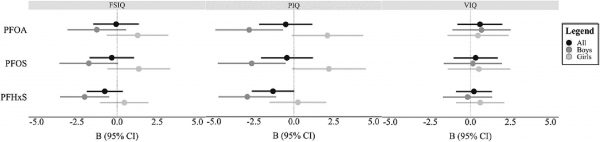
"Specifically, every doubling of PFOA, PFOS, and or PFHxS was inversely associated with performance IQ, but only in males..."
NOTE: iodine intake - again - not accounted for; fluoride not(!) accounted for.
Goodman CV, Till C, Berghuis S, Braun JM, Muckle G, Chen A, Oulhote Y, Lanphear B, Ashley-Martin J, Arbuckle T - "Prenatal exposure to phthalates and preschool children's intellectual scores: Effect modification by child sex" Environ Int 02:109701 (2025) doi: 10.1016/j.envint.2025.109701 MIREC
https://pubmed.ncbi.nlm.nih.gov/40749541/
Again (!) - no accounting for iodine/thyroid status - although phthalates toxicity is well known to be dependent on iodine/thyroid status!
Goodman C, Hall M, Green R, Hornung R, Martinez-Mier EA, Lanphear B, Till C - "Maternal fluoride exposure, fertility and birth outcomes: The MIREC cohort" Environ Adv 7:100135 (2022)
https://doi.org/10.1016/j.envadv.2021.100135
(Needless to say - no accounting for iodine/thyroid status, although it's been known for decades that iodine/thyroid controls birth weight and that birth outcomes are tied to thyroid status.)
Gounden V, Bhatt H, Jialal I - "Renal Function Tests" [Updated 2022 Jul 18]. In: StatPearls [Internet]. Treasure Island (FL): StatPearls Publishing; 2022 Jan-. Available from: https://www.ncbi.nlm.nih.gov/books/NBK507821/
Gowachirapant S, Jaiswal N, Melse-Boonstra A, Galetti V, Stinca S, Mackenzie I, Thomas S, Thomas T, Winichagoon P, Srinivasan K, Zimmermann MB - "Effect of iodine supplementation in pregnant women on child neurodevelopment: a randomised, double-blind, placebo-controlled trial" Lancet Diabetes Endocrinol 5(11):853-863 (2017). doi: 10.1016/S2213-8587(17)30332-7
https://pubmed.ncbi.nlm.nih.gov/29030199/
"Mean WPPSI-III scores for verbal IQ were 89·5 in the iodine group and 90·2 in the placebo group, and for performance IQ were 97·5 in the iodine group and 99·1 in the placebo group. The mean BRIEF-P global executive composite score was 90·6 in the iodine group and 91·5 in the placebo group."
Grandjean P, Hu H, Till C, Green R, Bashash M, Flora D, Tellez-Rojo MM, Song PXK, Lanphear B, Budtz-Jørgensen E - "A Benchmark Dose Analysis for Maternal Pregnancy Urine-Fluoride and IQ in Children" Risk Anal 42(3):439-449 (2022) doi: 10.1111/risa.13767
https://onlinelibrary.wiley.com/doi/10.1111/risa.13767 MIREC ELEMENT
NOTE: Thyroid/Iodine status was never considered in this analysis, neither in mothers nor in the children.
Grandjean P, Meddis A, Nielsen F, Beck IH, Bilenberg N, Goodman CV, Hu H, Till C, Budtz-Jørgensen E - "Dose dependence of prenatal fluoride exposure associations with cognitive performance at school age in three prospective studies" Eur J Public Health. 2023 Oct 5:ckad170 (2023). doi: 10.1093/eurpub/ckad170. Epub ahead of print MIREC ELEMENT ODENSE - OCC
https://academic.oup.com/eurpub/advance ... 70/7291347
""A doubling in maternal fluoride concentration led to a slight decrease of 0.04 FSIQ points in girls and a small increase of 0.20 points in boys, but the interaction between sex and fluoride exposure was marginal...In the OCC study, we did not find evidence of fluoride neurotoxicity at low maternal U-F concentrations in the third trimester...A possible negative association could not be confirmed within the exposures measured in the OCC...Although the fluoride association was not statistically significant in the OCC cohort by itself, the joint association was significant when combined with information from the other two cohorts."
In this questionable study, results form the Odense Child Cohort - which showed an increase in IQ in boys at levels comparable to MIREC/ELEMENT - are lumped together with MIREC/ELEMENT data to show (prove?) fluoride effects at low doses on IQ. This is entirely inappropriate. No effort was made to account for excessive iodine consumption in MIREC studies. Denmark does NOT have the same iodine/supplementation problem as Canada (MIREC). Median UIC in pregnant women in Denmark at time of study was 116 ug/Cr (see Knøsgaard et al., 2023), while in MIREC women it was 160% higher, namely 302 ug/Cr.

https://www.ncbi.nlm.nih.gov/pmc/articles/PMC7711675. MIREC ELEMENT
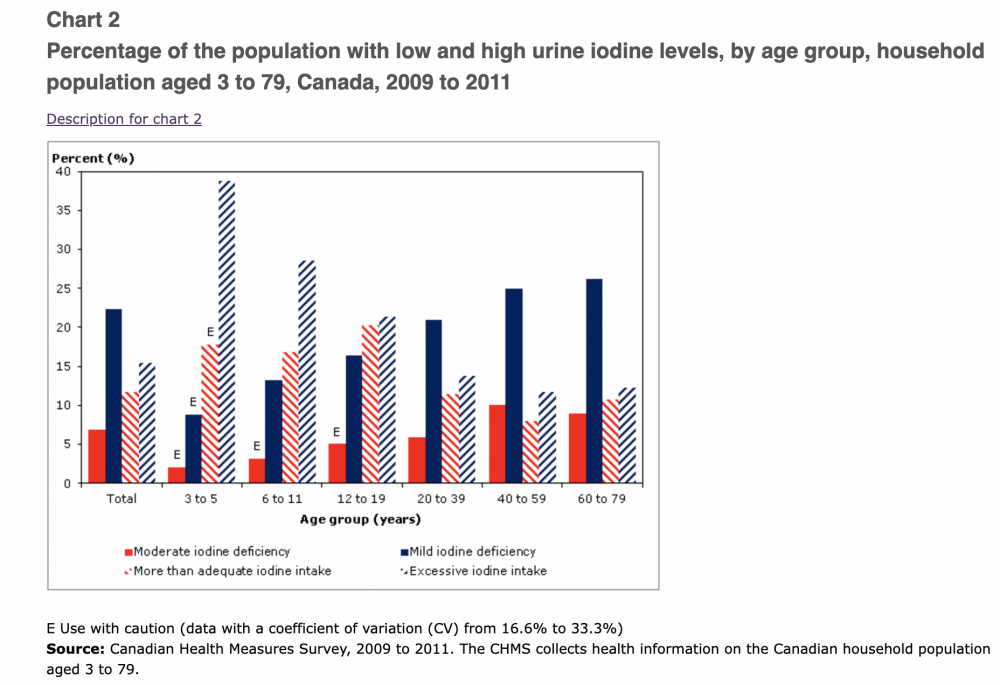
(NOTE: "We included 561 children (ages 4–6; mean age 4.8 years) from the Programming Research in Obesity, Growth, Environment, and Social Stress (PROGRESS) cohort in Mexico City, and 645 children (ages 2–6; mean age 3.7 years) from the Maternal–Infant Research on Environmental Chemicals (MIREC) cohort in Canada...We collected single urine samples under non-fasting conditions." 40% of Canadian children at that age and time had excessive iodine intake, an additional 15% had more-than-adequate iodine intake!(See chart below.) Similar data exists about children in Mexico City (Element).
Green R, Lanphear B, Hornung R, Flora D, Martinez-Mier EA, Neufeld R, Ayotte P, Muckle G, Till C - "Association Between Maternal Fluoride Exposure During Pregnancy and IQ Scores in Offspring in Canada" JAMA Pediatr 173(10):940-948 (2019) doi: 10.1001/jamapediatrics.2019.1729 MIREC
https://jamanetwork.com/journals/jamape ... le/2748634
NOTE: Deemed "high-quality" by NTP. This study did not disclose any info on - nor did account for - the use of iodine supplements (88% of women -->rapid chronic iodine intake), the important "more-than-adequate" iodine issue, the mothers with treated/untreated hypo/hyperthyroidism, or the mothers taking thyroid medication ---> all major factors now identified. [Some of the authors were well aware of the fluoride-iodine issue, having published a paper on it in the previous year (Malin et al., 2018).] As in later studies, the team never considered the thyroid status/iodine intake in the 3-4-year-old children investigated, most of whom - in Canada - have more-than-adequate or excessive iodine intake, which by itself is associated with loss of IQ (i.e. Li., et al. 2022; Cui et al., 2020).
--> SEE: viewtopic.php?f=97&t=3745
https://www.ncbi.nlm.nih.gov/pmc/articles/PMC7252070/
viewtopic.php?f=7&t=2620&p=3012#p3012
NOTE: This is only an abstract, and related to the Hall paper from 2023, as well as Hall's poster from 2021 (same cohort). Here, Green et al. compare 51 women "who reported a diagnosis of clinical hypothyroidism or reported taking medication for hypothyroidism" - to 1276 controls. Again, the high intake of iodine is not accounted for - 88% of the pregnant women also took prenatal supplements containing approx. 220 µg of potassium iodide (170 I). Any increase in hypothyroidism here is likely associated with the rapid chronic increase in iodine consumption [see the many references on this list ---> i.e. Wang et al., 2022; Shi et al., 2015; Alsayed et al., 2009; Corcino et al., 2019; Kim et al., 2019; Sang et al., 2012; Shresta et al., 2017; Zhang et al., 2022; Laurberg et al., 2010; Yang et al., 2020]. This is further reflected in the high levels of antibodies, and T4 levels - both associated with more-than-adequate iodine intake [T4 and TPOab can be observed in the other posters/publications -> Hall, 2021, Goodman 2021; Hall, 2023]. Fluoride may play a modifying role, but it is certainly not the main concern at the fluoride and iodine levels, and time frame, indicated.
Of further interest: a) Here, only data from 51 women are used, while in Hall 2023 the number is given as 78 for those women with a diagnosis of primary hypothyroidism who took thyroid medication. Why was only data from 51 pregnant women used? (There are more conflicts regarding the numbers of women with primary hypothyroidism in the Hall 2023 paper, as well as the Hall 2021 poster ---> in the 2023 paper, number of women is given as either 78, 79 or 59, in the poster as 58; see FAQ)
b) Where is the high number of controls (1276) coming from, presuming controls are those who are euthyroid? Hall's 2023 numbers are 945 (Euthyroid, Water Fluoride + Thyroid Status) and 857 (Euthyroid, Fluoride Intake & Thyroid Status). c) How many of the 51 women in Green's study were on thyroid medication, and how many of them also took prenatal multivitamins? d) How many months/years before the first-trimester exam had the diagnosis of hypothyroidism been made? Diagnosis made in the same location? See further discussions in the forum.
Griebel-Thompson AK, Sands S, Chollet-Hinton L, Christifano D, Sullivan DK, Hull H, Carlson SE - "A scoping review of iodine and fluoride in pregnancy in relation to maternal thyroid function and offspring neurodevelopment" Advances in Nutrition Pre-print, 2023,
https://doi.org/10.1016/j.advnut.2023.01.003
viewtopic.php?f=7&t=4982
Gu S, Mo Z, Chen Z, Li X, Jiang Y, Liu C, Guo F, Li Y, Mao G, Huang X, Wang X - "Assessment of Individual and Mixed Effects of Six Minerals on Thyroid Hormones in Chinese Pregnant Women" Nutrients 16(3):450 (2024). doi: 10.3390/nu16030450
https://www.ncbi.nlm.nih.gov/pmc/articles/PMC10857285/
"Iodine was negatively associated with thyroid-stimulating hormone (TSH) and positively associated with FT3 and FT4."
Guan H, Li C, Li Y, Fan C, Teng Y, Shan Z, Teng W - "High iodine intake is a risk factor of post-partum thyroiditis: result of a survey from Shenyang, Chin" J Endocrinol Invest 28(10):876-81 (2005) doi: 10.1007/BF03345318
https://link.springer.com/article/10.1007/BF03345318
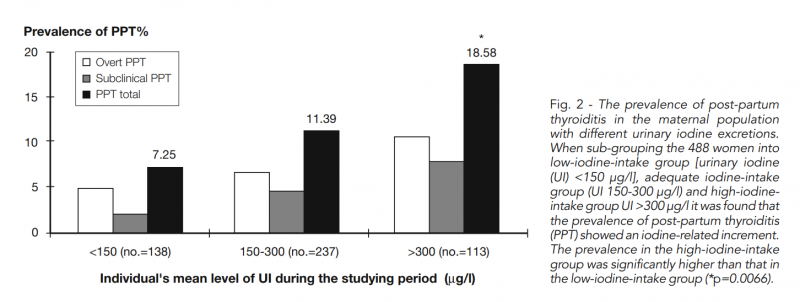
"The median urinary iodine (MUI) of patients with PPT was significantly higher than that of healthy women (231.93 vs 199.88 microg/l p=0.00153). Pregnant women with high iodine intake had more risk of developing PPT when compared with those with low iodine intake (RR=2.92, 95%CI 1.31-6.50). We concluded that positive TPOAb was of value for predicting the occurrence and severity of PPT, and a high iodine intake was a risk factor triggering PPT."

https://www.jle.com/fr/revues/ecn/e-doc ... icle.phtml
Gulinaizer A, Huang J, Tian R, Bai J, Aihemaiti A, Gao Z, Ma Y - "Influence of high iodine during gestation on thyroid function and cerebral cortical ultrastructure in offspring rats" Environmental Hygiene 13(1):48-53 (2023)
https://www.hjwsxzz.com/en/article/doi/ ... 023.01.007
"Excessive iodine intake can affect the thyroid function of offspring rats, and mild iodine excess and severe iodine excess during pregnancy can cause pathological damage to the cerebral cortex of offspring rats, thereby affecting the brain development and function of offspring."
Guo H, Yang J, Zhang X, Feng X, Yang H, Xu Y, Deng Y – “The impact of treatment on the intellectual and motor development of offspring in TPOAb-negative SCH pregnant women in early pregnancy” Journal of Zhengzhou University (Medical Sciences) 54(2):302-304 (2019) PFPC Library
"Offspring of women who are TPOAb positive in early pregnancy show a significant decrease in intelligence and motor development index, and the higher the TPOAb titer, the greater the decrease."
Guo X, Shan Z, Teng W - "Experimental study on the effect of excessive fluoride and iodine fluoride on thyroid function and morphology" Chin J Intern Med 45(10):845-846 (2006)
"The influence of excessive fluoride is related to the iodine nutrition status of the body: in normal iodine nutrition conditions
excess fluoride can seriously damage thyroid cells; under iodine excess nutrition, the damage caused by high iodine is the main one."
Guo F, Liu Y, Ding Z, Zhang C, Liu Z, Fan J - "Supplemental iodine-containing prenatal multivitamins use and the potential effects on pregnancy outcomes in a mildly iodine-deficient region" Journal of Endocrinological Investigation 44(3):443-452 (2021)
https://doi.org/10.1007/s40618-020-01321-6
Propensity score matched analysis (I+PMV n=1280 vs I−PMV n=2560) in Shanghai found iodine-containing prenatal multivitamins were linked to slightly higher maternal FT4 (P=0.01), no meaningful difference in maternal TSH (P=0.79), and lower neonatal TSH on day 3 (P<0.0001). Critically, these thyroid changes were observed only in TPOAb-negative mothers, not in TPOAb-positive mothers, implying thyroid autoimmunity modifies the maternal and neonatal thyroid response to supplemental iodine in multivitamins.
Hall M - "Maternal Fluoride Exposure and Offspring IQ: An Investigation of the Potential Mediating Role of Thyroid Dysfunction in Pregnancy" Masters Thesis (2022)
https://yorkspace.library.yorku.ca/serv ... 01/content
Hall M, Lanphear B, Chevrier J, Hornung R, Green R, Goodman C, Ayotte P, Esperanza Angeles Martinez-Mier EA, Zoeller RT, Christine Till - "Fluoride exposure and hypothyroidism in a Canadian pregnancy cohort" Science of The Total Environment 869 (April 15, 2023)161149 Available online 9 February 2023, 161149 MIREC
https://www.sciencedirect.com/science/a ... 9722082523
[Note: All comments made re Goodman et al, 2022 apply here as well. The York team had been informed about the issue of high iodine intake from supplements and UIC >250 ug/L (WHO "more-than-adequate" category) being strongly associated with hypothyroidism, in Nov 2021. Yet it was entirely disregarded in both studies. Not only that, Goodman et al. even came up with their own "adequate" range of UIC/cr 200-600 μg/g]. Average iodine intake reported here is 444 μg/day, WHO recommendation is 250 μg/day.
- NOTE ALSO:
1) Discrepancies in TSH numbers compared to Hall poster from 2021 (next reference):
2023 Study: TSH in primary hypothyroid women (n=78; µIU/mL; M ± SD): 3.2 (2.8)
2021 Poster: TSH in primary hypothyroid women (n=58 (?); µIU/mL; M ± SD): 1.65 (1.04)
2) Discrepancies in TT4 numbers compared to Hall poster from 2021 (next reference):
2023 Study: TT4 in primary hypothyroid women (n=78; ng/mL; M ± SD): 109.3 (26.6)
2021 Poster: TT4 in primary hypothyroid women (n= 58 (?); ng/mL; M ± SD): 118.66 (±25.23)
There are yet more discrepancies - see TG and TPO
https://poisonfluoride.com/dir/wp-conte ... others.pdf
viewtopic.php?f=107&t=5086
NOTE:
TSH in hypothyroid group (µIU/mL; M ± SD): 1.65 (±1.04)
TT4 in hypothyroid group: (ng/mL; M ± SD) 118.66 (±25.23) --> hypothyroid?!?
(see above)
Hall M, Hornung R, Chevrier J, Ayotte P, Lanphear B, Till C - "Fluoride Exposure and Thyroid Hormone Levels in Pregnancy: The MIREC Cohort" Environment International 108442 (2024) MIREC
https://doi.org/10.1016/j.envint.2024.108442
SEE: PFPC Commentary viewtopic.php?p=6643#p6643
Hall M, Lanphear B, Chevrier J, Hornung R, Green R, Goodman C, Ayotte P, Martinez-Mier EA, Zoeller RT, Till C - "Letter to the editor regarding Hall et al. (2023): Fluoride exposure and hypothyroidism in a Canadian pregnancy cohort" Sci Total Environ 933:173121 (2024) doi: 10.1016/j.scitotenv.2024.173121 MIREC
https://www.sciencedirect.com/science/a ... 9724032686
Hall R, Lazarus JH - "Changing iodine intake and the effect on thyroid disease" Br Med J (Clin Res Ed) 294(6574):721-2 (1987) doi: 10.1136/bmj.294.6574.721
https://www.ncbi.nlm.nih.gov/pmc/articles/PMC1245784/
He X, Yan Q, Liu C, Wang Z, Liao P, Liu T, Shi Z, Song Q, Cui X, Wang W, Zang J - "Association of maternal thyroid dysfunction and autoimmunity with adverse birth outcomes" Endocr Connect 11(4):e210599 (2022). doi: 10.1530/EC-21-0599 SBC
https://www.ncbi.nlm.nih.gov/pmc/articles/PMC9066600/
" Women with higher TT3 had a higher risk of preterm (17.0% vs 4.5%; OR: 4.19; P < 0.001) and LGA (34.0% vs 11.1%; OR: 3.70; P < 0.001) births than euthyroid women. In conclusion, thyroid function during pregnancy could affect birth weight and birth outcome."
Henrichs J, Bongers-Schokking JJ, Schenk JJ, Ghassabian A, Schmidt HG, Visser TJ, Hooijkaas H, de Muinck Keizer-Schrama SM, Hofman A, Jaddoe VV, Visser W, Steegers EA, Verhulst FC, de Rijke YB, Tiemeier H - "Maternal thyroid function during early pregnancy and cognitive functioning in early childhood: the generation R study" J Clin Endocrinol Metab 95(9):4227-34 (2010) doi: 10.1210/jc.2010-0415
https://academic.oup.com/jcem/article/95/9/4227/2835322
Hernandez A, Martinez ME, Ng L, Forrest D - "Thyroid Hormone Deiodinases: Dynamic Switches in Developmental Transitions" Endocrinology 162(8):bqab091 (2021) doi: 10.1210/endocr/bqab091
https://www.ncbi.nlm.nih.gov/pmc/articles/PMC8248586/
Hernandez A, Stohn JP - "The Type 3 Deiodinase: Epigenetic Control of Brain Thyroid Hormone Action and Neurological Function" Int J Mol Sci 19(6):1804 (2018) doi: 10.3390/ijms19061804 Essential Reading
https://www.mdpi.com/1422-0067/19/6/1804
Hong FG, Cao YX, Yang D, Wang H - "Research on the effects of fluoride on child intellectual development under different environmental conditions" Chin Prim Health Care 15(3): 56-57 (2001)
"When fluoride and iodine not meeting national standards for drinking water are present in the same area and ingested together, the harmful effects of fluoride are more pronounced, and the resulting damage compounded. However, the damage caused independently by either high or low iodine is greater than that caused by fluoride."
Hopperton KE, O'Neill E, Chakrabarti S, Stanton M, Parnel S, Arbuckle TE, Ashley-Martin J, Bertinato J, Bouchard MF, Borghese MM, Brooks S, Cockell K, Dabeka R, Joung MJ, Lanphear BP, Lapointe P, MacFarlane AJ, MacPherson S, Krzeczkowski J, Rawn DFK, von Dadelszen P, Weiler HA, Xiao CW, Fisher M - "Concentrations and predictors of select nutrients in Canadian human milk samples from the Maternal-Infant Research on Environmental Chemicals pregnancy cohort" Am J Clin Nutr 2:S0002-9165(24)00805-0 (2024) MIREC doi: 10.1016/j.ajcnut.2024.09.029
https://www.sciencedirect.com/science/a ... 6524008050
Mixed milk collection (4 different times); iodine in milk at 75th percentile: 271.25 ng/g; see differences: Season of Collection
Huang Q, Xu C, Deng F, He J, Li J, Qin P, Tan L - "Association of maternal urinary pesticide metabolites with neonatal birth outcomes and the moderating effects of iodine" Ecotoxicol Environ Saf 297:118261 (2025) doi: 10.1016/j.ecoenv.2025.118261
https://www.sciencedirect.com/science/a ... 1325005974
See MIREC data on PFAS, etc.
Ibarluzea J, Gallastegi M, Santa-Marina L, Jiménez Zabala A, Arranz E, Molinuevo A, Lopez-Espinosa MJ, Ballester F, Villanueva CM, Riano I, Sunyer J, Tardon A, Lertxundi A - "Prenatal exposure to fluoride and neuropsychological development in early childhood: 1-to 4 years old children" Environ Res. 112181 (2021) INMA
https://www.sciencedirect.com/science/a ... 5121014821
[See extensive PFPC member forum on Gipuzkoa, including history and discussion of findings: viewforum.php?f=103 ]
Ibarluzea J, Subiza-Pérez M, Arregi A, Molinuevo A, Arranz-Freijo E, de Miguel MS, Jiménez A, Andiarena A, Santa-Marina L, Lertxundi A - "Association of maternal prenatal urinary fluoride levels with ADHD symptoms in childhood" Environ Res 19:116705 (2023) doi: 10.1016/j.envres.2023.116705. INMA
https://www.sciencedirect.com/science/a ... 5123015098}
"Higher levels of MUFcr in pregnant women were associated with a lower risk of cognitive problems-inattention at 11 years. These findings are inconsistent with those from previous studies and indicate the need for other population-based studies to confirm or overturn these results."
[Gipuzkoa => 97% of women took specific iodine supplements. See: ADHD and Iodine: viewtopic.php?f=7&t=5277&p=6075 ]
Ibarluzea J, Subiza-Pérez M, Arregi A, Santa Marina L, Irizar A, Grimalt JO, Sunyer J, Barreto FB, Schettgen T, Guxens M, Lertxundi A – "Are Fluoride Levels During Prenatal Development Associated with Internalizing and Externalizing Problems in Late Childhood?" Exposure and Health 17(4):1357–1369 (2025). INMA
https://doi.org/10.1007/s12403-025-00728-x
NOTE: The authors claim to have adjusted for iodine as a covariate. No actual UIC means, medians, ranges, or categories are given anywhere in the article or the posted supplement. The Gipuzkoa women represent a particularly important INMA subcohort, as almost all of them (96%) took a specific iodine supplement during pregnancy. Failure to account for this renders the entire study useless for evaluating fluoride’s independent effects.
Induswe B, Opiniya G, Khasakhala LI, Owino R - "The Intellectual Efficiency of Adolescents Aged 13-15- Years-Old Using Drinking Water with Varying Fluoride Concentrations in Kajiado North Sub County, Kajiado County" American Journal of Medicine and Medical Sciences 8(1):295-311 (2018)
doi:10.5923/j.ajmms.20180811.02
(Only fluoride water considered, not UF)

https://www.ncbi.nlm.nih.gov/books/NBK222310/
NOTE: In 2001, the Nutritionists at the US Institute of Medicine set the tolerable upper limit of iodine to 1100 ug/day, claiming that "no altered susceptibility of pregnant or lactating women to excess iodine has been noted". In fact, there are hundreds, if not thousands, of studies documenting increased susceptibility to excessive iodine consumption in pregnant women. A few are listed on this page. The IOM also set the UL of fluoride at an incredible 10 mg/day for pregnant women.
- The UL is defined as "the maximum level of total chronic daily intake of a nutrient judged to be likely to pose no risk of adverse health effects to the most sensitive members of the healthy population."
https://www.sciencedirect.com/science/a ... 8917300066
Jansen TA, Korevaar TIM, Mulder TA, White T, Muetzel RL, Peeters RP, Tiemeier H - "Maternal thyroid function during pregnancy and child brain morphology: a time window-specific analysis of a prospective cohort" Lancet Diabetes Endocrinol 7(8):629-637 (2019) doi: 10.1016/S2213-8587(19)30153-6
https://linkinghub.elsevier.com/retriev ... 19)30153-6
"Analyses stratified for gestational age at blood sampling showed an inverted U-shaped association of maternal TSH with child total grey matter volume and cortical grey matter volume, which was most evident at 8 weeks gestation. After about 14 weeks of gestation, TSH was no longer associated with child brain morphology."
Jaiswal N, Melse-Boonstra A, Sharma SK, Srinivasan K, Zimmermann MB - "The iodized salt programme in Bangalore, India provides adequate iodine intakes in pregnant women and more-than-adequate iodine intakes in their children" Public Health Nutr 18(3):403-13 (2015) doi: 10.1017/S136898001400055X
https://www.cambridge.org/core/journals ... 16AE599433
"In this selected urban population of southern India, the iodized salt programme provides adequate iodine to women throughout pregnancy, at the expense of higher iodine intake in their children."
Jastrzębska H, Kochman M, Bartoszewicz Z, Ołtarzewski M, Dębski R, Zgliczyński W - "Iodine supplementation during pregnancy of hypothyroid women treated with L-thyroxine neither influences neonatal TSH nor prevents decrease in maternal free thyroid hormone concentrations in second and third trimesters" Endokrynol Pol 67(4):367-74 (2016) doi: 10.5603/EP.a2016.0049
https://journals.viamedica.pl/endokryno ... view/43562
"Median neonate TSH concentration in both groups was within normal range, but was 33% higher in the 'thyroxine + iodine' than in the 'thyroxine' group (1.91 mU/L vs. 1.34 mU/L). Moreover, 8.77% of newborns in the 'thyroxine + iodine' group had TSH > 5 mIU/L....fT4 level was lower in the third trimester in the 'thyroxine + iodine' group...The newborn TSH concentration above 5 mIU/L was found in five neonates (5.11, 5.33, 5.66, 7.38, and 9.26 mU/L, respectively). Interestingly, all of those children were from mothers of the 'thyroxine + iodine' group (5/57 = 8.77%), who were treated because of overt hypothyroidism (four of them due to Hashimoto’s thyroiditis and one— after strumectomy propter nodular goitre) (Table II)." NOTE: 72.9% of the "primary hypothyroid" women in the Hall study were on thyroid medication for hypothyroidism (Levothyroxine) - in addition to taking iodine-containing supplements.
Jensen RC, Glintborg D, Timmermann CAG, Nielsen F, Boye H, Madsen JB, Bilenberg N, Grandjean P, Jensen TK, Andersen MS - "Higher free thyroxine associated with PFAS exposure in first trimester. The Odense Child Cohort" Environ Res 212(Pt D):113492 (2022). doi: 10.1016/j.envres.2022.113492. ODENSE - OCC
https://www.sciencedirect.com/science/a ... 5122008192
Jensen RC, Glintborg D, Batzella E, Nielsen F, Boye H, Schmedes AV, Jensen TK, Andersen MS - "Higher PFOS exposure associated with higher SHBG in third trimester. The Odense Child Cohort" Environ Res 274:121265 (2025) doi: 10.1016/j.envres.2025.121265 ODENSE - OCC
https://www.sciencedirect.com/science/a ... 512500516X
Jiang Y, Guo X, Sun Q, Shan Z, Teng W - "Effects of Excess Fluoride and Iodide on Thyroid Function and Morphology" Biol Trace Elem Res 170(2):382-38 (2015)
http://link.springer.com/article/10.100 ... 015-0479-0
http://poisonfluoride.com/phpBB3/viewto ... f=7&t=1459
"The damage to follicular epithelial cells upon fluoride or iodide treatment was easily observed by transmission electron microscopy, but the effects were most dramatic upon treatment with both fluoride and iodide. These results suggest that iodide causes the most damage but that fluoride can promote specific changes in the function and morphology of the thyroid, either alone or in combination with iodide."
Jiang Y, Yuan W, Wang S, Yao Y, Luo W, Song K, Fan X, Lin L, Li Y, Xie Y, Zhao L, Wang B, Dang F, Wang J, Ma W, Fan P - "Analysis of Influencing Factors of Iodine Nutritional Abnormalities During Pregnancy Based on Thyroid Function and Thyroid Autoantibodies" Journal of Practical Medicine 41(16):2549-2555 (2025) doi: 10.3969/j.issn.1006-5725.2025.16.016 PFPC Library
"Adverse pregnancy outcomes by iodine status: The total adverse outcome rate was higher in the iodine-abnormal group than in the adequate group (P<0.05). By subgroup, deficiency (17.38%), more-than-adequate (22.22%), and excess (28.13%) were each higher than 8.85% in the adequate group (P<0.05). TPOab levels: deficiency: 7.09%, adequate: 4.02%, more-than-adequate: 9.03%, excess: 9.38%."
Jin M, Zhou Z, Zhang L, Chen Y, Liu L, Shen H – "Effects of excessive iodine on the BDNF-TrkB signaling pathway and related genes in offspring of EAT rats" Biological Trace Element Research 201(2):776-785 (2023). doi: 10.1007/s12011-022-03187-6
https://link.springer.com/article/10.10 ... 22-03187-6
"Maternal AIT may reduce the levels of certain neurodevelopmental mechanisms in the offspring, such as the BDNF-TrkB signaling pathway and related factors, while excessive iodine consumption by the mother may exacerbate this effect."
Jin M, Zhang Z, Li Y, Teng D, Shi X, Ba J, Chen B, Du J, He L, Lai X, Teng X, Li Y, Chi H, Liao E, Liu C, Liu L, Qin G, Qin Y, Quan H, Shi B, Sun H, Tang X, Tong N, Wang G, Zhang JA, Wang Y, Xue Y, Yan L, Yang J, Yang L, Yao Y, Ye Z, Zhang Q, Zhang L, Zhu J, Zhu M, Ning G, Mu Y, Zhao J, Teng W, Shan Z - "U-Shaped Associations Between Urinary Iodine Concentration and the Prevalence of Metabolic Disorders: A Cross-Sectional Study" Thyroid 30(7):1053-1065 (2020) doi: 10.1089/thy.2019.0516
https://www.liebertpub.com/doi/10.1089/thy.2019.0516
"The association between UICs in adults and metabolic disorders and its related diseases is U-shaped. The association between UIC and metabolic disorders disappears in cases of iodine deficiency (<100 μg/L) or excess (≥500 μg/L)."
Jin M, Zhou Z, Zhang L, Chen Y, Liu L, Shen H - "Effects of Excessive Iodine on the BDNF-TrkB Signaling Pathway and Related Genes in Offspring of EAT Rats" Biol Trace Elem Res 201(2):776-785 (2023). doi: 10.1007/s12011-022-03187-6.
https://link.springer.com/article/10.10 ... 22-03187-6
"Maternal AIT may reduce the levels of certain neurodevelopmental mechanisms in the offspring, such as the BDNF-TrkB signaling pathway and related factors, while excessive iodine consumption by the mother may exacerbate this effect."
Johnson N, Chatrani V, Taylor-Christmas AK, Choo-Kang E, Smikle M, Wright-Pascoe R, Phillips K, Reid M - "Population Reference Values and Prevalence Rates following Universal Screening for Subclinical Hypothyroidism during Pregnancy of an Afro-Caribbean Cohort" Eur Thyroid J 3(4):234-9 (2014). doi: 10.1159/000367654
https://pmc.ncbi.nlm.nih.gov/articles/PMC4311298/
"A significantly greater prevalence of TPOAb was found in subclinical hypothyroid subjects using all three reference values than in euthyroid subjects."
Juan W, Trumbo PR, Spungen JH, Dwyer JT, Carriquiry AL, Zimmerman TP, Swanson CA, Murphy SP - "Comparison of 2 methods for estimating the prevalences of inadequate and excessive iodine intakes" Am J Clin Nutr 104 Suppl 3(Suppl 3):888S-97S (2016)
https://academic.oup.com/ajcn/article/1 ... 8S/4564248
Similarly to Canadian children, 40% of US children between the ages of 6 and 8 now have excessive iodine intake. The rates are higher for boys than girls.
Kämpe O, Jansson R, Karlsson FA - "Effects of L-thyroxine and iodide on the development of autoimmune postpartum thyroiditis" J Clin Endocrinol Metab 70(4):1014-8 (1990) doi: 10.1210/jcem-70-4-1014
Kalarani IB, Veerabathiran R - "Impact of iodine intake on the pathogenesis of autoimmune thyroid disease in children and adults" Ann Pediatr Endocrinol Metab 27(4):256-264 I (2022) doi: 10.6065/apem.2244186.093
https://www.ncbi.nlm.nih.gov/pmc/articles/PMC9816468/
"Excessive iodine intake is a risk factor for thyroid diseases, including AITD, and certain people are more susceptible, including the elderly, pregnant women, fetuses, and neonates, as well as those with pre-existing goiters or iodine deficiency. Either a deficit or excess of iodine may increase the incidence of thyroid disease, and iodine intakes should be maintained within a limited optimal range."
Kampouri M, Gustin K, Stråvik M, Barman M, Levi M, Daraki V, Jacobsson B, Sandin A, Sandberg AS, Wold AE, Vahter M, Kippler M - "Association of maternal urinary fluoride concentrations during pregnancy with size at birth and the potential mediation effect by maternal thyroid hormones: The Swedish NICE birth cohort" Environ Res 214(Pt 4):114129 (2022). doi: 10.1016/j.envres.2022.114129114129. NICE https://www.sciencedirect.com/science/a ... 5122014566
PFPC Commentary: viewtopic.php?p=5767#p5767
Kampouri M, Zander E, Gustin K, Sandberg AS, Wold AE, Barman M, Bölte S, Vahter M, Kippler M - "Associations of gestational and childhood exposure to lead, cadmium, and fluoride with cognitive abilities, behavior, and social communication at 4 years of age: NICE Birth Cohort Study" (2024) NICE
https://www.sciencedirect.com/science/a ... 5124020309
(1. Note again - gestational week 29!). 2. Regarding cadmium - incredible ignorance on the documented effects on cadmium on deiodinases, especially D3 --> hence effects need to be evaluated in placenta. 3. Spot urine samples for fluoride. 4. Iodine NOT considered.
Kampouri M, Margetaki K, Koutra K, Kyriklaki A, Karakosta P, Anousaki D, Chalkiadaki G, Vafeiadi M, Kogevinas M, Chatzi L - "Maternal mild thyroid dysfunction and offspring cognitive and motor development from infancy to childhood: the Rhea mother-child cohort study in Crete, Greece" J Epidemiol Community Health 75(1):29-35 (2021) RHEA
https://jech.bmj.com/content/75/1/29.long
"Maternal hypothyroxinemia is associated with reduced offspring verbal and motor ability [see: Gipuzkoa]... Maternal thyroid autoimmunity is associated with decreased offspring perceptual performance and motor ability and increased risk for adverse non-verbal cognitive development from infancy to childhood."
Kampouri M, Margetaki K, Koutra K, Kyriklaki A, Daraki V, Roumeliotaki T, Bempi V, Vafeiadi M, Kogevinas M, Chatzi L, Kippler M - "Urinary iodine concentrations in preschoolers and cognitive development at 4 and 6 years of age, the Rhea mother-child cohort on Crete, Greece" J Trace Elem Med Biol 85:127486 (2024). doi: 10.1016/j.jtemb.2024.127486 RHEA
https://linkinghub.elsevier.com/retriev ... 24)00106-8
"Children with UIC ≥300 μg/L had lower cognitive scores both at 4 (MSCA; B= -3.5; 95 %CI -6.9, -0.1; n =101) and 6 years of age (RCPM-total score; B= -1.2; 95 %CI -2.3, -0.0; n =98) than children in the reference group."
NOTE: UICs above 181 μg/L showed downward cognition scores.
Kampouri M, Tofail F, Rahman SM, Gustin K, Vahter M, Kippler M - "Gestational and childhood urinary iodine concentrations and children's cognitive function in a longitudinal mother-child cohort in rural Bangladesh" Int J Epidemiol 52(1):144-155 (2023) doi: 10.1093/ije/dyac110
https://pmc.ncbi.nlm.nih.gov/articles/PMC9908062/
Note: Mariza Kampouri again pooled the adequate and more-than-adequate groups, misapplying WHO guidance. WHO defines adequate iodine in pregnancy as a population median UIC of 150–249 µg/L, not ≤500 µg/L. For children, adequate is 100–199 µg/L, not ≤300 µg/L. Moreover, maternal UIC ≥250 µg/L has been associated in multiple studies with higher risk of thyroid dysfunction and with poorer child neurocognitive outcomes.
Kang MJ, Hwang IT, Chung HR - "Excessive Iodine Intake and Subclinical Hypothyroidism in Children and Adolescents Aged 6-19 Years: Results of the Sixth Korean National Health and Nutrition Examination Survey, 2013-2015" Thyroid 28(6):773-779 (2018) doi: 10.1089/thy.2017.0507
https://www.liebertpub.com/doi/10.1089/thy.2017.0507
"The prevalence of SCH was significantly higher in the iodine deficient and iodine excess groups compared to those in the UIC 100-299.9 μg/L group (p = 0.038). Therefore, there was a U-shaped and inverted U-shaped correlation between serum levels of TSH and fT4 with UIC, respectively."
Kanno J, Onodera H, Furuta K, Maekawa A, Kasuga T, Hayashi Y - “Tumor-promoting effects of both iodine deficiency and iodine excess in the rat thyroid” Toxicol Pathol 20(2):226-35 (1992) doi: 10.1177/019262339202000209
https://journals.sagepub.com/doi/10.117 ... 9202000209
Karbownik-Lewińska M, Stępniak J, Iwan P, Lewiński A - "Iodine as a potential endocrine disruptor-a role of oxidative stress" Endocrine 78(2):219-240 (2022) doi: 10.1007/s12020-022-03107-7
https://www.ncbi.nlm.nih.gov/pmc/articles/PMC9584999/
Kalarani IB, Veerabathiran R - "Impact of iodine intake on the pathogenesis of autoimmune thyroid disease in children and adults" Ann Pediatr Endocrinol Metab 27(4):256-264 (2022) doi: 10.6065/apem.2244186.093
https://www.ncbi.nlm.nih.gov/pmc/articles/PMC9816468/
"Excessive iodine intake is a risk factor for thyroid diseases, including AITD, and certain people are more susceptible, including the elderly, pregnant women, fetuses, and neonates, as well as those with pre-existing goiters or iodine deficiency. Either a deficit or excess of iodine may increase the incidence of thyroid disease, and iodine intakes should be maintained within a limited optimal range."
Katagiri R, Yuan X, Kobayashi S, Sasaki S - "Effect of excess iodine intake on thyroid diseases in different populations: A systematic review and meta-analyses including observational studies" PLoS One 12(3):e0173722 (2017). doi: 10.1371/journal.pone.0173722
https://www.ncbi.nlm.nih.gov/pmc/articles/PMC5345857/
"Chronic exposure to excess iodine from water or poorly monitored salt are risk factors for hypothyroidism in free-living populations. Monitoring of both iodine concentration in salt as well as the iodine concentration in local drinking water are essential to preventing thyroid diseases. Hypothyroidism should be also carefully monitored in areas with excess iodine."
Katz PM, Leung AM, Braverman LE, Pearce EN, Tomlinson G, He X, Vertes J, Okun N, Walfish PG, Feig DS - "Iodine nutrition during pregnancy in Toronto, Canada" Endocr Pract 19(2):206-11 (2013) doi: 10.4158/EP12193.OR.
https://linkinghub.elsevier.com/retriev ... 20)40458-6
Keestra SM, Königs M, van Welie N, Dreyer K, Oosterlaan J, Mijatovic V, Roseboom TJ, Finken MJJ - "Iodine deficiency in the first pregnancy trimester and intelligence in adolescence" Eur J Nutr 65(3):111 (2026) doi: 10.1007/s00394-026-03955-3
https://pmc.ncbi.nlm.nih.gov/articles/PMC13038719/
"The observed association between higher maternal TSH and higher verbal and full-scale intelligence in iodine-deficient pregnancies suggests a possible compensatory role of the maternal thyroid axis."
Khan D, Franks S, Wang Z, Miles A, Hu H, Malin AJ - "Urinary fluoride levels among youth in the National Health and Nutrition Examination Survey (NHANES) 2015–2016: Potential differences according to race" Nutrients 17(2):309 (2025) doi:10.3390/nu17020309
https://www.mdpi.com/2072-6643/17/2/309
- Khan D, Franks S, Wang ZL, Miles A, Hu H, Malin AJ - "Urinary Fluoride Levels Among Youth in NHANES 2015-2016: Potential Differences According to Race" Scierxiv 20240906 (2024) https://doi.org/10.20517/scierxiv202410.07.v1
https://link.springer.com/article/10.10 ... 017-6288-5
http://poisonfluoride.com/phpBB3/viewto ... f=3&t=1722
Kheradpisheh Z, Mirzaei M, Mahvi AH, Mokhtari M, Azizi R, Fallahzadeh H, Ehrampoush MH - "Impact of Drinking Water Fluoride on Human Thyroid Hormones: A Case-Control Study" Scientific Reports Volume 8, Article number: 2674 (2018)
https://www.nature.com/articles/s41598-018-20696-4
http://poisonfluoride.com/phpBB3/viewto ... 1737#p1737
Khudair A, Khudair A, Niinuma SA, Habib H, Butler AE - "From deficiency to excess: the impact of iodine excess on reproductive health" Front Endocrinol (Lausanne) 16:1568059 (2025) doi: 10.3389/fendo.2025.1568059
https://www.frontiersin.org/journals/en ... 68059/full
"Given the rising prevalence of iodine excess, it is crucial to raise awareness and implement proactive measures to prevent it from escalating into a major public health crisis in the future."
Kim HI, Oh HK, Park SY, Jang HW, Shin MH, Han JM, Bae JC, Kim SW, Kim TH, Chung JH - "Non-immune-related hypothyroidism and its relationship with excess iodine" Eur J Nutr 58(7):2851-2858 (2019)
https://pubmed.ncbi.nlm.nih.gov/30276524/
"In the TPO Ab negative population, the prevalence of hypothyroidism was increased significantly in the subgroup with UIC between 250 and 749 µg/L (HR 2.12 [1.17, 3.83]) and ≥ 750 µg/L (HR 3.42 [1.93, 6.04]) or the subgroups with estimated iodine intake ≥ 750 µg/day (HR 2.81 [1.64, 4.80]). This nationwide study demonstrated that most cases of hypothyroidism in iodine-sufficient areas are non-immune-related and are associated with excess iodine above a certain level. More attention to this unrecognized but widespread potential health risk is needed...Because many cases of iodine-induced hypothyroidism are reversible by iodine restriction without T4 replacement, modest iodine restriction might be considered before T4 replacement as a treatment option for subclinical hypothyroidism in iodine-sufficient areas."
Among 233 subjects with hypothyroidism, 130 (55.8%) had non-immune-related hypothyroidism with UIC ≥ 250 μg/L.
Kippler M, Bottai M, Georgiou V, Koutra K, Chalkiadaki G, Kampouri M, Kyriklaki A, Vafeiadi M, Fthenou E, Vassilaki M, Kogevinas M, Vahter M, Chatzi L - "Impact of prenatal exposure to cadmium on cognitive development at preschool age and the importance of selenium and iodine" Eur J Epidemiol 31(11):1123-1134 (2016). RHEA
https://doi.org/10.1007/s10654-016-0151-9
"The association between the mother’s urinary cadmium concentration and the children’s general cognitive score was nonlinear (Fig. 1); slightly positive up to a urinary concentration of 0.8 lg Cd/L, and steeply decreasing after that value. The associations of urinary
selenium and urinary iodine with the children’s general cognitive score "appeared linear"." [SEE Margetaki, 2021; Kampouri, 2021; Kampouri, 2024 - UICs above 181 μg/L showed downward cognition scores"]
Klubo-Gwiezdzinska J, Burman KD, Van Nostrand D, Wartofsky L - "Levothyroxine treatment in pregnancy: indications, efficacy, and therapeutic regimen" J Thyroid Res 2011:843591 (2011)doi: 10.4061/2011/843591
https://www.ncbi.nlm.nih.gov/pmc/articles/PMC3163038/
Knøsgaard L, Andersen S, Hansen AB, Sørensen A, Vestergaard P, Andersen SL - "Iodine status in Danish pregnant women after an increase in iodine fortification" Clin Endocrinol (Oxf) 98(3):407-414 (2023) doi: 10.1111/cen.14797
https://onlinelibrary.wiley.com/doi/10.1111/cen.14797

https://academic.oup.com/jcem/article/86/8/3599/2848663
Konno N, Makita H, Yuri K, Iizuka N, Kawasaki K - "Association between dietary iodine intake and prevalence of subclinical hypothyroidism in the coastal regions of Japan" J Clin Endocrinol Metab 78(2):393-7 (1994) doi: 10.1210/jcem.78.2.8106628
https://academic.oup.com/jcem/article-a ... 93/2655500
"These results indicate that 1) the prevalence of hypothyroidism in iodine sufficient areas may be associated with the amount of iodine ingested; 2) hypothyroidism is more prevalent and marked in subjects consuming further excessive amounts of iodine; and 3) excessive intake of iodine should be considered an etiology of hypothyroidism in addition to chronic thyroiditis in these areas."
Korevaar TI, Muetzel R, Medici M, Chaker L, Jaddoe VW, de Rijke YB, Steegers EA, Visser TJ, White T, Tiemeier H, Peeters RP - "Association of maternal thyroid function during early pregnancy with offspring IQ and brain morphology in childhood: a population-based prospective cohort study" Lancet Diabetes Endocrinol 4(1):35-43 (2016)
https://pubmed.ncbi.nlm.nih.gov/26497402/
"Both low and high maternal free thyroxine concentrations during pregnancy were associated with lower child IQ and lower grey matter and cortex volume. The association between high maternal free thyroxine and low child IQ suggests that levothyroxine therapy during pregnancy, which is often initiated in women with subclinical hypothyroidism during pregnancy, might carry the potential risk of adverse child neurodevelopment outcomes when the aim of treatment is to achieve high-normal thyroid function test results."

Krzeczkowski JE, Boylan K, Arbuckle TE, Muckle G, Poliakova N, Séguin JR, Favotto LA, Savoy C, Amani B, Mortaji N, Van Lieshout RJ - "Maternal Pregnancy Diet Quality Is Directly Associated with Autonomic Nervous System Function in 6-Month-Old Offspring" J Nutr 150(2):267-275 (2020). doi: 10.1093/jn/nxz228 MIREC
https://www.sciencedirect.com/science/a ... 6622020314
Krzeczkowski JE, Hall M, McGuckin T, Lanphear B, Bertinato J, Ayotte P, Chevrier J, Goodman C, Green R, Till C - “Iodine status in a large Canadian pregnancy cohort” Am J Obstet Gynecol MFM 5(1):100784 I (2023) doi: 10.1016/j.ajogmf.2022.100784 MIREC
https://linkinghub.elsevier.com/retriev ... 22)00214-2
An incredibly incompetent study - using false reference ranges for iodine sufficiency, applying a 24-hour creatinine excretion formula intended for non-pregnant adults to pregnant women, and misinterpreting the literature are just a few of the issues.
Krzeczkowski JE, Hall M, Saint-Amour D, Oulhote Y, McGuckin T, Goodman C, Green R, Muckle G, Lanphear B, Till C - "Prenatal fluoride exposure, offspring visual acuity and autonomic nervous system function in 6-month-old infants" Environment International
Available online 27 November 2023, 108336 MIREC
https://www.sciencedirect.com/science/a ... 2023006098
Nov. 27, 2023: Again, the York team made no effort whatsoever to account for the high iodine intake in the MIREC mothers, although iodine/thyroid function has been tied to visual acuity, as well as heart activity, for decades. The most critical confounder not addressed. Thyroid implication not considered at all. In addition, infant formula - in Canada mandated to contain iodine - also not considered in the 6-months old infants. Krzeczkowski et al. didn't even adjust for maternal diet, although maternal diet quality was declared to be "directly associated with autonomic nervous system function in 6-month-old offspring" in his 2020 study on the same cohort.
Kusrini I, Samsudin M, Broto P, Kumorowulan S, Supadmi S, Laksono AD - "Thyroid Dysfunction among School‑Aged Children due to Chronically Excessive Iodine Groundwater, Central Java, Indonesia" Journal of Environmental Science and Technology 13(3):131–138 (2020) doi: 10.3923/jest.2020.131.138
"Subclinical hypothyroidism is the most prevalent thyroid disease in iodine excess area due to elevated iodine in groundwater."
Kuzmenko NV, Tsyrlin VA, Pliss MG, Galagudza MM - "Seasonal variations in levels of human thyroid-stimulating hormone and thyroid hormones: a meta-analysis" Chronobiol Int 38(3):301-317 (2021) doi: 10.1080/07420528.2020.1865394 https://www.tandfonline.com/doi/abs/10. ... 20.1865394
"We found that circulating TSH levels were higher in winter than in other seasons, and FT4 levels were higher in autumn than in winter. T4 level had no pronounced seasonal dynamics. The level of circulating T3 was significantly higher in winter than in summer and FT3 levels were lower in summer than in autumn and spring. In addition, analysis of TSH seasonal dynamics (winter vs summer) accounting for gender differences showed pronounced increases in TSH levels during winter in women, but not in men; and also significant increases in FT4 levels during summer in men, but not in women."
Lanphear BP, Den Besten P, Till C - "Time to Reassess Systemic Fluoride Exposure, Again" JAMA Pediatrics 179(3):234-236 (2025)
https://doi.org/10.1001/jamapediatrics.2024.5549
"Nine years later, after taking exceptional steps to manage bias and ensure transparency, Taylor and other NTP scientists report their findings in JAMA Pediatrics."
Lanphear B - "The Fluoride Experiment: How the Sugar Industry Used Fluoridation as a Smokescreen" (September 30, 2025) Substack
https://substack.com/home/post/p-174893633
- SEE: Comments on Fluoride Toothpaste - Limeback -- Childsmile - "Spit, Dont Rinse"
https://blanphear.substack.com/p/the-fl ... /169274516
https://substack.com/home/post/p-176345481
Laurberg P, Andersen S, Bjarnadóttir RI, Carlé A, Hreidarsson A, Knudsen N, Ovesen L, Pedersen I, Rasmussen L - "Evaluating iodine deficiency in pregnant women and young infants-complex physiology with a risk of misinterpretation" Public Health Nutr 10(12A):1547-52 (2007) discussion 1553. doi: 10.1017/S1368980007360898
https://www.cambridge.org/core/journals ... 8C843CEBFF
"An increase in the concentration of serum thyroglobulin (Tg) during pregnancy is not a sign of maternal iodine deficiency."
Laurberg P, Cerqueira C, Ovesen L, Rasmussen LB, Perrild H, Andersen S, Pedersen IB, Carlé A - "Iodine intake as a determinant of thyroid disorders in populations" Best Pract Res Clin Endocrinol Metab 24(1):13-27 (2010) doi: 10.1016/j.beem.2009.08.013
https://www.sciencedirect.com/science/a ... 0X09001006
"Even minor differences in iodine intake between populations are associated with differences in the occurrence of thyroid disorders. Both iodine intake levels below and above the recommended interval are associated with an increase in the risk of disease in the population. Optimally, iodine intake of a population should be kept within a relatively narrow interval where iodine deficiency disorders are prevented, but not higher."
Laurberg P, Pedersen I, Carle A, Andersen S, Knudsen N, Ovesen L, Rasmussen LB - "The U-shaped Curve of Iodine Intake and Thyroid Disorders" Comprehensive Handbook of Iodine, Elsevier, Amsterdam, pp. 449–455 (2009)
Lebsir D, Guemri J, Kereselidze D, Grison S, Benderitter M, Pech A, Cohen D, Benadjaoud MA, Lestaevel P, Souidi M - "Repeated potassium iodide exposure during pregnancy impairs progeny's brain development" Neuroscience 406:606-616 (2019). doi: 10.1016/j.neuroscience.2019.02.016
https://pubmed.ncbi.nlm.nih.gov/30797025/
"Repeated KI prophylaxis is not adequate during pregnancy since it led to long-term irreversible neurotoxicity in the male progeny."
Lee G, Kim S, Park H, Lee J, Lee JP, Kho Y, Choi G, Park J, Worakhunpiset S, Moon HB, Choi K - "Variability of urinary creatinine, specific gravity, and osmolality over the course of pregnancy: Implications in exposure assessment among pregnant women" Environ Res 198:110473 (2021) doi: 10.1016/j.envres.2020.110473
https://www.sciencedirect.com/science/a ... 5120313700
Lee SY, Pearce EN - "Reproductive endocrinology: Iodine intake in pregnancy--even a little excess is too much" Nat Rev Endocrinol 11(5):260-1 (2015) doi: 10.1038/nrendo.2015.28
https://www.ncbi.nlm.nih.gov/pmc/articles/PMC4590285/
Lee YJ, Cho SW, Lim YH, Kim BN, Kim JI, Hong YC, Park YJ, Shin CH, Lee YA - "Relationship of iodine excess with thyroid function in 6-year-old children living in an iodine-replete area" Front Endocrinol (Lausanne) 14:1099824 (2023) doi: 10.3389/fendo.2023.1099824
https://www.frontiersin.org/articles/10 ... 23.1099824
"Excess iodine was prevalent (73.8%) in 6-year-old Korean children. Excess iodine was associated with a decrease in FT4 or T3 levels and an increase in TSH levels."
Lee G, Kim S, Park H, Lee J, Lee JP, Kho Y, Choi G, Park J, Worakhunpiset S, Moon HB, Choi K - "Variability of urinary creatinine, specific gravity, and osmolality over the course of pregnancy: Implications in exposure assessment among pregnant women" Environ Res 198:110473 (2021) doi: 10.1016/j.envres.2020.110473
https://www.sciencedirect.com/science/a ... 5120313700
"In general, temporal variation was the least when the urinary chemical concentrations were unadjusted...If one could assume that the amount of chemical exposure should be similar over time, these observations suggest that the temporal variations of urinary correction factors might increase uncertainty in exposure assessment for urinary chemicals in pregnant women."
León G, Murcia M, Rebagliato M, Álvarez-Pedrerol M, Castilla AM, Basterrechea M, Iñiguez C, Fernández-Somoano A, Blarduni E, Foradada CM, Tardón A, Vioque J - "Maternal thyroid dysfunction during gestation, preterm delivery, and birthweight. The Infancia y Medio Ambiente Cohort, Spain" Paediatr Perinat Epidemiol 29(2):113-22 (2015) doi: 10.1111/ppe.12172
https://onlinelibrary.wiley.com/doi/10.1111/ppe.12172. INMA
"High fT4 levels were also associated with an increased risk of SGA [odds ratio, 95% confidence interval (CI) 1.28 (95% CI 1.08, 1.51)]. Mean birthweight was higher in the hypothyroxinaemic group (β = 109, P < 0.01)." NOTE: LGA was highest in Gipuzkoa, where iodine intake was also highest. SGA was lowest. [NOTE 2: Increase in GDM in Gipuzkoa]
Leung AM, Braverman LE - "Consequences of excess iodine" Nat Rev Endocrinol 10(3):136-42 (2014) doi: 10.1038/nrendo.2013.251
https://europepmc.org/backend/ptpmcrend ... obtype=pdf
Levie D, Korevaar TIM, Bath SC, Murcia M, Dineva M, Llop S, Espada M, van Herwaarden AE, de Rijke YB, Ibarluzea JM, Sunyer J, Tiemeier H, Rayman MP, Guxens M, Peeters RP - "Association of Maternal Iodine Status With Child IQ: A Meta-Analysis of Individual Participant Data" J Clin Endocrinol Metab 104(12):5957-5967 (2019) doi: 10.1210/jc.2018-02559
https://academic.oup.com/jcem/article/1 ... 57/5421020
Levie D, Derakhshan A, Shu H, Broeren MAC, de Poortere RA, Peeters RP, Bornehag CG, Demeneix B, Korevaar TIM - "The Association of Maternal Iodine Status in Early Pregnancy with Thyroid Function in the Swedish Environmental Longitudinal, Mother and Child, Asthma and Allergy Study" Thyroid 29(11):1660-16 (2019)
https://www.liebertpub.com/doi/10.1089/thy.2019.0164
"TPOAb positivity is associated with a higher risk of miscarriage, preterm birth, child behavioral problems, and lower child IQ. In the current study, TPOAb positivity occurred more often in women with low or high UI/Creat...Interestingly, thyroid antibody concentrations tend to decline after the first trimester due to immune tolerance, and this could potentially affect the definition of TPOAb positivity."
Li P, Teng Y, Ru X, Liu Z, Han Y, Tao F, Huang K - "Sex-specific Effect of Maternal Thyroid Hormone Trajectories on Preschoolers' Behavioral Development: A Birth Cohort Study" J Clin Endocrinol Metab 107(5):e2037-e2046 (2022) doi: 10.1210/clinem/dgab887
https://academic.oup.com/jcem/article/1 ... 37/6484555
"Maternal thyroid hormone trajectories impact preschool boys’ behavioral development."
Li C, Peng S, Zhang X, Xie X, Wang D, Mao J, Teng X, Shan Z, Teng W - "The Urine Iodine to Creatinine as an Optimal Index of Iodine During Pregnancy in an Iodine Adequate Area in China" J Clin Endocrinol Metab 101(3):1290-8 (2016) doi: 10.1210/jc.2015-3519
https://academic.oup.com/jcem/article/1 ... 90/2804950
NOTE: This much-cited study was conducted in three cities [Dalian City, Dandong City, and Shenyang City] in the Liaoning province in China, an endemic fluorosis area (Li et al., 2004; Yu et al., 2018; Liu et al., 2006). Unfortunately, this study included thousands of women from endemic fluorosis areas - yet fluoride intake was never considered in the assessment! In addition, some of the areas included had high I and high F intake. (The upper limit of serum TSH in the first trimester was much higher than 2.5 mIU/L - see Li et al., 2014).
The Till group cites this study to justify creatinine correction of iodine, arguing that UIC/Cr correlates better with 24-hour urinary iodine excretion, which is the gold standard, than uncorrected UIC. However, Li used a carefully standardized protocol. The Li team collected 24-hour urine at 8 weeks of gestation [after overnight fasting] and, at subsequent visits, used timed fasting spot samples collected between 8 and 9 a.m. By contrast, in MIREC, spot urines were collected at random times throughout the day, which introduces substantial diurnal and hydration variability. Li’s results therefore do not validate applying creatinine correction to untimed MIREC specimens and, if anything, argue for strict timing and fasting when using spot samples.
Li C, Shan Z, Mao J, Wang W, Xie X, Zhou W, Li C, Xu B, Bi L, Meng T, Du J, Zhang S, Gao Z, Zhang X, Yang L, Fan C, Teng W - "Assessment of thyroid function during first-trimester pregnancy: what is the rational upper limit of serum TSH during the first trimester in Chinese pregnant women?" J Clin Endocrinol Metab 99(1):73-9 (2014) doi: 10.1210/jc.2013-1674
https://pubmed.ncbi.nlm.nih.gov/24276458/
Li Dong, LiJu, Li Li, et al. - "Association between Urinary Iodine Levels and Sensory Integration Dysfunction in Preschool Children" Chinese General Practice 22(26):3222-3226 (2019) DOI: 10.12114/j.issn.1007-9572.2019.00.265 [Hubei province]
https://www.chinagp.net/EN/10.12114/j.i ... 019.00.265
"Conclusion: Urinary iodine levels in preschool children may affect the SID [sensory integration dysfunction], and low-level urinary iodine may increase the risk of children's vestibular imbalance and proprioceptive dysfunction."
(The higher the UIC, the higher the SID incidence, in males more than females.)
Li F, Wan S, Zhang L, Li B, He Y, Shen H, Liu L - "A Meta-Analysis of the Effect of Iodine Excess on the Intellectual Development of Children in Areas with High Iodine Levels in their Drinking Water" Biol Trace Elem Res 200(4):1580-1590 (2022)
https://link.springer.com/article/10.10 ... 21-02801-3
"This study found that high iodine concentration was statistically significantly associated with a decline in intelligence level in children. Comparatively, the intelligence level of children who were exposed to high iodine concentrations reduced significantly by 1.64 points. These findings have public health implications."
Li J, Li Y, Shi X, Teng D, Teng X, Teng W, Shan Z; Thyroid Disorders, Iodine Status and Diabetes Epidemiological Survey Group - "Prevalence and risk factors of hypothyroidism after universal salt iodisation: a large cross-sectional study from 31 provinces of China" BMJ Open 13(2):e064613 (2023) doi: 10.1136/bmjopen-2022-064613
"...SCH was positively correlated with increased urine iodine concentration, but this correlation was only in antibody-negative female patients. In non-autoimmune and male populations, there was a U-shaped relationship between severe SCH and OH and urine iodine concentration." [Fluoride not investigated...]
Li J, Liu JX, Shen XL, Wang YQ, Yan CH - "A national survey of iodine nutrition in children aged 3-6 years in China and its relationship with children's physical growth" Matern Child Nutr 20(4):e13685 (2024) doi: 10.1111/mcn.13685
https://pmc.ncbi.nlm.nih.gov/articles/PMC11574653/
"Iodine nutrition is intricately linked to the growth and development of these children. Consequently, it is imperative to implement decisive measures to prevent both iodine deficiency and excess."
Li N, Jiang Y, Shan Z, Teng W - "Prolonged high iodine intake is associated with inhibition of type 2 deiodinase activity in pituitary and elevation of serum thyrotropin levels" Br J Nutr 107(5):674-82 (2012). doi: 10.1017/S0007114511003552
https://www.cambridge.org/core/journals ... 4C5D7EE4EE
"We conclude that prolonged high iodine intake inhibits pituitary D2 activity and induces elevation of serum TSH levels. These findings may provide a potential mechanism of iodine excess-induced overt and subclinical hypothyroidism."
Li S, Zha H, Cui Y, Sun L, Yu L, Yuan Q - "The relationship between excessive iodine during pregnancy and adverse pregnancy complications" Endocrine 88(1):203-210 (2025) doi: 10.1007/s12020-024-04134-2
https://link.springer.com/article/10.10 ... 24-04134-2
"Abnormal iodine status especially iodine excess during pregnancy was found to be related with higher prevalence of adverse mother and fetus outcomes, abnormal blood glucose and lipid level...A U-shaped relationship between UIC and thyroid dysfunction were found. Iodine deficiency, excess iodine and even more than adequate iodine can lead to increased incidence of thyroid diseases such as isolated hypothyroxinaemia and overt hyperthyroidism."
Li X, Zhang J, Ding H, Tu P, Wu L, Xing M, Niu H, Mo Z, Chen Z - "Iodine Nutritional Status and Thyroid Autoimmunity in Chinese Children and Adolescents Aged 6-17 Years" Nutrients 16(21):3720 (2024) doi: 10.3390/nu16213720
https://pmc.ncbi.nlm.nih.gov/articles/PMC11547706/
"Notably, a low urinary iodine-to-creatinine ratio (UI/Cr) level was linked to an increased risk of TgAb positivity in males...In individuals with negative thyroid antibodies, increased BMI and high UI/Cr levels were risk factors for subclinical hypothyroidism...These results highlight the importance of considering individual TAI status when devising iodine supplementation policies."
Li X, Xing M, Tu P, Wu L, Niu H, Xu M, Xu Y, Mo Z, Wang X, Chen Z - "Urinary iodine levels and thyroid disorder prevalence in the adult population of China: a large-scale population-based cross-sectional study" Sci Rep 15(1):14273 (2025) doi: 10.1038/s41598-025-97734-5
https://pmc.ncbi.nlm.nih.gov/articles/PMC12022125/
Large population-based cross-sectional analysis of Chinese adults showing a clear association between higher urinary iodine levels and increased prevalence of thyroid disorders, supporting a non-linear relationship in which excess iodine intake is linked to elevated risk of thyroid dysfunction at the population level. SEE: Differences between UIC and UIC/Cr: https://www.nature.com/articles/s41598- ... /figures/2
"Excessive iodine intake (UIC ≥ 300 µg/L) increased the risk of subclinical hypothyroidism (adjusted OR 1.451, 95% CI 1.252-1.681), while insufficient iodine intake (UIC < 100 µg/L) reduced this risk (adjusted OR 0.831, 95% CI 0.716-0.965)."
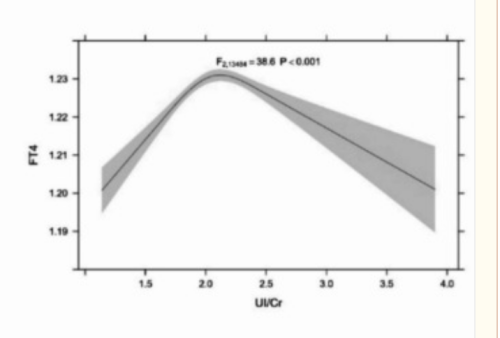
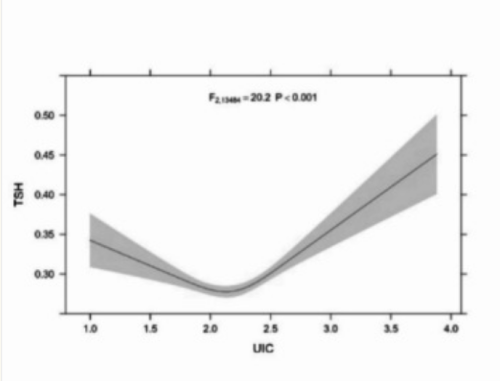
http://www.cqvip.com/qk/94093x/200905/32046867.html
http://poisonfluoride.com/phpBB3/viewtopic.php?p=594


https://www.liebertpub.com/doi/10.1089/thy.2019.0067
Increased iodine intake was significantly associated with elevated serum thyrotropin (TSH) levels. "Furthermore, the association was only found in non-autoimmune subclinical hypothyroidism (negative thyroid antibodies) but not in autoimmune subclinical hypothyroidism (positive thyroid antibodies)" | DI and EI were both associated with higher prevalence of overt hyperthyroidism resulting in a U-shaped curve.
Li Y, Shan Z, Teng W; Thyroid Disorders, Iodine Status and Diabetes Epidemiological Survey Group - "The Iodine Status and Prevalence of Thyroid Disorders Among Women of Childbearing Age in China: National Cross-sectional Study" Endocr Pract 27(10):1028-1033 (2021) doi: 10.1016/j.eprac.2021.03.017
https://www.endocrinepractice.org/artic ... 5/fulltext
"19.04% and 19.87% of the participants were classified as having iodine deficiency and excessive iodine, respectively. ..14.28% had subclinical hypothyroidism, 13.53% were positive for thyroid peroxidase antibodies, and 14.55% were positive for thyroglobulin antibodies. Excessive iodine and overweight were associated with higher odds of subclinical hypothyroidism."
Li Y, Shan Z, Teng W, Yu X, Li Y, Fan C, Teng X, Guo R, Wang H, Li J, Chen Y, Wang W, Chawinga M, Zhang L, Yang L, Zhao Y, Hua T - "Abnormalities of maternal thyroid function during pregnancy affect neuropsychological development of their children at 25-30 months" Clin Endocrinol (Oxf) 72(6):825-9 (2010). doi: 10.1111/j.1365-2265.2009.03743.x.
https://onlinelibrary.wiley.com/doi/10. ... 09.03743.x
"Children of women with subclinical hypothyroidism, hypothyroxinemia and elevated TPOAb titres had mean intelligence scores 8.88, 9.30 and 10.56 points lower than those of the control group ...mean motor scores were 9.98, 7.57 and 9.03 points lower than those of the controls...Unconditional multivariate logistic regression analysis showed that increased maternal serum TSH, decreased maternal serum tT(4), and elevated maternal TPOAb titres were separately associated with lower intelligence scores (ORs 15.63, 12.98, and 6.69, respectively) and poorer motor scores (ORs 9.23, 5.52, and 8.25, respectively)."" SEE: Hall et al., 2024
Li S, Li J, Wu Y, Liu X, Zhang L – "Bayesian benchmark dose assessment of per- and polyfluorinated substances exposure-associated thyroid function disruption during pregnancy" Food and Chemical Toxicology 201:115456 (2025). doi: 10.1016/j.fct.2025.115456
https://linkinghub.elsevier.com/retriev ... 25)00224-8
"PFASs were associated with the FT4/TSH ratio at the 25th to 40th percentile. The BMD value of the increasing FT4 effect induced by PFBA and PFPeA in pregnant women were 6.68 ng/mL and 1.37 ng/mL, respectively... The fact that BMD results at this stage are lower than current exposure levels to PFHxS underscores the urgency of prioritizing endocrine end points in PFASs risk assessment."
Lin Fa-Fu, Aihaiti, Zhao Hong-Xin, Lin Jin, Jiang Ji-Yong, Maimaiti, and Aiken - "High-fluoride and Low-iodine Environment and Subclinical Cretinism in Xinjiang" Endemic Diseases Bulletin 6(2):62-67 (1991)
viewtopic.php?p=596
Lin Fa-Fu - "A Study on the Relationship between Serum rT3 and Environmental Iodine or Fluoride Levels" Endem Dis Bull 7(2):68-70 (1992)
http://poisonfluoride.com/phpBB3/viewtopic.php?p=632
Notice suppression of TSH at High Iodine + High Fluoride and the rT3 increase in all instances.

https://www.frontiersin.org/articles/10 ... 00778/full
Liu GY, Chai CY, Kang SL - "Effects of fluoride on the activity of deiodinase in the liver of chickens" Chin J Vet Med 39:14-5 (2003)
http://www.cqvip.com/qk/92143x/200305/7939505.html
First, fluoride causes an increase in D1, then, at 90 days, a severe decrease. Downregulation of D1 leads to an increase in circulating rT3, because the conversion of rT3 to T2 is significantly reduced, resulting in an accumulation of rT3. (Compare to timing issues in Zhao et al., 1998;1992)

https://www.sciencedirect.com/science/a ... 8914001513
Liu H, Hou C, Zeng Q, Zhao L, Cui Y, Yu L, Wang L, Zhao Y, Nie J, Zhang B, Wang A - "Role of endoplasmic reticulum stress-induced apoptosis in rat thyroid toxicity caused by excess fluoride and/or iodide" Environ Toxicol Pharmacol 46:277-285 (2016) doi: 10.1016/j.etap.2016.08.007
https://www.sciencedirect.com/science/a ... 8916302083
"The combined effects of excess fluoride and iodide on follicular structure depend on the dominant element: the iodide cytotoxicity is dominant with a low fluoride concentration, while the fluoride cytotoxicity is dominant with a high fluoride concentration."
Liu Y, Chen H, Jing C, Li F - "The Association Between Maternal Subclinical Hypothyroidism and Growth, Development, and Childhood Intelligence: A Meta-analysis" J Clin Res Pediatr Endocrinol 10(2):153-161 (2018) doi: 10.4274/jcrpe.4931
https://jag.journalagent.com/jcrpe/pdfs ... 53_161.pdf
"Conclusion: Maternal SCH in pregnancy is associated with increased risk of adverse neonatal outcomes, including delayed intellectual and motor development, low birth weight, premature delivery, fetal distress and fetal growth restriction."
Liu Y, Liu C, Wei Y - "Influence of pregnancy subhypothyroidism on offspring intelligence and its intervention study" Chin J Coal Ind Med. 19(4):501–504 (2016) PFPC Library
"Subclinical hypothyroidism in pregnant women has adverse effects on the intelligence, motor function and other body functions of offspring. LT4 has an important effect on the TSH level in patients with subclinical hypothyroidism in early pregnancy."
Liu HL, Lam LT, Zeng Q, Han SQ, Fu G, Hou CC - "Effects of drinking water with high iodine concentration on the intelligence of children in Tianjin, China" J Public Health (Oxf) 31(1):32-8 (2009) doi: 10.1093/pubmed/fdn097
https://academic.oup.com/jpubhealth/art ... 32/1586582
(Study conducted in 2005 - children born in mid 1990s)
"There was a significant association between residing in the very high water iodine region and a reduction of IQ by an average of about nine points (P = 0.022), after adjusting for the potential confounding factors."
Liu L, Wang D, Liu P, Meng F, Wen D, Jia Q, Liu J, Zhang X, Jiang P, Shen H - "The relationship between iodine nutrition and thyroid disease in lactating women with different iodine intakes" Br J Nutr 114(9):1487-95 (2015)
https://www.cambridge.org/core/journals ... 11F952186A
"The prevalence of thyroid disease in lactating women, particularly subclinical hypothyroidism, was higher in the I-excess group than in the I-sufficient group (P<0·05). In areas with excessive water I content, high thyroid peroxidase antibody and high thyroglobulin levels were risk factors for abnormal thyroid-stimulating hormone levels. Our data collectively suggest that excessive I intake potentially causes subclinical hypothyroidism in lactating women. Moreover, enhanced monitoring of I status is important to avoid adverse effects of I deficiency or excess, particularly in susceptible populations such as pregnant or lactating women and infants."
Liu X, Xiao Z, Cheng L, Jian L - "Iodine nutrition level and thyroid function in pregnant women in the Yongchuan district of Chongqing" J Clin Transl Res 8(6):516-522 (2022)
https://www.ncbi.nlm.nih.gov/pmc/articles/PMC9706315
"The rate of thyroid diseases was significantly higher in subjects with more than adequate as well as excessive iodine intake cohorts compared to pregnant women with adequate iodine intake..."
Liu X, Zhang C, Lin Z, Zhu K, He R, Jiang Z, Wu H, Yu J, Luo Q, Sheng J, Fan J, Pan J, Huang H - "Association of maternal mild hypothyroidism in the first and third trimesters with obstetric and perinatal outcomes: a prospective cohort study" American Journal of Obstetrics and Gynecology 232(5):480.e1-480.e19 (2025)
https://doi.org/10.1016/j.ajog.2024.08.047
"Results suggest the timing of mild hypothyroidism in pregnancy may be pivotal in determining its effects on adverse pregnancy outcomes and underscore the importance of trimester-specific evaluations of thyroid function."
Liu S, Yu X, Xing Z, Ding P, Cui Y, Liu H - "The Impact of Exposure to Iodine and Fluorine in Drinking Water on Thyroid Health and Intelligence in School-Age Children: A Cross-Sectional Investigation" Nutrients 16(17):2913 (2024) https://doi.org/10.3390/nu16172913
https://www.mdpi.com/2072-6643/16/17/2913
viewtopic.php?f=7&t=6292
NOTE: Yet another study from the Tianjin group, this time acknowledging the high iodine levels in the children and associated IQ loss.
Liu Y, Téllez-Rojo M, Hu H, Sánchez BN, Martinez-Mier EA, Basu N, Mercado-García A, Solano-González M, Peterson KE - "Fluoride exposure and pubertal development in children living in Mexico City" Environ Health 18(1):26 (2019). doi: 10.1186/s12940-019-0465-7 ELEMENT
https://link.springer.com/article/10.11 ... 019-0465-7
"Childhood fluoride exposure, at the levels observed in our study, was associated with later pubertal development among Mexican boys at age 10–17 years." -> Iodine intake not considered.
Liu J, Feng Z, Gao R, Liu P, Meng F, Fan L, Liu L, Du Y - "Analysis of risk factors for autoimmune thyroid disease based on blood indicators and urinary iodine concentrations" Front Endocrinol (Lausanne) 15:1453828 (2024). doi: 10.3389/fendo.2024.1453828
https://pmc.ncbi.nlm.nih.gov/articles/PMC11581849/
"In this study, the median urinary iodine level was found to be significantly higher in the AITD group than in the control group (257.52 vs. 209.69 μg/L, P<0.01). Within the AITD group, a higher incidence of excessive iodine nutrition was identified, indicating that iodine consumption exceeding physiological needs potentially contributes to the development of autoimmune thyroid diseases..To mitigate the risk of autoimmune thyroid disorders, it is imperative to ascertain that iodine consumption remains within the recommended thresholds." [WHO stipulates a median urinary iodine concentration range of 100-200 µg/L for adults/children
Liu Z, Chen C, Wang C, Wang Y, Li M, Pan W - "Extra-thyroidal impacts of serum iodine concentrations during early pregnancy on metabolic profiles and pregnancy outcomes: prospective study based on Huizhou Mother-Infant Cohort" Nutrients 17(10):1626 (2025) doi: 10.3390/nu17101626
https://pmc.ncbi.nlm.nih.gov/articles/PMC12113788/
"Our prospective data in the iodine replete region indicated that high SICs at T1 were associated with increased risk of metabolic conditions and adverse birth outcomes, with the associations being independent of thyroid hormones."
Liu Z, Zhang K - "Effects of positive thyroid peroxidase antibody status during pregnancy on pregnancy outcomes and offspring" International Journal of Endocrinology and Metabolism Issue 4:253-256 (2014) PFPC Library
"Positive TPOab status during pregnancy is associated with adverse pregnancy outcomes and developmental problems in offspring. Studies have shown that TPOAb positivity is associated with an increased risk of miscarriage, preterm birth, premature rupture of membranes, and postpartum thyroiditis in pregnant women. Offspring of TPOAb-positive mothers have lower intelligence and motor skill scores than offspring of TPOAb-negative mothers."
Lopes van Balen VA, van Gansewinkel TAG, de Haas S, Spaan JJ, Ghossein-Doha C, van Kuijk SMJ, van Drongelen J, Cornelis T, Spaanderman MEA - "Maternal kidney function during pregnancy: systematic review and meta-analysis" Ultrasound Obstet Gynecol 54(3):297-307 (2019)
https://www.ncbi.nlm.nih.gov/pmc/articles/PMC6772153/
"Creatinine clearance was highest at 15–21 weeks' gestation....in healthy pregnancy, GFR is increased as early as the first trimester, as compared with non-pregnant values, and the kidneys continue to function at a higher rate throughout gestation."
Lu C, Dong H, Shi P, Dong W, Wen X, Gao Q - "Correlations between iodine status and the risk of thyroid nodules, a systematic review and dose–response meta-analysis" Frontiers in Endocrinology 17:1711749 (2026)
https://doi.org/10.3389/fendo.2026.1711749
"Continuous dose-response analysis revealed a significant U-shaped nonlinear correlation (P for nonlinearity < 0.001), with increased risks at both deficient and excessive iodine levels."
Luo Y, Kawashima A, Ishido Y, Yoshihara A, Oda K, Hiroi N, Ito T, Ishii N, Suzuki K - "Iodine excess as an environmental risk factor for autoimmune thyroid disease" Int J Mol Sci 15(7):12895-912 (2014). doi: 10.3390/ijms150712895
https://www.mdpi.com/1422-0067/15/7/12895
Luo J, Li C, Zhang X, Shan Z, Teng W - "Reference Intervals of the Ratio of Urine Iodine to Creatinine in Pregnant Women in an Iodine-Replete Area of China" Biol Trace Elem Res 199(1):62-69 (2021) doi: 10.1007/s12011-020-02133-8
https://link.springer.com/article/10.10 ... 20-02133-8
(cited by Berghuis, Goodman, etc.)
Lv M, Cao Z, Xu C, Qu X, Bao Y, Yuan L, Ying H - “The impact of hypothyroidism on the risk of intrahepatic cholestasis of pregnancy: a large-scale study based on pregnant women with hypothyroidism in Shanghai, China” J Glob Health 16:04013 (2026)
https://doi.org/10.7189/jogh.16.04013
"We found that CH was significantly associated with a greater risk of ICP. CH, especially TPOAb(+) CH, is associated with a greater risk of both early and severe ICP. Furthermore, the prevalence of ICP increases with increasing TSH and decreasing FT4."
Ma ZF, Venn BJ, Manning PJ, Cameron CM, Skeaff SA - “The sensitivity and specificity of thyroglobulin concentration using repeated measures of urinary iodine excretion” Eur J Nutr 57(4):1313-1320 (2018) doi: 10.1007/s00394-017-1410-6
https://link.springer.com/article/10.10 ... 017-1410-6
Ma ZF, Skeaff SA - “Thyroglobulin as a biomarker of iodine deficiency: a review” Thyroid 24(8):1195-209 (2014) doi: 10.1089/thy.2014.0052
https://www.liebertpub.com/doi/10.1089/thy.2014.0052
"Although six of eight studies (37,38,74,75,77,79) collected information on the use of iodine supplements in pregnancy, of these, only one study (37) reported that the Tg concentration of women taking iodine supplements was significantly lower compared with women who did not take supplements (i.e., difference of ∼15 μg/L). We are unaware of any published studies of pregnant women with adequate iodine status that include measures of both UIC and Tg.”
Ma R, Yan M, Han P, Wang T, Li B, Zhou S, Zheng T, Hu Y, Borthwick AGL, Zheng C, Ni J - "Deficiency and excess of groundwater iodine and their health associations" Nat Commun 13(1):7354 (2022) doi: 10.1038/s41467-022-35042-6
https://www.nature.com/articles/s41467-022-35042-6#Sec5
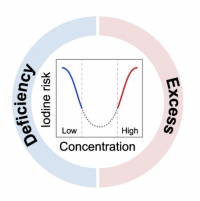
Ma ZF, Brough L - "Effect of Iodine Nutrition During Pregnancy and Lactation on Child Cognitive Outcomes: A Review" Nutrients 17(12):2016 (2025) doi: 10.3390/nu17122016
https://www.mdpi.com/2072-6643/17/12/2016
"Our findings highlight a U-shaped association, whereby both insufficient and excessive iodine exposure during pregnancy and lactation may impair optimal brain development in the offspring."
MacPherson S, Arbuckle TE, Fisher M - "Adjusting urinary chemical biomarkers for hydration status during pregnancy" J Expo Sci Environ Epidemiol. 28(5):481-493 (2018) doi: 10.1038/s41370-018-0043-z.
https://www.nature.com/articles/s41370-018-0043-z
"This study demonstrated that urinary flow rates vary greatly by time of day, with the highest rates occurring during the daytime. Dilution of urine will affect the urinary concentration of the biomarkers leading to incorrect conclusions on the extent of exposure...Based on the linear mixed model results, we found that UFR and creatinine excretion rates differed systematically across the population, with respect to body mass index (BMI) and time...This analysis showed that SG showed a slightly better within-person reproducibility and the least amount of systematic variation when compared to creatinine adjustment."
Maitre L, Villanueva CM, Lewis MR, Ibarluzea J, Santa-Marina L, Vrijheid M, Sunyer J, Coen M, Toledano MB - "Maternal urinary metabolic signatures of fetal growth and associated clinical and environmental factors in the INMA study" BMC Med 14(1):177 (2016) doi: 10.1186/s12916-016-0706-3. INMA
https://bmcmedicine.biomedcentral.com/a ... 016-0706-3
Malin AJ, Riddell J, McCague H, Till C - "Fluoride exposure and thyroid function among adults living in Canada: Effect modification by iodine status." Environ Int 121(Pt 1):667-674 (2018) doi: 10.1016/j.envint.2018.09.026
https://www.sciencedirect.com/science/a ... 201830833X
Malin AJ, Hu H, Martínez-Mier EA, Eckel SP, Farzan SF, Howe CG, Funk W, Meeker JD, Habre R, Bastain TM, Breton CV - "Urinary fluoride levels and metal co-exposures among pregnant women in Los Angeles, California" Environ Health 22(1):74 (2023) doi: 10.1186/s12940-023-01026-2.
https://ehjournal.biomedcentral.com/art ... 23-01026-2. MADRES
Mallawa Kankanamalage O, Zhou Q, Li X - “Understanding the Pathogenesis of Gestational Hypothyroidism” Front Endocrinol (Lausanne) 12:653407 (2021)doi: 10.3389/fendo.2021.653407
https://www.frontiersin.org/articles/10 ... 53407/full
Man N, Guan HX, Shan ZY, Li YS, Fan CL, Guo XJ, Chen W, Tong YJ, Chong W, Mao JY, Teng WP - "Long-term effects of high iodine intake: inhibition of thyroid iodine uptake and organification in Wistar rats" Chinese Medical Journal 86(48):3420-4 (2006) PFPC Library
https://pubmed.ncbi.nlm.nih.gov/17313856/
Mancini FR, Rajaobelina K, Dow C, Habbal T, Affret A, Balkau B, Bonnet F, Boutron-Ruault MC, Fagherazzi G - "High iodine dietary intake is associated with type 2 diabetes among women of the E3N-EPIC cohort study" Clin Nutr 38(4):1651-1656 (2019) doi: 10.1016/j.clnu.2018.08.015
https://linkinghub.elsevier.com/retriev ... 18)32386-0
"In our population, the mean iodine intake is above the recommended nutritional intake despite the fact that the estimated intake is probably underestimated. Our work highlights for the first time a higher risk of type 2 diabetes with high iodine intake."
Margetaki K, Vafeiadi M, Kampouri M, Roumeliotaki T, Karakosta P, Daraki V, Kogevinas M, Hu H, Kippler M, Chatzi L - "Associations of exposure to cadmium, antimony, lead and their mixture with gestational thyroid homeostasis" Environ Pollut 289:117905 (2021) doi: 10.1016/j.envpol.2021.117905 RHEA
https://pmc.ncbi.nlm.nih.gov/articles/PMC11808336/
"The negative association of Cd with TSH persisted only when iodine sufficiency was unfavorable."
In iodine-deficient women, Pb was harmful via lower fT4 and TSH. In more-than-adequate women, Pb was harmful via higher fT3 and fT4
Markhus MW, Dahl L, Moe V, Abel MH, Brantsæter AL, Øyen J, Meltzer HM, Stormark KM, Graff IE, Smith L, Kjellevold M - "Maternal Iodine Status is Associated with Offspring Language Skills in Infancy and Toddlerhood" Nutrients 10(9):1270 (2018) doi: 10.3390/nu10091270
"Maternal use of iodine-containing supplements was associated with lower gross motor skills...The use of iodine-containing supplements was not associated with beneficial effects."
Markhus MW, Dahl L, Moe V, Abel MH, Brantsæter AL, Øyen J, Meltzer HM, Stormark KM, Graff IE, Smith L, Kjellevold M - "Maternal Iodine Status is Associated with Offspring Language Skills in Infancy and Toddlerhood" Nutrients 10(9):1270 (2018)
https://www.ncbi.nlm.nih.gov/labs/pmc/a ... -01270.pdf
"UIC in µg/L was used as the primary exposure since creatinine excretion varies in pregnancy with regards to gestational age, maternal age and body composition..."Maternal use of iodine-containing supplements was associated with lower gross motor skills...The use of iodine-containing supplements was not associated with beneficial effects."
Markhus MW, Hysing M, Midtbø LK, Nerhus I, Næss S, Aakre I, Kvestad I, Dahl L, Kjellevold M - "Effects of two weekly servings of cod for 16 weeks in pregnancy on maternal iodine status and infant neurodevelopment: Mommy's Food, a randomized-controlled trial" Thyroid 31(2):288-298 (2021)
https://doi.org/10.1089/thy.2020.0115
RCT
"Infants of mothers in the intervention group had a lower cognitive composite score on the Bayley-III compared with the control group (p = 0.045). There were no group differences in the Bayley III language- or motor composite scores."
Markou K, Georgopoulos N, Kyriazopoulou V, Vagenakis AG - "Iodine-Induced hypothyroidism" Thyroid 11(5):501-10 (2001)
Martinez ME, Hernandez A - "The Type 3 Deiodinase Is a Critical Modulator of Thyroid Hormone Sensitivity in the Fetal Brain" Front Neurosci 15:703730 (2021). doi: 10.3389/fnins.2021.703730
https://www.frontiersin.org/articles/10 ... 03730/full
"Our results demonstrate that the rodent fetal brain is sensitive to TH as early as E13.5 of gestational age, and suggest that TH distinctly affects brain developmental programs in early and late gestation. We conclude that DIO3 function is critical to ensure an adequate timing for TH action in the developing brain..."
Maumené E -“Experiencé pour déterminer l’action des fluores sur l’economie animale” Compt Rend Acad Sci (Paris) 39:538-539 (1854)
Medici M, Ghassabian A, Visser W, de Muinck Keizer-Schrama SMPF, Jaddoe VWV, Visser WE, Hooijkaas H, Hofman A, Steegers EAP, Bongers-Schokking JJ, Ross HA, Tiemeier H, Visser TJ, de Rijke YB, Peeters RP - "Women with high early pregnancy urinary iodine levels have an increased risk of hyperthyroid newborns: the population-based Gener
ation R Study" Clin Endocrinol (Oxf) 80(4):598–606 (2014)
https://pubmed.ncbi.nlm.nih.gov/23992400/
Meng F, Zhao R, Liu P, Liu L, Liu S - "Assessment of iodine status in children, adults, pregnant women and lactating women in iodine-replete areas of China" PLoS One 8(11):e81294 (2013) doi: 10.1371/journal.pone.0081294
https://journals.plos.org/plosone/artic ... ne.0081294
"The iodine status in children and adults is above the requirement, we should reduce their their iodine intake. Subclinical hypothyroidism easily occurs in the Tg-Ab or TM-Ab positive groups."
Modesto T, Tiemeier H, Peeters RP, Jaddoe VW, Hofman A, Verhulst FC, Ghassabian A - "Maternal Mild Thyroid Hormone Insufficiency in Early Pregnancy and Attention-Deficit/Hyperactivity Disorder Symptoms in Children" JAMA Pediatr 169(9):838-45 (2015)
https://pubmed.ncbi.nlm.nih.gov/26146876/
"Children exposed to maternal hypothyroxinemia in early pregnancy had more ADHD symptoms, independent of confounders. This finding suggests that intrauterine exposure to insufficient thyroid hormone levels influences neurodevelopment in offspring."
Moleti M, Trimarchi F, Tortorella G, Candia Longo A, Giorgianni G, Sturniolo G, Alibrandi A, Vermiglio F - "Effects of maternal iodine nutrition and thyroid status on cognitive development in offspring: a pilot study" Thyroid 26(2):296-305 (2016) doi: 10.1089/thy.2015.0336
https://www.liebertpub.com/doi/10.1089/thy.2015.0336
"Neuro-intellectual outcomes in children appear to be more dependent on their mothers' nutritional iodine status than on maternal thyroid function."
Morales de Villalobos LM, Campos G, Ryder E - "Effect of chronic ingestion of iodide during pregnancy and lactation on rat pup brain enzymes" Enzyme 35(2):96-101 (1986) doi: 10.1159/000469328
https://karger.com/ebd/article-abstract ... m=fulltext
Moreno-Reyes R, Glinoer D, Van Oyen H, Vandevijvere S - "High prevalence of thyroid disorders in pregnant women in a mildly iodine-deficient country: a population-based study" J Clin Endocrinol Metab 98(9):3694-701 (2013) doi: 10.1210/jc.2013-2149
https://academic.oup.com/jcem/article-a ... 94/2833171
(Moreno-Reyes is yet another case where UIC/Cr was used as if it were UIC, with WHO’s µg/L cutoffs essentially reinterpreted in µg/g.)
Morisset AS, Weiler HA, Dubois L, Ashley-Martin J, Shapiro GD, Dodds L, Massarelli I, Vigneault M, Arbuckle TE, Fraser WD - "Rankings of iron, vitamin D, and calcium intakes in relation to maternal characteristics of pregnant Canadian women" Appl Physiol Nutr Metab 41(7):749-57 (2016). doi: 10.1139/apnm-2015-0588 MIREC
https://pubmed.ncbi.nlm.nih.gov/27324651/
Moynihan M, Telléz-Rojo MM, Colacino J, Jones A, Song PXK, Cantoral A, Mercado-García A, Peterson KE - "Prenatal Cadmium Exposure Is Negatively Associated With Adiposity in Girls Not Boys During Adolescence" Front Public Health 7:61 (2019) doi: 10.3389/fpubh.2019.00061 ELEMENT
https://www.frontiersin.org/articles/10 ... 00061/full
Mulder TA, Korevaar TIM, Peeters RP, van Herwaarden AE, de Rijke YB, White T, Tiemeier H - "Urinary Iodine Concentrations in Pregnant Women and Offspring Brain Morphology" Thyroid 31(6):964-972 (2021) doi: 10.1089/thy.2020.0582
https://www.liebertpub.com/doi/10.1089/thy.2020.0582
TABLE 2: https://www.liebertpub.com/doi/10.1089/thy.2020.0582#f2
Note the bi-phasic effects on grey matter. Compare to T4 data in Korevaar et al., 2016.
"In sensitivity analyses using the UI/Creat categories based on the WHO categorization for UIC values, both low and high UI/Creat across pregnancy were associated with smaller total gray matter volume when considering UI/Creat 150–249 μg/g as the reference category (β [CI]: −14.7 [−23.8 to −5.7] and −13.0 [−20.6 to −5.5], respectively) (Table 4)."

https://www.nature.com/articles/s41430-022-01144-z
Mumm H, Dreyer AF, Bleses D, Glintborg D, Jensen TK, Boye H, Trecca F, Andersen M - "Maternal cortisol levels in 3rd trimester and early language development, a study of 1,093 mother-child pairs from Odense Child Cohort". ODENSE - OCC
Endocrine Abstracts (2023) 90 P449 | DOI: 10.1530/endoabs.90.P449.
"Higher 3rd trimester maternal cortisol levels showed a positive association with development of productive vocabulary in boys at age 12-21 months and age 22-37 months...Higher maternal cortisol levels in 3rd trimester were positively associated with receptive vocabulary in girls at 12-21 months-of-age."
Murcia M, Rebagliato M, Espada M, Vioque J, Santa Marina L, Alvarez-Pedrerol M, Lopez-Espinosa MJ, León G, Iñiguez C, Basterrechea M, Guxens M, Lertxundi A, Perales A, Ballester F, Sunyer J; INMA Study Group - "Iodine intake in a population of pregnant women: INMA mother and child cohort study, Spain" J Epidemiol Community Health 64(12):1094-9 (2010) doi: 10.1136/jech.2009.092593 INMA
https://jech.bmj.com/content/64/12/1094.short
Murcia M, Rebagliato M, Iñiguez C, Lopez-Espinosa MJ, Estarlich M, Plaza B, Barona-Vilar C, Espada M, Vioque J, Ballester F - "Effect of iodine supplementation during pregnancy on infant neurodevelopment at 1 year of age" Am J Epidemiol 173(7):804-12 (2011)
doi: 10.1093/aje/kwq424 INMA
https://academic.oup.com/aje/article/173/7/804/102758
"Maternal intake of ≥150 μg/day, compared with <100 μg/day, of iodine from supplements was associated with a 5.2-point decrease in PDI (95% confidence interval: -8.1, -2.2) and a 1.8-fold increase in the odds of a PDI <85 (95% confidence interval: 1.0, 3.3). When analyses were stratified by sex, this association was intensified for girls but was not observed for boys."
Næss S, Aakre I, Strand TA, Dahl L, Kjellevold M, Stokland AM, Nedrebø BG, Markhus MW - "Infant iodine status and associations with maternal iodine nutrition, breast-feeding status and thyroid function" Br J Nutr 129(5):854-863 (2023) doi: 10.1017/S0007114522001465
https://www.ncbi.nlm.nih.gov/pmc/articles/PMC9975782/
"Breastfed infants had lower median UIC compared with formula-fed infants at ages 3 months (76 v. 190 µg/l) and 6 months (105 v. 315 µg/l)."
National Toxicology Program - "NTP Monograph on the State of the Science Concerning Fluoride Exposure and Neurodevelopment and Cognition: A Systematic Review" NTP Monograph (8):NTP-MGRAPH-8 (2024)
https://doi.org/10.22427/NTP-MGRAPH-8
Nazarpour S, Ramezani Tehrani F, Rahmati M, Azizi F - "Prediction of preterm delivery based on thyroid peroxidase antibody levels and other identified risk factors" Eur J Obstet Gynecol Reprod Biol 284:125-130 (2023) doi: 10.1016/j.ejogrb.2023.03.025
https://linkinghub.elsevier.com/retriev ... 23)00116-1 [see also: Xu et al., 2023]
"A combination of T4, TPOAb, and previous preterm delivery was identified as independent risk factors that accurately predicted preterm delivery. The total score obtained based on the nomogram designed based on risk factors can predict the risk of preterm delivery."
Nazarpour S, Ramezani Tehrani F, Amiri M, Rahmati M, Azizi F - "Maternal subclinical hyperthyroidism and adverse pregnancy outcomes considering the iodine status: Tehran thyroid and pregnancy study" J Trace Elem Med Biol 74:127063 (2022) doi: 10.1016/j.jtemb.2022.127063
https://linkinghub.elsevier.com/retriev ... 22)00143-2
"According to our results, maternal SH appears to be a risk factor for preterm delivery. This effect is more pronounced in women with higher UIC than those with lower UIC."
Nazeri P, Pearce EN, Farrokhzad N, Baghalha F, Shariat M, Azizi F - "Do Postpartum Maternal Iodine Status or Supplementation Affect Thyroid Function After Delivery? A Systematic Review and Meta-Analysis" Biol Trace Elem Res 202(8):3425-3441 (2024) doi: 10.1007/s12011-023-03934-3
https://link.springer.com/article/10.10 ... 23-03934-3
"The pooled mean for TSH concentration in women with UIC > 200 µg/L was 2.23 mIU/L, whereas the corresponding values in women with UIC < 50, 50-100 and 100-200 µg/L were 0.56, 0.56 and 0.95 mIU/L, respectively."
Nazeri P, Zarghani NH, Tahmasebinejad Z, Dashtkoohi M, Hedayati M, Mirmiran P, Shariat M, Azizi F – "Breast Milk and Brain: The Influence of Iodine and Neurotrophic and Growth Factors on Children's Neurodevelopment-A Secondary Analysis" Journal of Family and Reproductive Health 19(3):232-239 (2025)
https://doi.org/10.18502/jfrh.v19i3.20062
(NOTE: Nazeri again minimizing...WS)
Newman DJ, Pugia MJ, Lott JA, Wallace JF, Hiar AM - "Urinary protein and albumin excretion corrected by creatinine and specific gravity" Clin Chim Acta 294(1-2):139-55 (2000) doi: 10.1016/s0009-8981(00)00181-9
https://linkinghub.elsevier.com/retriev ... 8100001819
Nøhr SB, Laurberg P - "Opposite variations in maternal and neonatal thyroid function induced by iodine supplementation during pregnancy" J Clin Endocrinol Metab 85(2):623-7 (2000) doi: 10.1210/jcem.85.2.6391
https://academic.oup.com/jcem/article/85/2/623/2853673
"Iodine supplementation (+I) induced opposite variations in thyroid function in the mother and the fetus. In +I mothers, TSH was 7.6% lower than in mothers with no supplementation (P < 0.05). In cord blood, on the contrary, TSH was 27.3% higher in the +I group (P < 0.05). The variations were caused by opposite shifts in TSH frequency distribution in mothers and neonates."
Opazo MC, Coronado-Arrázola I, Vallejos OP, Moreno-Reyes R, Fardella C, Mosso L, Kalergis AM, Bueno SM, Riedel CA - "The impact of the micronutrient iodine in health and diseases" Crit Rev Food Sci Nutr 62(6):1466-1479 (2022) doi: 10.1080/10408398.2020.1843398
https://www.tandfonline.com/doi/10.1080 ... 20.1843398
Oulhote Y, Lanphear B, Braun JM, Arbuckle TE, Etzel T, Forget-Dubois N, Fraser WD, Gaudreau É, Monnier P, Muckle G, Ouellet E, Séguin JR, Tétreault L-F, Till C - "Gestational exposures to phthalates and folic acid, and autistic traits in Canadian children" Environ Health Perspect 128(2):027012 (2020)
https://doi.org/10.1289/EHP5621 MIREC
"Although the SRS-2 measures traits that occur on a continuum, it is not used to diagnose autism. Higher scores on the questionnaire often correlate with other scores used for ASD clinical diagnosis, says Oulhote, though it is unclear how many and which of the children in the study actually may have had autism."
Packull-McCormick S, Ashley-Martin J, Singh K, Fisher M, Arbuckle TE, Lanphear B, Laird BD, Muckle G, Booij L, Asztalos E, Walker M, Bouchard MF, Saint-Amour D, Boivin M, Borghese M - "Prenatal and concurrent blood mercury concentrations and associations with IQ in Canadian preschool children" Environ Res 233:116463 (2023). doi: 10.1016/j.envres.2023.116463. MIREC
https://www.sciencedirect.com/science/a ... 5123012677
"Prenatal exposure to low levels of Hg was associated with lower PIQ scores in male children with low prenatal fish intake...Among children whose mothers ate more fish during pregnancy, higher mercury exposures during pregnancy tended to be associated with higher IQ for male and female children. Childhood mercury exposures tended to be associated with higher IQ and language score in female children." --> see INMA study.
Page R, Robichaud A, Arbuckle TE, Fraser WD, MacFarlane AJ - "Total folate and unmetabolized folic acid in the breast milk of a cross-section of Canadian women" Am J Clin Nutr 105(5):1101-1109 (2017) MIREC
https://doi.org/10.3945/ajcn.116.137968
Using 561 MIREC mothers, this paper reports UMFA detectable in 96.1 percent of breast-milk samples, higher total folate in supplement users, and a much larger UMFA fraction in women taking more than 400 µg/day FA.
Päkkilä F, Männistö T, Hartikainen AL, Ruokonen A, Surcel HM, Bloigu A, Vääräsmäki M, Järvelin MR, Moilanen I, Suvanto E - "Maternal and Child's Thyroid Function and Child's Intellect and Scholastic Performance" Thyroid 25(12):1363-74 (2015) doi: 10.1089/thy.2015.0197
https://pubmed.ncbi.nlm.nih.gov/26438036/
Päkkilä F, Männistö T, Pouta A, Hartikainen AL, Ruokonen A, Surcel HM, Bloigu A, Vääräsmäki M, Järvelin MR, Moilanen I, Suvanto E - "The impact of gestational thyroid hormone concentrations on ADHD symptoms of the child" J Clin Endocrinol Metab 99(1):E1-8 (2014) doi: 10.1210/jc.2013-2943. Epub 2013 Dec 11. PMID: 24384024; PMCID: PMC3879664
https://www.ncbi.nlm.nih.gov/pmc/articles/PMC3879664/
"Overall, boys had higher prevalence of ADHD symptoms, Rutter B2 scores of 9 or greater, and combined ADHD symptoms than girls....The prevalence of both inattention and hyperactivity were slightly higher in boys than girls, being in line with previous data."
Park S, Lee SM, Park JS, Hong JS, Chin HJ, Na KY, Kim DK, Oh KH, Joo KW, Kim YS, Lee H - "Midterm eGFR and Adverse Pregnancy Outcomes: The Clinical Significance of Gestational Hyperfiltration" Clin J Am Soc Nephrol 12(7):1048-1056 (2017) doi: 10.2215/CJN.12101116
https://www.ncbi.nlm.nih.gov/pmc/articles/PMC5498359/
"Data from 1931 pregnancies were included. The relationship between midterm eGFR and adverse pregnancy outcomes, which occurred in 538 mothers, was defined by a nonlinear U-shaped curve."
Pearce EN - "Diagnosis and management of thyrotoxicosis" BMJ 332(7554):1369-73 (2006) doi: 10.1136/bmj.332.7554.1369
https://www.ncbi.nlm.nih.gov/pmc/articles/PMC1476727/
Pearce EN, Lazarus JH, Moreno-Reyes R, Zimmermann MB - "Consequences of iodine deficiency and excess in pregnant women: an overview of current knowns and unknowns" Am J Clin Nutr 104 Suppl 3(Suppl 3):918S-23S (2016). doi: 10.3945/ajcn.115.110429
https://www.ncbi.nlm.nih.gov/pmc/articles/PMC5004501/
Pecina J, Garrison GM, Bernard ME - "Levothyroxine dosage is associated with stability of thyroid-stimulating hormone values" Am J Med 127(3):240-5 (2014) doi: 10.1016/j.amjmed.2013.11.012
https://www.amjmed.com/article/S0002-93 ... 8/fulltext
Pedersen IB, Knudsen N, Carle A, Vejbjerg P, Jorgensen T, Perrild H, Ovesen L, Rasmussen LB, Laurberg P - “A cautious iodization programme bringing iodine intake to a low recommended level is associated with an increase in the prevalence of thyroid autoantibodies in the population” Clin Endocrinol 75:120-126 (2011)
https://onlinelibrary.wiley.com/doi/10. ... 11.04008.x
Pedersen IB, Laurberg P, Knudsen N, Jørgensen T, Perrild H, Ovesen L, Rasmussen LB - "An increased incidence of overt hypothyroidism after iodine fortification of salt in Denmark: a prospective population study" J Clin Endocrinol Metab 92(8):3122-7 (2007) doi: 10.1210/jc.2007-0732
https://academic.oup.com/jcem/article/92/8/3122/2598027
Perez-lobato R, Ramos R, Arrebola JP, Calvente I, Ocon-Hernandez O, Dávila-Arias C, et al. - "Thyroid status and its association with cognitive functioning in healthy boys at 10 years of age" Eur J Endocrinol 172(2):129–39 (2014). INMA-Granada
https://academic.oup.com/ejendo/article ... 29/6660916
"Children with TSH levels in the top tertile had worse verbal comprehension and immediate and long-term recall."
Perlasa LA, Ulanday JR, Marcos JM, Seraficob ME, Desnacido JA, Alibayan MV, Duante CA, Capanzana MV - "Iodine Deficiency Disorder Among Filipino School Children, Pregnant and Lactating Women and the Elderly 20 Years After the Act for Salt Iodization Nationwide Law" J Endocrinol Metab 7(3):86-93 (2017)
https://jofem.org/index.php/jofem/article/view/414/502
"UIE levels corresponding to excessive intakes have steadily increased and should be given equal attention as this may cause adverse health consequences such as iodine-induced hyperthyroidism and autoimmune thyroid diseases."
Pingping Z - "Effects of serum TPOAb, TGAb, TSH, and FT4 levels on pregnancy outcomes in patients with thyroid disease during pregnancy" Jilin Med J (7):1648-1651 (2024) PFPC Library
"The positive rates of TPOAb and TGAb, high TSH, and low FT4 can significantly increase the incidence of fetal growth restriction, premature birth, gestational hypertension, and low birth weight in pregnant women with thyroid disease during pregnancy."
Pop VJ, de Vries E, van Baar AL, Waelkens JJ, de Rooy HA, Horsten M, Donkers MM, Komproe IH, van Son MM, Vader HL - "Maternal thyroid peroxidase antibodies during pregnancy: a marker of impaired child development?" J Clin Endocrinol Metab 80(12):3561-6 (1995) doi: 10.1210/jcem.80.12.8530599.
https://academic.oup.com/jcem/article-a ... 61/2649903
"After correction for possibly confounding variables, maternal TPO-Ab during gestation was found to be the most important factor related to the scores on the General Cognitive Scale (odds ratio = 10.5; 95% confidence interval = 3-34; P = 0.003). We conclude that children of pregnant women who had elevated titers of TPO-Ab but normal thyroid function are at risk for impaired development."
Pugsley LI, Anderson EM, Collip JB - "The effect of thyreotropic hormone and of desiccated thyroid upon creatine and creatinine excretion" Biochem J. 28(3):1135-40 (1934) doi: 10.1042/bj0281135
https://www.ncbi.nlm.nih.gov/pmc/articles/PMC1253305/
Puvvula J, Hwang WT, McCandless L, Xie C, Braun JM, Vuong AM, Oulhote Y, Schisterman EF, Shinohara RT, Booij L, Bouchard MF, Linn K, Borghese MM, Seguin JR, Zidek A, Till C, Fraser W, Yolton K, Cecil KM, Ashley-Martin J, Arbuckle TE, Lanphear B, Chen A - "Gestational exposure to environmental chemical mixtures and cognitive abilities in children: A pooled analysis of two North American birth cohorts" Environ Int 196:109298 (2025) doi: 10.1016/j.envint.2025.109298 MIREC
https://pmc.ncbi.nlm.nih.gov/articles/PMC11896093/
Qin Y, Hu D, Cong X, Wu Y, Shen Q, Chen L, Chen X - "Lipid profiles and risk of gestational diabetes mellitus in women with isolated TPOAb positivity during early pregnancy" Sci Rep (2026)
https://doi.org/10.1038/s41598-026-53582-5
"Elevated first-trimester LDL levels are associated with increased GDM risk in isolated TPOAb-positive women. Furthermore, PC (20:0/16:0) and TG (16:0/16:0/18:1), combined with TSH and TPOAb titers, are potential biomarkers for early prediction of GDM in this specific population."
Rasmussen LB, Ovesen L, Christiansen E - "Day-to-day and within-day variation in urinary iodine excretion" Eur J Clin Nutr 53:401–407 (1999)
https://pubmed.ncbi.nlm.nih.gov/10369497/
Rasmussen LB, Kirkegaard-Klitbo DM, Laurberg P, Jørgensen T, Ovesen L, Perrild H - "Iodine excretion in school children in Copenhagen" Dan Med J. 63(5):A5223 (2016)
https://ugeskriftet.dk/dmj/iodine-excre ... copenhagen
"The median UIC was within the recommended level; 145 (range: 116-201) µg/l for boys and 128 (range: 87-184) µg/l for girls, and was lower in fifth grade students than in first grade students. Estimated 24-h iodine excretion was higher in boys than in girls, but did not differ according to grade...UIC was significantly higher in children than in adults and in pregnant women from the same geographical area, but iodine excretion expressed as estimated 24-h iodine excretion was significantly lower in children than in adults."
Rebagliato M, Murcia M, Alvarez-Pedrerol M, Espada M, Fernández-Somoano A, Lertxundi N, Navarrete-Muñoz E-M, Forns J, Aranbarri A, Llop S, Julvez J, Tardón A, Ballester F - "Iodine supplementation during pregnancy and infant neuropsychological development: INMA Mother and Child Cohort Study" Am J Epidemiol 177(9):944–953 (2013) INMA
https://pubmed.ncbi.nlm.nih.gov/23548753/
"In multivariate analyses, maternal consumption of 150 μg/day or more of iodine from supplements was related to a 1.5-fold increase in the odds of a psychomotor score less than 85 (95% confidence interval: 0.8, 2.9) and to a 1.7-fold increase in the odds of a mental score less than 85 (95% confidence interval: 0.9, 3.0)." NOTE: This paper is cited by Goodman et al (#28) in their 2022 paper. Hence, they must be presumed to be in full knowledge of this information. Yet, they never addressed the issue!
Rebagliato M, Murcia M, Espada M, Alvarez-Pedrerol M, Bolúmar F, Vioque J, Basterrechea M, Blarduni E, Ramón R, Guxens M, Foradada CM, Ballester F, Ibarluzea J, Sunyer J - "Iodine intake and maternal thyroid function during pregnancy" Epidemiology 21(1):62-9 (2010) doi: 10.1097/EDE.0b013e3181c1592b INMA
https://journals.lww.com/epidem/Fulltex ... ng.11.aspx
"There was an increased risk of TSH above 3 μU/mL in women who consumed 200 μg or more of iodine supplements daily compared with those who consumed less than 100 μg/day..."
Riis KR, Bonnema SJ, Dreyer AF, Jensen TK, Glintborg D, Bilenberg N, Bleses D, Trecca F, Andersen M - "The association between maternal thyroid function and language acquisition in offspring aged 12 to 37 months: an Odense Child Cohort study" Endocrine Abstracts (2023) 92 OP04-04 | DOI: 10.1530/endoabs.92.OP-04-04 ODENSE - OCC
https://www.endocrine-abstracts.org/ea/ ... 2op-04-04/
"The probability of producing words within the MB-CDI at the age of 12 to 37 months correlated negatively with maternal FT4 in both girls and boys (P < 0.001). Likewise, language acquisition was better in both girls and boys when maternal FT4 was below the 20th percentile compared to children exposed to a maternal FT4 above the 80th percentile (P < 0.001, P = 0.002, respectively)...Language acquisition at age 12-37 months for both girls and boys was inversely correlated with TPOAb levels, as TPOAb >11 kIU/L decreased the probability of producing words compared to those with maternal TPOAb levels <11 kIU/L (P < 0.001)...Conclusion: Language acquisition in offspring at age 12-37 months correlated inversely with maternal FT4 and serological markers of thyroid autoimmunity in early pregnancy. Thus, thyroid autoimmunity per se may have a negative impact on fetal neural development. However, the finding that maternal thyroid function in the lower-normal range may be favorable for language acquisition contrasts with the current perception."
Rosique C, Lebsir D, Lestaevel P, Benatia S, Guigon P, Caire-Maurisier F, Benderitter M, Bennouna D, Souidi M, Martin JC - "Assessment of the effects of repeated doses of potassium iodide intake during pregnancy on male and female rat offspring using metabolomics and lipidomics" J Toxicol Environ Health A 82(10):603-615 (2019)
https://www.tandfonline.com/doi/abs/10. ... 19.1625474
(Sustained supplementation with iodine caused a high drop in TSH in male rats only.)
Rydbeck F, Bottai M, Tofail F, Persson LÅ, Kippler M - "Urinary iodine concentrations of pregnant women in rural Bangladesh: a longitudinal study" J Expo Sci Environ Epidemiol 24(5):504-9 (2014) doi: 10.1038/jes.2013.79 MINIMat
https://pmc.ncbi.nlm.nih.gov/articles/P ... 01379a.pdf
NOTE: Companion paper to highly questionable Singh 2025 study on IQ and fluoride on the same cohort.
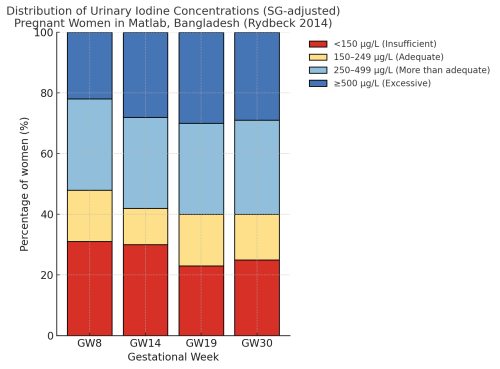
https://brieflands.com/articles/ijem-72082.pdf
"It is concluded that children whose mothers received iodide supplementation before conception had normal IQs of significantly higher values than those whose mothers received iodine during pregnancy and the children who received iodine after birth."
Sankoda A, Arata N, Sato S, Umehara N, Morisaki N, Ito Y, Sago H, Yano Y, Horikawa R - "Association of isolated hypothyroxinemia and subclinical hypothyroidism with birthweight: a cohort study in Japan" J Endocr Soc 7(5):bvad045 (2023)
https://doi.org/10.1210/jendso/bvad045
"Pregnant women with isolated hypothyroxinemia and subclinical hypothyroidism in the first trimester have an increased likelihood of SGA [ small for gestational age ]."
Sang Z, Wei W, Zhao N, Zhang G, Chen W, Liu H, Shen J, Liu J, Yan Y, Zhang W - "Thyroid dysfunction during late gestation is associated with excessive iodine intake in pregnant women" J Clin Endocrinol Metab 97(8):E1363–E1369 (2012)
https://pubmed.ncbi.nlm.nih.gov/22669304/
"Living with high water iodine content and having urinary iodine concentration higher than 250 μg/liter are associated risk factors for subclinical hypothyroidism in pregnant women (OR(1) = 41.822, OR(2) = 6.202; P < 0.05, where OR(1) is the odds ratio for living with high water iodine content and hypothyroidism and OR(2) is the odds ratio for urinary iodine concentration >250 μg/liter and hypothyroidism).”
Sang Z, Chen W, Shen J, Tan L, Zhao N, Liu H, Wen S, Wei W, Zhang G, Zhang W – "Long-term exposure to excessive iodine from water is associated with thyroid dysfunction in children" Journal of Nutrition 143(12):2038-2043 (2013). doi: 10.3945/jn.113.179135
https://www.sciencedirect.com/science/a ... 6622013815
Sang Z, Zhao N, Zhang S - "Effects of iodine intake on thyroid function and thyroid autoimmunity in pregnant women" The 7th National Academic Conference of Maternal and Child Nutrition of China Nutrition Society 354-359 (2010)
https://www.sciencedirect.com/science/a ... 6622013815
Schiller T, Agmon A, Ostrovsky V, Shefer G, Knobler H, Zornitzki T - “Moderate Iodine Deficiency Is Common in Pregnancy but Does Not Alter Maternal and Neonatal Thyroid Function Tests” Front Endocrinol (Lausanne) 11:523319 (2020). doi: 10.3389/fendo.2020.523319 (2020)
https://www.ncbi.nlm.nih.gov/pmc/articles/PMC7759626/
Schmidt M, Voell M, Rahlff I, Dietlein M, Kobe C, Faust M, Schicha H - "Long-term follow-up of antithyroid peroxidase antibodies in patients with chronic autoimmune thyroiditis (Hashimoto's thyroiditis) treated with levothyroxine" Thyroid 18(7):755-60 (2008) doi: 10.1089/thy.2008.0008
https://www.liebertpub.com/doi/10.1089/thy.2008.0008
"Serum TPO-Ab levels decline in most patients with Hashimoto's thyroiditis who are taking levothyroxine."
Schmitz EM, Langelaan ML, de Groot MJ, Ermens TA, Joosen AM - "Trimester-specific reference intervals for cystatin C and neutrophil gelatinase-associated lipocalin during pregnancy" Ann Clin Biochem 59(3):199-204 (2022)
https://pubmed.ncbi.nlm.nih.gov/35044277/
Sengupta P - "A Scientific Review of Age Determination for a Laboratory Rat: How Old is it in Comparison with Human Age?" Biomedicine International
2: 81-89 (2011) or Sengupta P - "The Laboratory Rat: Relating Its Age With Human's" Int J Prev Med 4(6):624-30 (2013)
Serrano-Nascimento C, Salgueiro RB, Pantaleão T, Corrêa da Costa VM, Nunes MT - "Maternal Exposure to Iodine Excess Throughout Pregnancy and Lactation Induces Hypothyroidism in Adult Male Rat Offspring" Sci Rep 7(1):15591 (2017)
https://pubmed.ncbi.nlm.nih.gov/29142304/
"In conclusion, our results indicate that rat dams' exposure to IE during pregnancy and lactation induces primary hypothyroidism and triggers several epigenetic changes in the thyroid gland of their male offspring in adulthood."
Shan Z, Chen L, Lian X, Liu C, Shi B, Shi L, Tong N, Wang S, Weng J, Zhao J, Teng X, Yu X, Lai Y, Wang W, Li C, Mao J, Li Y, Fan C, Teng W - "Iodine Status and Prevalence of Thyroid Disorders After Introduction of Mandatory Universal Salt Iodization for 16 Years in China: A Cross-Sectional Study in 10 Cities" Thyroid 26(8):1125-30 (2016) doi: 10.1089/thy.2015.0613
"Compared with a five-year prospective study conducted in 1999, the prevalence of goiter significantly decreased (2.9% vs. 5.02%, p = 0.001), but there was a significant increase in thyroid nodules (12.8% vs. 2.78%, p = 0.001). The prevalence of subclinical hypothyroidism (16.7% vs. 3.22%), positive TPOAb (11.5% vs. 9.81%), and positive TgAb (12.6% vs. 9.09%) significantly increased..."
Shan Z, Teng W, Li Y, et al. - "Comparative epidemiological study on the prevalence of iodine-induced hypothyroidism" Chin J Endocrinol Metab 7:71–4 (2001) DOI: 10.3760/j.issn:1000-6699.2001.02.003
"The main cause of overt hypothyroidism was autoimmune thyroiditis; one-third of the cases with subclinical hypothyroidism showed positive thyroid autoantibodies...Higher prevalence of overt and subclinical hypothyroidism was found in the rural communities with higher iodine supply in a cross sectional epidemiologic study, suggesting a possible role of increasing or excessive iodine intake in hypothyroidism."
Shen J, Haliya H, Wang D, Cai J, Mukedasi A - "Relationship between serum IL-6, TNF-α, IGF-1 levels, blood lipids, thyroid function, and pregnancy outcome in patients with subclinical hypothyroidism during pregnancy" Chinese J of Difficult and Complex Cases 22(2):176-181 (2023) DOI: 10.3969/j.issn.1671-6450.2023.02.012
"During pregnancy, serum IL-6 and TNF-α levels increase, IGF-1 levels decrease in SCH patients, and these are associated with blood lipids, thyroid function, and adverse pregnancy outcomes."
Shi X, Han C, Li C, Mao J, Wang W, Xie X, Li C, Xu B, Meng T, Du J, Zhang S, Gao Z, Zhang X, Fan C, Shan Z, Teng W - "Optimal and safe upper limits of iodine intake for early pregnancy in iodine-sufficient regions: a cross-sectional study of 7190 pregnant women in China" J Clin Endocrinol Metab 100(4):1630–1638 (2015)
https://academic.oup.com/jcem/article/1 ... 30/2815136
"The upper limit of iodine intake during early pregnancy in an iodine- sufficient region should not exceed UIC 250 μg/L, because this is associated with a significantly high risk of subclinical hypothyroidism, and a UIC of 500 μg/L should not be exceeded, as it is associated with a significantly high risk of isolated hypothyroxinemia."
Shi C, Teng X, Sun W, Wei J, Shan Z, Guan H, Gao Y, Wang W, Chen W, Tong Y - "Multifactor analysis of relationship between the biological exposure to iodine and hypothyroidism" Chinese Medical Journal 14:1171-1174 (2004) (PFPC Library)
"More than adequate iodine and excessive iodine were independent risk factors of subclinical hypothyroidism (OR =3.172 and 6.391, P <0.05) and overt hypothyroidism (OR =3 696 and 9.213, P <0.05). When interactions of iodine exposure and thyroid peroxidase antibody (TPOAb) or thyroglobulin antibody (TgAb ) were included, more than adequate iodine was still a risk factor of subclinical hypothyroidism (OR =2.788, P <0.01), but had no such effect on overt hypothyroidism. Interaction of more than adequate iodine and positive TgAb significantly affected subclinical hypothyroidism and overt hypothyroidism (OR =2.656 and 3.347, P <0.05). More than adequate and excessive iodine exposure are independent risk factors of hypothyroidism. The risk of hypothyroidism grows and thyroid dysfunction becomes more serious with the increasing of the biological exposure to iodine."
Shrestha U, Gautam N, Agrawal KK, Jha AC, Jayan A - "Iodine Status among Subclinical and Overt Hypothyroid Patients by Urinary Iodine Assay: A Case-Control Study" Indian J Endocrinol Metab 21(5):719-723 (2017) doi: 10.4103/ijem.IJEM_413_16
https://journals.lww.com/indjem/Fulltex ... rt.16.aspx
"A significantly higher median UIC was observed among cases of subclinical hypothyroidism (224.90 μg/l) and overt hypothyroidism (281.0 μg/l) as compared to the controls (189.90 μg/l) (P = 0.0001, P = 0.001).”
Silva de Morais N, Ayres Saraiva D, Corcino C, Berbara T, Schtscherbyna A, Moreira K, Vaisman M, Alexander EK, Teixeira P - "Consequences of Iodine Deficiency and Excess in Pregnancy and Neonatal Outcomes: A Prospective Cohort Study in Rio de Janeiro, Brazil" Thyroid 30(12):1792-1801 (2000) doi: 10.1089/thy.2019.0462
https://www.liebertpub.com/doi/10.1089/thy.2019.0462
Study of 214 pregnant women found that those with a UIC of 250–499 µg/L had a higher prevalence of gestational diabetes mellitus (GDM) at 20.3% compared with 9.7% in the 150–249 µg/L group. Moreover, hypertensive disorders of pregnancy (HDP), including pre-eclampsia and gestational hypertension, were observed in 33.3% of women with UIC ≥ 250 µg/L versus 4.3% in those with 150–249 µg/L (24).
Singh B, Bakian AV, Newman M, Sundaresh V - "The Association Between Thyrotropin and Clinically Relevant Depression: A Retrospective Cross-Sectional Study" Thyroid. 2025 Feb 5. doi: 10.1089/thy.2024.0428
https://www.liebertpub.com/doi/10.1089/thy.2024.0428
"Both the low TSH and high TSH groups showed increased odds of CRD...Patients with mood disorders were more likely to be female, Caucasian, non-Hispanic/Latino, on AD, had hypothyroidism diagnoses, on thyroid medications, had higher mean PHQ-9 scores, and had CRD. "
Singh T, Gustin K, Rahman SM, Shiraji S, Tofail F, Vahter M, Kampouri M, Kippler M - "Prenatal and Childhood Exposure to Fluoride and Cognitive Development: Findings from the Longitudinal MINIMat Cohort in Rural Bangladesh" Environ Health Perspect 133(3-4):47008 (2025) doi: 10.1289/EHP14534 MINIMat
https://pmc.ncbi.nlm.nih.gov/articles/PMC12010932/
(See also: Rydbeck 2014) Singh et al. (2025) analyzed fluoride and cognition in MINIMat without adequately investigating iodine. Although cohort iodine levels were high, iodine appeared only as a continuous covariate in sensitivity models, with no WHO category stratification and no tests for nonlinearity. By contrast, the authors examined nonlinearity for fluoride and fitted a spline for child urine fluoride at 10 years. Arsenic, cadmium, and lead were likewise treated only as covariates in sensitivity models rather than tested as interacting co-exposures or within mixture frameworks. (The study was initiated to test for arsenic poisoning.)
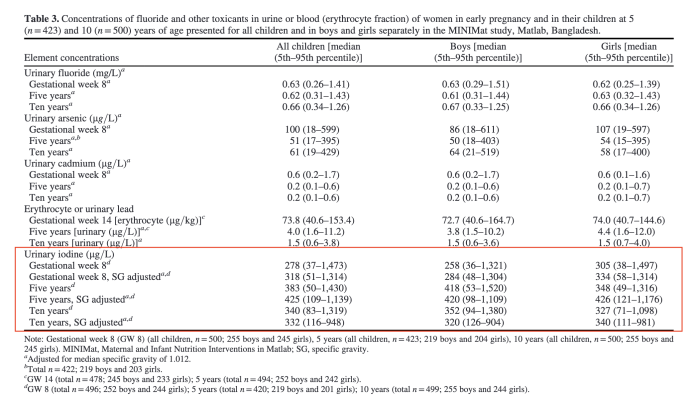
- SEE also: Hossen MS, Islam MM, Das A, Ripon MAR, Tohidul Amin M, Basher MA, Rashid MMO - "Thyroid Dysfunction Prevalence and Risk Factors in the Southeastern Part of Bangladesh: A Cross-Sectional Study" Health Science Reports 8(1):e70329 (2025) doi: 10.1002/hsr2.70329
https://pmc.ncbi.nlm.nih.gov/articles/PMC11705530/
Note prevalence of hypothyroidism in males [46.15% vs 27.75%], hyperthyroidism in females [43.06% vs 18.69%]
NOTE: Matlab Upazila, Chandpur District, is in Southeastern Bangladesh
Asaduzzaman M, Kamrul-Hasan ABM, Aminul-Islam AKM, Rafiq-Uddin M, Hasanat MA, Fariduddin M - "Impact of iodine nutrition status on thyroid autoimmunity in subclinical hypothyroid patients attending a tertiary hospital of Bangladesh" Thyroid Research and Practice 15(2):75-79 (2018) doi: 10.4103/trp.trp_14_18
https://journals.lww.com/trap/fulltext/ ... oid.5.aspx
"It was observed that iodine nutrition status of SCH patients is mostly more than adequate or excess and a very few are deficient."
https://etj.bioscientifica.com/view/jou ... 1-0001.xml
Sokoloff K, Fraser W, Arbuckle TE, Fisher M, Gaudreau E, LeBlanc A, Morisset AS, Bouchard MF - “Determinants of urinary concentrations of dialkyl phosphates among pregnant women in Canada - Results from the MIREC study” Environ Int 94:133-140 (2016) doi: 10.1016/j.envint.2016.05.015 MIREC
https://www.sciencedirect.com/science/a ... 201630188X
Soldin OP - "Thyroid function testing in pregnancy and thyroid disease: trimester-specific reference intervals" Ther Drug Monit 28(1):8-11 (2006)
doi: 10.1097/01.ftd.0000194498.32398.7b
https://www.ncbi.nlm.nih.gov/pmc/articles/PMC3625634/
Soldin OP- " Controversies in urinary iodine determinations" Clin Biochem 35(8):575-9 (2002) doi: 10.1016/s0009-9120(02)00406-x
https://www.ncbi.nlm.nih.gov/pmc/articles/PMC3637997/
"It is normal for the GFR to be as much as 50% higher during pregnancy...A higher GFR during pregnancy results in decreased circulating creatinine and a possible trend toward lower urinary creatinine concentrations...a higher requirement for iodine during pregnancy might lead to a lower UI/Cr ratio. In mild ID the correlation between UI concentrations and UI/Cr ratio was lower for pregnant women than for nonpregnant women."
Song J, Zou SR, Guo CY, Zang JJ, Zhu ZN, Mi M, Huang CH, Yu HT, Lu X, Ruan Y, Wu F - "Prevalence of Thyroid Nodules and Its Relationship with Iodine Status in Shanghai: a Population-based Study" Biomed Environ Sci 29(6):398-407 (2016) doi: 10.3967/bes2016.052
https://www.besjournal.com/en/article/d ... es2016.052
"The relationship between UIC and prevalence of TNs is U-shaped, with an increase in risk when the UIC was <140 μg/L and >400 μg/L. Very low or high UIC levels need attention and correction."
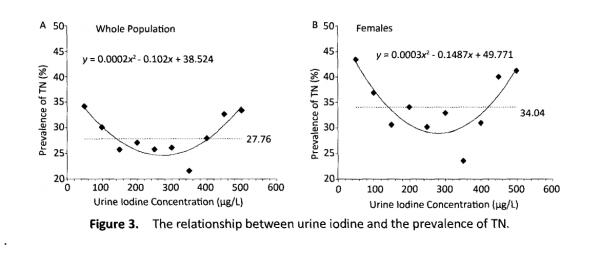
https://www23.statcan.gc.ca/imdb/p2SV.p ... y&Id=62444
- Iodine status of Canadians, 2009 to 2011
https://www150.statcan.gc.ca/n1/en/pub/ ... t=sx6_7ZZ0
https://academic.oup.com/jcem/article/93/5/1737/2598659
Stinca S, Andersson M, Weibel S, Herter-Aeberli I, Fingerhut R, Gowachirapant S, Hess SY, Jaiswal N, Jukic T, Kusic Z, Mabapa NS, Nepal AK, San Luis TO, Zhen JQ, Zimmermann MB - “Dried Blood Spot Thyroglobulin as a Biomarker of Iodine Status in Pregnant Women” J Clin Endocrinol Metab 102(1):23-32 (2017). doi: 10.1210/jc.2016-2829
https://www.zora.uzh.ch/id/eprint/147094/
Sullivan TR, Best KP, Gould J, Zhou SJ, Makrides M, Green TJ - "Too much too little: clarifying the relationship between maternal iodine intake and neurodevelopmental outcomes" Journal of Nutrition 154(1):185-190 (2024) doi: 10.1016/j.tjnut.2023.09.008
https://www.sciencedirect.com/science/a ... 6623726023
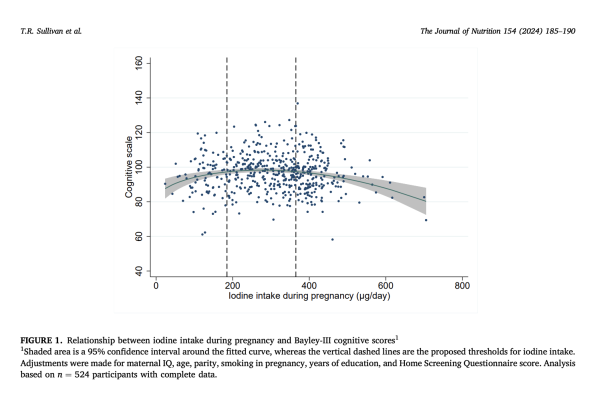
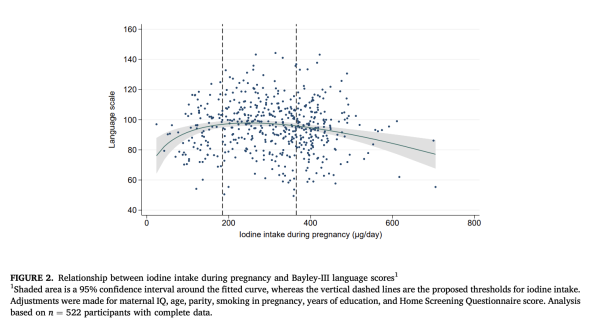
http://en.cnki.com.cn/Article_en/CJFDTO ... 318110.htm
viewtopic.php?p=619
Researchers withdrew iodized salt for two months, tested before and after in areas with "normal" fluoride in water supply (0.42 ~ 0.95 ppm, average of 0.73 ppm). When iodine intake was reduced while fluoride intake remained unchanged: urine iodine excretion decreased, urinary fluoride excretion increased.
Sun R, Qian TT, Liu LC, Zhao MC, Che WJ, Zhang LL, Li WD, Whang JH, Chen ZH, Zhang BY, Liu P - "Effect of Iodine Supplementation on Iodine Nutrition and Thyroid Function in Pregnant Women: A Cross-Sectional Study" China CDC Study, Biomedicine and Environmental Science: English Edition (7):641-647 (2022)
http://222.198.130.40:81/Qikan/Article/ ... 7107886714
"In addition, pregnant women with MUIC in the 150–249μg/L range showed higher rates of TPOAb-positive (13.78%) disease and sub-hypothyroidism (5.38%) compared to those with MUIC in the 100–149μg/L range; however, goiter showed the opposite trend...Through this study, we found that different iodine supplements had different effects on thyroid function and iodine nutrition, and the effects varied from person to person. Therefore, iodine should be supplemented using scientific approaches." (See also Wu, 2017)
Sun J, Teng D, Li C, Peng S, Mao J, Wang W, Xie X, Fan C, Li C, Meng T, Zhang S, Du J, Gao Z, Shan Z, Teng W - "Association between iodine intake and thyroid autoantibodies: a cross-sectional study of 7073 early pregnant women in an iodine-adequate region" J Endocrinol Invest 43(1):43-51 (2020). doi: 10.1007/s40618-019-01070-1ALSO: "Moreover, concerning family annual income, pregnant women with high annual income had higher FT4 levels, likely due to the diversity and quality of their diets. For TSH, the third trimester had risks of both high and low TSH levels; in addition, dietary habits also had an effect on TSH. For factors influencing thyroid antibody, it was found that higher annual income had a positive effect on the value of TPOAb, which may be consistent with the cause of high FT4 in these participants."
https://link.springer.com/article/10.10 ... 19-01070-1
NOTE: U-shape - UIC

https://pmc.ncbi.nlm.nih.gov/articles/PMC9786336/
"Long-term excess iodine exposure caused oxidative damage and showed sex difference..."
Sun Y, Du X, Shan Z, Teng W, Jiang Y - "Effects of iodine excess on serum thyrotropin-releasing hormone levels and type 2 deiodinase in the hypothalamus of Wistar rats" Br J Nutr 127(11):1631-1638 (2022) doi: 10.1017/S0007114521002592
https://www.cambridge.org/core/journals ... 8D670C18B8
"These results indicate that iodine excess affects the levels of Dio2, TRH and MCT8 in the hypothalamus."
Sun Y, Chen C, Liu GG, Wang M, Shi C, Yu G, Lv F, Wang N, Zhang S - "The association between iodine intake and semen quality among fertile men in China" BMC Public Health 20(1):461 (2020) doi: 10.1186/s12889-020-08547-2
https://pmc.ncbi.nlm.nih.gov/articles/PMC7137216/
This study of 1,098 fertile Chinese men examining the relationship between iodine intake and semen quality found that those with iodine excess (UIC ≥ 200 µg/L) had 5% higher semen volume, 26% lower sperm concentration, 20% lower total sperm count, and a 1.48-month longer time to pregnancy compared with men having optimal iodine intake (100 ≤ UIC < 200 µg/L)
Ssewanyana D, Knight JA, Matthews SG, Wong J, Khani NA, Lye J, Murphy KE, Foshay K, Okeke J, Lye SJ, Hung RJ - "Maternal prenatal psychological distress and vitamin intake with children's neurocognitive development" Pediatr Res 92(5):1450-1457 (2022) doi: 10.1038/s41390-022-02003-0
https://pubmed.ncbi.nlm.nih.gov/35288638/
(Canadian study - Toronto; showing that exposure to prenatal psychological distress, in moderate-to-severe form, in the early stages of pregnancy, can have detrimental effects on the offspring's cognitive development at 4 years.)
Tan L, Sang Z, Shen J, Liu H, Chen W, Zhao N, Wei W, Zhang G, Zhang W - "Prevalence of thyroid dysfunction with adequate and excessive iodine intake in Hebei Province, People's Republic of China" Public Health Nutr 18(9):1692-7 (2015) doi: 10.1017/S1368980014002237
https://www.cambridge.org/core/journals ... E574A4C6D8
Taylor KW, Eftim SE, Sibrizzi CA, Blain RB, Magnuson K, Hartman PA, Rooney AA, Bucher JR - "Fluoride Exposure and Children's IQ Scores: A Systematic Review and Meta-Analysis" JAMA Pediatr 179(3):282-292 (2025) doi: 10.1001/jamapediatrics.2024.5542
https://jamanetwork.com/journals/jamape ... le/2828425
(NTP Report; 3 NTP authors, 4 ICF participants)
Taylor KW, Eftim SE, Sibrizzi CA, Blain RB, Magnuson K, Hartman PA, Bucher JR, Rooney AA - "Addressing Critiques of the Evidence Linking Fluoride and Children's IQ" Annals of Global Health 91(1):83 (2025)
https://doi.org/10.5334/aogh.4853
Teng W, Shan Z, Teng X, Guan H, Li Y, Teng D, Jin Y, Yu X, Fan C, Chong W, Yang F, Dai H, Yu Y, Li J, Chen Y, Zhao D, Shi X, Hu F, Mao J, Gu X, Yang R, Tong Y, Wang W, Gao T, Li C - "Effect of iodine intake on thyroid diseases in China" N Engl J Med 354(26):2783-93 (2006) doi: 10.1056/NEJMoa054022.
https://www.nejm.org/doi/10.1056/NEJMoa054022
"We observed an increase in the prevalence of overt hypothyroidism, subclinical hypothyroidism, and autoimmune thyroiditis with increasing iodine intake in China in cohorts from three regions with different levels of iodine intake: mildly deficient (median urinary iodine excretion, 84 μg per liter), more than adequate (median, 243 μg per liter), and excessive (median, 651 μg per liter)...Among subjects with euthyroidism and antithyroid antibodies at baseline, the five-year incidence of elevated serum thyrotropin levels was greater among those with more than adequate or excessive iodine intake than among those with mildly deficient iodine intake.
Teng X, Shan Z, Chen Y, Lai Y, Yu J, Shan L, Bai X, Li Y, Li N, Li Z, Wang S, Xing Q, Xue H, Zhu L, Hou X, Fan C, Teng W - "More than adequate iodine intake may increase subclinical hypothyroidism and autoimmune thyroiditis: a cross-sectional study based on two Chinese communities with different iodine intake levels" Eur J Endocrinol 164(6):943-50 (2011) doi: 10.1530/EJE-10-1041
https://academic.oup.com/ejendo/article ... 43/6676827
"The result that a higher positive thyroid autoantibodies were found in diffuse goiter in Rongxing [UIC 261 μg/L|UF - 0.62 mg/L)] indicated that when iodine nutrition shifted from iodine deficiency to more than adequate iodine, thyroid autoimmunity will be the main cause of diffuse goiter rather than in iodine deficiency." [Chengshan UIC 145 μg/L | UF - 0.56 mg/L] [Fluoride played no role - it was iodine toxicity] "More than adequate iodine intake could be a public health concern in terms of thyroid function and thyroid autoimmunity in the Chinese populations."
Teng X, Shi X, Shan Z, Jin Y, Guan H, Li Y, Yang F, Wang W, Tong Y, Teng W - "Safe range of iodine intake levels: a comparative study of thyroid diseases in three women population cohorts with slightly different iodine intake levels" Biol Trace Elem Res 121(1):23-30 (2008) doi: 10.1007/s12011-007-8036-0
https://link.springer.com/article/10.10 ... 007-8036-0
"Among the subjects with mildly deficient iodine intake, those with adequate intake, and those with more than adequate intake, the prevalence of clinical and subclinical hypothyroidism was 0, 1.13, and 2.84%." [Fluoride played no role - similar in all three areas, comparable to MIREC data =>median urinary fluorine were 0.56, 0.67, and 0.59 mg/l] In the present study, in areas with MUI of 78.1, 113.8, and 223.3 μg/l, we also observed an iodine-related increase, indicating that even a slight increase of iodine intake level may be accompanied by an increased prevalence of hypothyroidism. The same trend was also observed by Laurberg et al. [12] and Szabolcs et al. [13]. A U-shaped curve between the goiter and iodine status has been widely accepted [14, 15]. Our current study suggested that MUI more than 200 μg/l might lead to an increased prevalence of goiter."
Teng Xiaochun , Teng Di, Shan Zhongyan, Guan Haixia, Li Yushu, Yu Xiaohui, Fan Chenling, Chong Wei, Yang Fan, He Li, Liu Hua, Wen Songchen, Dai Hongmao, Jin Yuan, Gu Xiaolan, Yu Yang, Li Jia , Chen Yanyan , Zhao Dong , Yang Rong , Jiang Yaqiu , Li Chenyang , Teng Weiping - "Impact of iodine intake on thyroid diseases - A five-year prospective epidemiological study" Chinese Journal of Endocrinology and Metabolism 6:512-517 (2006)
"More than adequate or excessive dietary iodine intake may induce and promote the occurrence and development of hypothyroidism and AIT, therefore, median urinary iodine excretion (MUI) more than 200 μg/L in the population appears not safe."
Teti C, Panciroli M, Nazzari E, Pesce G, Mariotti S, Olivieri A, Bagnasco M - "Iodoprophylaxis and thyroid autoimmunity: an update" Immunol Res 69(2):129-138 (2021) doi: 10.1007/s12026-021-09192-6
https://www.ncbi.nlm.nih.gov/pmc/articles/PMC8106604/
"In conclusion, available data from long-term population surveys show that a higher than adequate population iodine intake due to a poorly controlled program of iodine prophylaxis could induce thyroid dysfunction, including thyroid autoimmunity mostly represented by euthyroid or subclinical hypothyroid autoimmune thyroiditis."
Thomas DB, Basu N, Martinez-Mier EA, Sánchez BN, Zhang Z, Liu Y, Parajuli RP, Peterson K, Mercado-Garcia A, Bashash M, Hernández-Avila M, Hu H, Téllez-Rojo MM - "Urinary and plasma fluoride levels in pregnant women from Mexico City" Environ Res 150:489-495 (2016) ELEMENT
https://www.sciencedirect.com/science/a ... 5116302808
"Upon enrollment women were not screened for renal problems that could potentially affect the urinary fluoride levels. The early morning 2nd voided urine samples and plasma samples we measured were not taken with the requirement that each subject be in the fasting state, which may have introduced variability. However, the early morning 2nd void nature of the urine specimens would have reduced time-of-day variations driven by diurnal metabolic changes, and the adjustment by creatinine corrected for urinary dilution. Nonetheless, future studies should either provide 24-hour measures or measure samples that have been collected after fasting."
Threapleton DE, Snart CJP, Keeble C, Waterman AH, Taylor E, Mason D, Reid S, Azad R, Hill LJB, Meadows S, McKillion A, Alwan NA, Cade JE, Simpson NAB, Stewart PM, Zimmermann M, Wright J, Waiblinger D, Mon-Williams M, Hardie LJ, Greenwood DC - "Maternal iodine status in a multi-ethnic UK birth cohort: Associations with child cognitive and educational development" Paediatr Perinat Epidemiol 35(2):236-246 (2021). doi: 10.1111/ppe.12719
https://eprints.whiterose.ac.uk/164441/
"In the largest single study of its kind, there was little evidence of detrimental neurodevelopmental outcomes in children born to pregnant women with iodine insufficiency as defined by World Health Organization–outlined thresholds."
Tian Y, Liu J, Tang X, Fu S, Ma L, Sun W - "Study on the relationship between iodine nutritional status and TSH, thyroid autoantibodies, and thyroid nodules in adults in Gansu Province" Acta Nutr Sin (3):248-252 (2019) PFPC Library
"The levels of TPOAb and TGAb in males and females with UIC<100 μg/L and UIC100-199 μg/ L were significantly lower than those in UIC≥300 μg/L group(P<0.05)."
Till C, Green R, Grundy JG, Hornung R, Neufeld R, Martinez-Mier EA, Ayotte P, Muckle G, Lanphear B - "Community Water Fluoridation and Urinary Fluoride Concentrations in a National Sample of Pregnant Women in Canada" Environ Health Perspect 126(10):107001 (2018) doi: 10.1289/EHP3546 MIREC
https://ehp.niehs.nih.gov/doi/pdf/10.1289/EHP3546
"There are several limitations of this study. First, overnight fasting or 24-h urine samples are considered to be the optimal dosimeter for measuring chronic fluoride exposure (WHO 2014). In contrast, the present study measured the concentration of fluoride in a spot urine sample that did not control for recent fluoride ingestion. Urinary fluoride concentration does not measure total exposure (intake) nor did we estimate the 24-h daily urinary fluoride excretion level, which would require multiplying our fluoride:creatinine ratio by a standard creatinine value (not established to our knowledge for each trimester of pregnancy)...We noted that 11% of women had different postal codes between trimesters, although we presume some of these women moved within the same WTP zone."
Till C, Green R, Flora D, Hornung R, Martinez-Mier EA, Blazer M, Farmus L, Ayotte P, Muckle G, Lanphear B - "Fluoride exposure from infant formula and child IQ in a Canadian birth cohort" Environ Int 134:105315 (2020) doi: 10.1016/j.envint.2019.105315 MIREC
https://linkinghub.elsevier.com/retriev ... 19)32614-5
[NOTE: No efforts undertaken to investigate iodine content in formula or the use of iodine supplements during lactation. By law, infant formula in Canada has to contain iodine, usually at 5 ug per 100 calories. If one liter of formula is approx 800 calories, then this would mean 40 ug from this source alone, roughly close to the 50 ug/day advised by the WHO. The percentages of mothers that used a multivitamin-mineral (MVM) supplement containing iodine were 79% and 59% at 1 and 6 months of lactation, respectively." (Bertinato et al., 2022)]
Till C - "Invited Perspective: Prenatal and childhood exposure to fluoride and cognitive development: findings from the longitudinal MINIMat cohort in rural Bangladesh" Environ Health Perspect (2025) doi: 10.1289/EHP16269
https://ehp.niehs.nih.gov/doi/10.1289/EHP16269
Till C, El-Sabbagh J, Goodman C, Subiza-Pérez M, Hall M - "How the public's knowledge, attitudes, and practice intersect with scientific evidence about fluoride" Curr Probl Pediatr Adolesc Health Care 55(6):101768 (2025) doi: 10.1016/j.cppeds.2025.101768
https://www.sciencedirect.com/science/a ... 4225000422
Kyla Taylor (NTP), Bruce Lanphear
Till C, Grandjean P, Martinez-Mier EA, Hu H, Lanphear B - "Health Risks and Benefits of Fluoride Exposure During Pregnancy and Infancy" Annu Rev Public Health 46(1):253-274 (2025) doi: 10.1146/annurev-publhealth-060722-023526
https://www.annualreviews.org/docserver ... 023526.pdf
"All authors hold federal research awards related to fluoride research."
Till C, Green R, Lanphear B - "Association Between Maternal Fluoride Exposure and Child IQ - Reply" JAMA Pediatr 174(2):216-217 (2020) MIREC
https://doi.org/10.1001/jamapediatrics.2019.5251
Authors respond to criticism of their 2019 MIREC fluoride–IQ paper, reiterating that their primary conclusion concerns loss of IQ in boys at maternal urinary fluoride levels typical of water fluoridation, defending their statistical methods and covariate selection, and arguing that their findings are robust to alternative model specifications and clinically important even for modest IQ shifts at the population level.
- "Still, we considered many potential confounders. Unless unmeasured factors are identified and shown to be associated with both fluoride exposure and IQ, these criticisms are speculative."
https://healthlibrary.vanderbilthealth. ... s/6,759220
Vargas-Uricoechea H, Castellanos-Pinedo A, Meza-Cabrera IA, Pinzón-Fernández MV, Urrego-Noguera K, Vargas-Sierra H - "Iodine Intake from Universal Salt Iodization Programs and Hashimoto's Thyroiditis: A Systematic Review" Diseases 13(6):166 (2025) doi: 10.3390/diseases13060166
https://pmc.ncbi.nlm.nih.gov/articles/PMC12191997/
"Between 2004 and 2023, the number of countries with excessive iodine intake increased (from 5 countries in 2004 to 15 countries in 2023)....Excess iodine intake, mediated by USI programs without an adequate follow-up and monitoring plan, may explain (at least in part) the prevalence and distribution of HT; therefore, it is a real challenge to establish a balance between healthy salt intake, USI program strategies, and possible functional outcomes and thyroid autoimmunity in the population."
Villanger GD, Drover SSM, Nethery RC, Thomsen C, Sakhi AK, Øvergaard KR, Zeiner P, Hoppin JA, Reichborn-Kjennerud T, Aase H, Engel SM - "Associations between urine phthalate metabolites and thyroid function in pregnant women and the influence of iodine status" Environ Int 137:105509 (2000) doi: 10.1016/j.envint.2020.105509. MoBa
https://pubmed.ncbi.nlm.nih.gov/32044443/
"Iodine intake significantly modified (p-interaction < 0.05) the association of factor 1 with thyroid stimulating hormone (TSH), total thyroxine (TT4) and free T4 index (fT4i), such that only among women in the high iodine intake category (≥150 µg/day, i.e. sufficient) was this factor associated with increased TSH and decreased TT4 and FT4i, respectively. In contrast, factor 2, which included high loadings for di-2-ethylhexyl phthalate metabolites (∑DEHP) and di-iso-nonyl phthalate metabolites (∑DiNP), was associated with a decrease in TT3 and fT3i, which appeared fairly uniform across iodine intake categories."
Vorhees CV, Butcher RE, Brunner RL - "Developmental toxicity and psychotoxicity of potassium iodide in rats: a case for the inclusion of behaviour in toxicological assessment" Food Chem Toxicol 22(12):963-70 (1984). doi: 10.1016/0278-6915(84)90145-5
https://pubmed.ncbi.nlm.nih.gov/6210234/
Wan S, Jin B, Ren B, Qu M, Wu H, Liu L, Boah M, Shen H - "The Relationship between High Iodine Consumption and Levels of Autoimmune Thyroiditis-Related Biomarkers in a Chinese Population: a Meta-Analysis" Biol Trace Elem Res 196(2):410-418 (2020) doi: 10.1007/s12011-019-01951-9
https://link.springer.com/article/10.10 ... 19-01951-9
"High iodine can increase the risk of abnormal levels of TPOAb, TGAb, and TSH related to autoimmune thyroiditis in pregnant women, lactating women, and children in China."
Wang B, He W, Li Q, Jia X, Yao Q, Song R, Qin Q, Zhang JA - "U-shaped relationship between iodine status and thyroid autoimmunity risk in adults" Eur J Endocrinol 181(3):255-266 (2019) doi: 10.1530/EJE-19-0212
https://academic.oup.com/ejendo/article ... 55/6654156
"The study suggests an U-shaped relationship between iodine intake and TAI in adults, and both iodine deficiency and iodine excess are risk factors of TAI in adults."
Wang T, Liu Y, Kong Q, Cao X, Liu Y, Xia S, Zheng T, Yu L - "Effect of Moderate-to-Severe Iodine Deficiency in Early Pregnancy on Subclinical Hypothyroidism: A Longitudinal Study in an Iodine-Sufficient Region in China" Front Nutr 9:839651 (2022). doi: 10.3389/fnut.2022.839651
https://www.ncbi.nlm.nih.gov/pmc/articles/PMC9011046/
"TSH was significantly higher in the UIC more than or equal to 250 μg/L group than the UIC 150 to 249 g/L group (P = 0.043)."
Wang T, Liu Y, Kong Q, Cao X, Liu Y, Xia S, Zheng T, Yu L – "Effect of moderate-to-severe iodine deficiency in early pregnancy on subclinical hypothyroidism: a longitudinal study in an iodine-sufficient region in China" Frontiers in Nutrition 9:839651 (2022). doi: 10.3389/fnut.2022.839651
https://www.frontiersin.org/articles/10 ... 39651/full
"TSH was significantly higher in the UIC more than or equal to 250 μg/L group than the UIC 150 to 249 g/L group (P = 0.043)."
Wang X, Jia T, Liu D - "Iodine nutrition and thyroid autoantibodies in pregnancy and their relation to thyroid function" Chinese Journal of Endocrinology and Metabolism 5:408-410 (2014)
"The levels of serum thyroid peroxidase antibody (TPOAb) and thyroglobulin antibody were markedly related to serum TSH ( P<0.01 ), so was the level of serum TPOAb related to serum FT4 (P < 0.05)...Therefore, we advocate the screening of urine iodine and thyroid autoantibodies before or during the first trimester of pregnancy, aiming to correct iodine deficiency, avoiding supplementing too much iodine, improve the outcome of perinatal stage, and reduce all the negative effects on the offspring."
Wang W, Zhang Y, Tan L, San G, Zhang W - "Study on Effects of Iodine Excess on Brain and Serum Concentrations of Monoamine Neurotransmitters in Rats" - Acta Nutrimenta Sinica 39(2)200-202 (2017)
Notice the inverse U-shaped (V) effects of iodine on dopamine [C] in brain of rats.
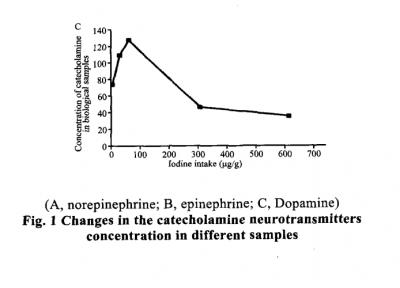
https://www.ncbi.nlm.nih.gov/pmc/articles/PMC1476727/
Wang Y, Cui Y, Chen C, Duan Y, Wu Y, Li W, Zhang D, Li F, Hou C - "Stopping the supply of iodized salt alone is not enough to make iodine nutrition suitable for children in higher water iodine areas: A cross-sectional study in northern China" Ecotoxicol Environ Saf 188:109930 (2020) doi: 10.1016/j.ecoenv.2019.109930
https://www.sciencedirect.com/science/a ... 1319312618
"Binary logistic regression analysis indicated that the risk of thyroid abnormalities was significantly increased in the UIC 200–299 μg/L group (OR: 4.534; 95% CI: 1.565, 13.135; bootstrapped 95% CI: 1.689, 21.206, P = 0.004) and in the UIC ≥ 300 μg/L group (OR: 6.962; 95% CI: 2.490, 19.460; bootstrapped 95% CI: 2.838, 32.570, P = 0.001) compared to the 100–199 μg/L group."
Wang R - "Effects of high fluoride and high iodine combination on thyroid damage and mental development" Master's Thesis, Tianjin University (2010)
https://kns.cnki.net/kcms/detail/detail ... VOaGo6_xMt
Wang Z, Shao C, Zhu Y, Shi Z, Qu M, Song Q, Shen L, Mai S, Lu W, Sun Z, Xiang X, Zang J - "Iodine Excess May Lead to Low Exam Score in Children Aged 8-10 Years" Biol Trace Elem Res 202(4):1468-1476 (2024) doi: 10.1007/s12011-023-03783-0
https://link.springer.com/article/10.10 ... 23-03783-0
"By correcting for potential confounding factors, logistic regression demonstrated that compared to the adequate iodine status group, students in the slight iodine excess group were less likely to get “A” (score > 90) in math, Chinese, and English exams (Math: OR = 0.775, 95% CI = 0.660–0.911, P = 0.002; Chinese: OR = 0.707, 95% CI = 0.543–0.842, P < 0.001; English: OR = 0.720, 95% CI = 0.610–0.849, P < 0.001). In Shanghai, the iodine status of 8–10-year-old children is approaching the upper limit of the adequate range. Iodine excess in Shanghai may lead to low exam scores for students."
Wang S, Bu Y, Shao Q, Cai Y, Sun D, Fan L - "A Cohort Study on the Effects of Maternal High Serum Iodine Status During Pregnancy on Infants in Terms of Iodine Status and Intellectual, Motor, and Physical Development" Biol Trace Elem Res 202(1):133-144 (2024) doi: 10.1007/s12011-023-03677-1
https://link.springer.com/article/10.10 ... 23-03677-1
"Maternal iodine excess in the first trimester had a slightly negative effect on infants' intellectual, motor, and physical development. In the third trimester, maternal iodine excess only may have a positive impact on infants' height. Additionally, maternal iodine status was closely related to infants' iodine status."
Wang K, Zhang J, Li F, Zhang W, Wang H, Ding L, Liu Y, Lin L, Zhang S, Zhu M - "Urinary iodine in early pregnancy is associated with subclinical hypothyroidism in Tianjin, China: an observational study" BMC Endocr Disord 17(1):10 (2017) doi: 10.1186/s12902-017-0162-x
https://www.ncbi.nlm.nih.gov/pmc/articles/PMC5316165/
"UIC ≥ 250 μg/L was associated with increased risk of SH. Serological negative autoimmune thyroiditis and UIC ≥ 250 μg/L may play a role in pathogenesis of SH cases with negative results for autoantibodies."
Wang YG, Yan S, Zhao S, Wang F, Yu X - "Correlation of Hashimoto′s thyroiditis with urine iodine level among the coastal districts in Shandong Province" Chinese Journal of Endocrinology and Metabolism 4:337-338 (2004)
"Urinary iodine level showed positive correlation with thyroglobulin antibody and thyroid peroxidase antibody, suggesting the urinary iodine level is better to be controlled under 300 μg/L in the residents along the coast."
Wang D, Li P, Zhou Z, Jin M, Li B, Li F, Shen H - "The association between endothelial function and autoimmune thyroiditis induced by iodine excess" J Trace Elem Med Biol 83:127413 (2024). doi: 10.1016/j.jtemb.2024.127413
https://www.sciencedirect.com/science/a ... 2X24000336
"IE supplementation had a suppressive effect on endothelial function, and this inhibition maybe due to the increase expression of inflammatory cytokines."
Wang Z, Shao C, Zhu Y, Shi Z, Qu M, Song Q, Shen L, Mai S, Lu W, Sun Z, Xiang X, Zang J - "Iodine excess may lead to low exam score in children aged 8-10 years" Biological Trace Element Research 202(4):1468-1476 (2024) doi: 10.1007/s12011-023-03783-0
https://link.springer.com/article/10.10 ... 23-03783-0
Wang H, Xi S, Chen X, Zhan Z, Yuan X, Zhang B - "Maternal TPO-Ab status modulates associations between gestational thyroid hormones and neonatal TSH in 10,154 Chinese mother-newborn pairs" Therapeutic Advances in Endocrinology and Metabolism 17:20420188261446409 (2026)"The median UIC of 3213 children aged 8-10 years in Shanghai was 195.4 (122.0, 285.8) µg/L and exceeded 200 µg/L in 48.8% of the population...By correcting for potential confounding factors, logistic regression demonstrated that compared to the adequate iodine status group, students in the slight iodine excess group were less likely to get "A" (score > 90) in math, Chinese, and English exams (Math: OR = 0.775, 95% CI = 0.660-0.911, P = 0.002; Chinese: OR = 0.707, 95% CI = 0.543-0.842, P < 0.001; English: OR = 0.720, 95% CI = 0.610-0.849, P < 0.001). In Shanghai, the iodine status of 8-10-year-old children is approaching the upper limit of the adequate range. Iodine excess in Shanghai may lead to low exam scores for students."
https://doi.org/10.1177/20420188261446409
"Maternal TSH correlates with neonatal TSH in TPO-Ab-negative pregnancies with a threshold at 4.85 mIU/L. TPO-Ab abolishes this association and reverses the FT3/FT4 ratio-neonatal TSH relationship, establishing TPO-Ab status as a critical modifier of maternal-fetal thyroid interactions."
Wasserman EE, Pillion JP, Duggan A, Nelson K, Rohde C, Seaberg EC, Talor MV, Yolken RH, Rose NR - "Childhood IQ, hearing loss, and maternal thyroid autoimmunity in the Baltimore Collaborative Perinatal Project" Pediatr Res 72(5):525-30 (2012) doi: 10.1038/pr.2012.117
https://www.nature.com/articles/pr2012117
Evidence obtained from the Baltimore Collaborative Perinatal Project showed that maternal TPOAb positivity was associated with lower IQ in children at 4 years of age - same age as the MIREC children.
Webster GM, Venners SA, Mattman A, Martin JW - "Associations between perfluoroalkyl acids (PFASs) and maternal thyroid hormones in early pregnancy: a population-based cohort study" Environ Res 133:338-47 (2014) doi: 10.1016/j.envres.2014.06.012
https://www.sciencedirect.com/science/a ... 5114002084
Webster GM, Rauch SA, Marie NS, Mattman A, Lanphear BP, Venners SA - "Cross-Sectional Associations of Serum Perfluoroalkyl Acids and Thyroid Hormones in U.S. Adults: Variation According to TPOAb and Iodine Status (NHANES 2007-2008)" Environ Health Perspect 124(7):935-42 (2016) doi: 10.1289/ehp.1409589
https://ehp.niehs.nih.gov/doi/10.1289/ehp.1409589
Weiler HA, Brooks SPJ, Sarafin K, Fisher M, Massarelli I, Luong TM, Johnson M, Morisset AS, Dodds L, Taback S, Helewa M, von Dadelszen P, Smith G, Lanphear BP, Fraser WD, Arbuckle TE - "Early prenatal use of a multivitamin diminishes the risk for inadequate vitamin D status in pregnant women: results from the Maternal-Infant Research on Environmental Chemicals (MIREC) cohort study" Am J Clin Nutr 114(3):1238-1250 (2021) doi: 10.1093/ajcn/nqab172 MIREC
https://www.ncbi.nlm.nih.gov/pmc/articles/PMC8408885/
Shows that early prenatal multivitamin use was very common in MIREC and was the main determinant of achieving adequate 25OHD status across pregnancy, confirming heavy routine supplement exposure.
World Health Organization. Worldwide Iodine Status. In WHO Global Database on Iodine Deficiency; Department of Nutrition for Health and Development World Health Organization: Geneva, Switzerland (2004)
http://apps.who.int/iris/bitstream/hand ... 592001.pdf
WHO/UNICEF/ICCIDD - "Assessment of iodine deficiency disorders and monitoring their elimination: a guide for programme managers" 3rd ed., Geneva: World Health Organization (2007)
http://whqlibdoc.who.int/publications/2 ... 27_eng.pdf
WHO Secretariat; Andersson M, de Benoist B, Delange F, Zupan J - “Prevention and control of iodine deficiency in pregnant and lactating women and in children less than 2-years-old: conclusions and recommendations of the Technical Consultation” Public Health Nutr 10(12A):1606-11 (2007) doi: 10.1017/S1368980007361004
https://www.cambridge.org/core/journals ... 23896F2120
Wiersinga WM - "Clinical relevance of environmental factors in the pathogenesis of autoimmune thyroid disease" Endocrinology and Metabolism 31(2):213-222 (2016)
https://doi.org/10.3803/EnM.2016.31.2.213
Wiles K, Bramham K, Seed PT, Nelson-Piercy C, Lightstone L, Chappell LC - "Serum Creatinine in Pregnancy: A Systematic Review" Kidney Int Rep 4(3):408-419 (2018) doi: 10.1016/j.ekir.2018.10.015"It is well known that at a population level thyroid antibodies and autoimmune hypothyroidism are more common in iodine-replete areas than in iodine-deficient areas. The most recent evidence supporting this statement comes from Denmark. The prevalence of TPO-Ab before and after mandatory iodization of salt was 14.3% and 23.8%, respectively [10], and the incidence of overt hypothyroidism increased from 38.3/100.000 per year at baseline to 47.2/100.000 per year 5 to 7 years after iodine fortification of salt [11]. Voluntary iodine prophylaxis in a small Italian community also increased prevalence of TPO-Ab (12.6% vs. 19.5%) and hypothyroidism (2.8% vs. 5.0%) 15 years later [12]. At an individual level, one should follow the World Health Organization recommendation of a daily iodine intake of about 150 µg."
https://pmc.ncbi.nlm.nih.gov/articles/PMC6409397/
Winder M, Kosztyła Z, Boral A, Kocełak P, Chudek J - "The Impact of Iodine Concentration Disorders on Health and Cancer" Nutrients 14(11):2209 (2022) doi: 10.3390/nu14112209
https://www.mdpi.com/2072-6643/14/11/2209
Wu N, Zhao ZL, et al. - "Effects of low doses of fluoride on thyroid function of young rats" Chinese Journal of Control of Endemic Diseases 8(4):244 (1993)
http://poisonfluoride.com/phpBB3/viewtopic.php?t=542
Wu M - "Study on appropriate threshold value of urinary iodine during pregnancy" Chinese Center for Disease Control and Prevention (2017)
Wu found that the appropriate MUIC in pregnant women was far below that recommended by the World Health Organization - subjects with UIC in of 100-150ug/L had normal thyroid function. (See also most recent Chinese CDC study - Sun et al., 2022)
Wu W, Guo W, Zhang N, Gao M, Zhang K, Pearce EN, Li S, Ren Z, Yang Y, Wang C, Zhang W - "Adverse Effects on the Thyroid of Chinese Pregnant Women Exposed to Long-Term Iodine Excess: Optimal and Safe Tolerable Upper Intake Levels of Iodine" Nutrients 15(7):1635 (2023) doi: 10.3390/nu15071635
https://www.ncbi.nlm.nih.gov/pmc/articles/PMC10097226/
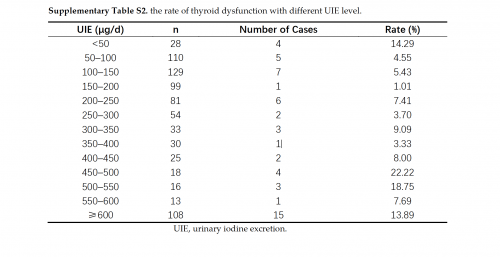
https://www.ncbi.nlm.nih.gov/pmc/articles/PMC10352823/
(Fasting, morning samples)
"In the subjects with UIC 250- 499 µg/L, UIC was positively correlated with TT3 and TT4 and TPOAB values (r= 0.228, p=0.022, r=0.208, p= 0.039, r=0.190, p=0.042, respectively...The relationship between the prevalence of thyroid diseases and UIC embodied a U-shaped curve."
(Note: many of Wu’s findings would be obscured if the iodine-sufficiency categories used by Till et al. were applied, that is, 150–500 µg/L for UIC/Cr as in Berghuis et al., 2025.)
Wu W, Chen Y, Guo W, Zhang K, Chen W, Fu M, Pan Z, Yang Y, Zhang N, Zhang W - "The Relationship Between Iodine Excess and Thyroid Function During Pregnancy and Infantile Neurodevelopment at 18-24 Months" J Nut 153(8):2320-2327 (2023). doi: 10.1016/j.tjnut.2023.05.012
https://linkinghub.elsevier.com/retriev ... 23)37605-3
"Maternal iodine nutritional status above requirement (UIC ≥250 μg/L or TSI >90th quantiles) during pregnancy negatively affects infantile neurodevelopment. Maternal TSH ≥2.5 mIU/L during pregnancy was an independent risk factor for infantile neurodevelopment."
Wu Z, Zhang Y, He C, Zhang W - "Urinary Iodine and Maternal Thyroid Hormones Across Pregnancy Trimesters: a Stratified and Nonlinear Analysis from 2020-2024" Biol Trace Elem Res (2026)doi: 10.1007/s12011-026-05086-6Our study included 469 mother-infant pairs. Compared with the maternal UIC of 150-249 μg/L during pregnancy, risk of adaptive developmental delay was increased in infants with maternal UIC ≥250 μg/L (OR: 2.38; 95% CI: 1.06, 5.35). Pregnant females with TSI >90th quantiles were more likely to have offspring with language developmental delay than those with lower TSI in 10th-90th quantiles (OR: 3.06; 95% CI: 1.09, 8.58). Risk of fine motor developmental delay was increased in infants with maternal TSH ≥2.5 mIU/L during pregnancy (OR: 4.32; 95% CI: 1.43, 13.0).
Conclusions: Maternal iodine nutritional status above requirement (UIC ≥250 μg/L or TSI >90th quantiles) during pregnancy negatively affects infantile neurodevelopment. Maternal TSH ≥2.5 mIU/L during pregnancy was an independent risk factor for infantile neurodevelopment.
https://link.springer.com/article/10.10 ... 26-05086-6
"Our data indicate a nonlinear relationship between iodine intake and thyroid function during pregnancy, characterized by trimester-specific effects. Ensuring adequate iodine levels while preventing both iodine deficiency and excess is essential for maternal thyroid health. These findings highlight the need for gestational stage-specific iodine monitoring and provide evidence to guide public health policies on maternal iodine supplementation."
Xia Y, Zhou Y, Zong D, Han L, Li X, Chen F – “Impact of mental development in offspring by maternal thyroid autoimmunity and subclinical hypothyroidism in pregnancy” Journal of Clinical and Experimental Medicine 8:670-672 (2015) PFPC Library
"A positive TPOAb result alone during pregnancy may affect the neurointellectual and motor development of offspring."
Xia Y, Ye Y, Liu M, Wang Y, Shang L, Wang P, Sun H - "Impact of high lodine and fluoride intake on children's IQ in rural China" Eur J Nutr 64(2):104. doi: 10.1007/s00394-025-03617-w.
https://link.springer.com/article/10.10 ... 25-03617-w
viewtopic.php?f=7&t=6560
Xia Y, Ye Y, Liu M, Wang Y, Shang L, Wang P, Xu Y - "Effects of high fluoride and iodine combined exposure on thyroid nodules and goiter in school-age children in Jiangsu, China" Heliyon 10(21)e40082 (2024)
https://doi.org/10.1016/j.heliyon.2024.e40082
viewtopic.php?f=7&t=6354
Xia Y, Xu Y, Shi M, et al. - "Effects of high-water fluoride exposure on IQ levels in school-age children: a cross-sectional study in Jiangsu, China" Expo Health 16:885-895 (2024). doi:10.1007/s12403-023-00597-2.
https://link.springer.com/article/10.10 ... 23-00597-2
In this study, no mention is made of the high iodine intake. -> see Xia et al., 2025[/list]
Xia Y, Ye Y, Liu M, Wang Y, Shang L, Wang P, Ding Z - "Effect of combined high iodine-fluorine water exposure on the occurrence of dental fluorosis in school-age children: a cross-sectional study from rural Jiangsu, China" Environ Geochem Health 47(9):369 (2025) doi: 10.1007/s10653-025-02685-5.
https://pubmed.ncbi.nlm.nih.gov/40783901/
viewtopic.php?f=7&t=6681
NOTE: This is the fourth study by Xia et al. on the Jiangsu cohort. The original study was the fluoride/IQ study used by the NTP in its fluoride neurotoxicity assessment. That study made no mention of the cohort’s high iodine intake. Although alerted to this, the NTP misled the public on this issue and made no adjustments or corrections. Subsequent Xia et al. papers (2024–2025) have explicitly documented high urinary iodine in the cohort and demonstrated strong UF–UI interactions affecting IQ, thyroid nodules, goiter, and now - dental fluorosis.
Xiao Y, Sun H, Li C, Li Y, Peng S, Fan C, Teng W, Shan Z - "Effect of Iodine Nutrition on Pregnancy Outcomes in an Iodine-Sufficient Area in China" Biol Trace Elem Res 182(2):231-237 (2008) doi: 10.1007/s12011-017-1101-4
https://link.springer.com/article/10.10 ... 017-1101-4
"Compared with the adequate group, incidence of macrosomia was significantly greater in the more than adequate and excessive group (12.42 vs. 9.79%, p < 0.05)."
Xing Z, Liu S, Ding P, Yu X, Song J, Sun H, Cui Y, Liu H - "A meta-analysis of the prevalence of children goiter in high water iodine areas of China" Biological Trace Element Research 202(10):4431-4439 (2024) doi: 10.1007/s12011-023-04035-x
https://link.springer.com/article/10.10 ... 23-04035-x
"The prevalence of goiter in children with urinary iodine levels 100-199 µg/L, 200-299 µg/L, and ≥ 300 µg/L was 2.4% [95% CI (1.9%, 2.9%)], 3.3% [95% CI (1.9%, 4.8%)], and 7.3% [95% CI (4.4%, 9.9%)], respectively, the difference was statistically significant (P < 0.01)."
Xu K, An N, Huang H, Duan L, Ma J, Ding J, He T, Zhu J, Li Z, Cheng X, Zhou G, Ba Y - "Fluoride exposure and intelligence in school-age children: evidence from different windows of exposure susceptibility" BMC Public Health 20(1):1657 (2020) doi: 10.1186/s12889-020-09765-4.
https://www.ncbi.nlm.nih.gov/pmc/articles/PMC7640398/
NOTE: This article has been retracted. None of the authors agree with the retraction. Retraction in: BMC Public Health. 2022 Nov 8;22(1):2044.

https://www.ncbi.nlm.nih.gov/pmc/articles/PMC8094504/
"When the UIC ≥ 300 μg/L or the WIC ≥ 100 μg/L, the risk of goiter will increase. The higher the UIC, the greater the risk of goiter development. In order to improve the public thyroid health, we should adhere to the monitoring of urinary iodine and water iodine, and keep them at an appropriate level."
Xu Y, Chen H, Ren M, Gao Y, Sun K, Wu H, Ding R, Wang J, Li Z, Liu D, Wang Z, Yan L - "Thyroid autoimmunity and adverse pregnancy outcomes: A multiple center retrospective study" Front Endocrinol (Lausanne) 14:1081851 (2023) doi: 10.3389/fendo.2023.1081851
https://www.frontiersin.org/articles/10 ... 81851/full
"TSH concentrations was higher in TAI women in baseline and remain higher before the third trimester. Positive thyroid autoantibodies were independently associated with higher risk of pregnancy-induced hypertension, gestational diabetes mellitus, and neonatal admission to NICU...increasing TPOAb concentration was correlated with higher probability of pregnancy-induced hypertension, and increasing TGAb concentration was positively correlated with pregnancy-induced hypertension, small for gestational age and NICU admission. Both TPOAb and TGAb concentration were negatively associated with neonatal birthweight." [see also: Nazarpour et al., 2023]
Yan R, Xu R, Zhou Y, Li Y, Pang Y, Liu J, Hu XH, Yang FG, Wen S, Zhang LP, Liu MQ - "Effects of iodine and fluoride content in drinking water on prevalence of adults thyroid nodules in Cangzhou, Hebei" Journal of Environmental and Occupational Medicine 36(5): 470-47 (2019)
http://www.jeom.org/article/en/10.13213 ... 2019.18828
viewtopic.php?f=7&t=1804
"Both high iodine and low iodine can induce thyroid nodules. In water source areas with high iodine content, both high iodine and high fluorine are the factors inducing thyroid nodules. The prevalence of thyroid nodules in low iodine and high fluorine area is significantly higher than that of low iodine area."
Yan DE, Hu L, Shen YF, Lai XY, Zhang MY, Zhou M, Chen C, Liu MM, Wu LT, Liu LQ, Fan QW, Min WL, Wan SC, Zou F, Li J, Cai X, Lei SH, Xiong Y, Yang Y, Yu R, Gao WW, Zhang Y, Chen T - "Iodine status and its association with prevalence of thyroid diseases in adults from Jiangxi Province, China" Endocrine 2023 Jun 12. doi: 10.1007/s12020-023-03413-8. Epub ahead of print
https://link.springer.com/article/10.10 ... 23-03413-8
"Both iodine deficiency and excessive iodine were risk factors for TAI."
Yang L, Li M, Liu X, Wu M, Zhang J, Zhao L, Ding G, Yang X - "Evaluation of Iodine Nutritional Status Among Pregnant Women in China" Thyroid 30(3):443-450 (2020). doi: 10.1089/thy.2019.0001
https://www.liebertpub.com/doi/10.1089/thy.2019.0001
"Pregnant women with UIC >250 μg/L had higher TSH levels than those with UIC 120-149 and 150-249 μg/L ...Compared with pregnant women who had UIC <250 μg/L, the prevalence of subclinical hypothyroidism was significantly increased in those with UIC >250 μg/L."
NOTE: In this study of the 2015 China National Nutrition and Health Survey (CNNHS), UIC was analyzed in a total of 6173 urinary samples collected from pregnant women residing in 31 provinces of China.
Yang Q, Zhou J, Xue B, Jiang Y, Zhang L - "Study on the correlation between urinary iodine level and thyroid function" Systems Medicine 2:07-110 (2023)
"In the comparison of the three groups, the urinary iodine level in the hypothyroidism group [265.2 (165.56, 284.56) μg/L] was significantly higher, and the difference was statistically significant (F=3.825, P=0.022). The double-positive rate of TGAb and TPOAb in the hypothyroidism/subclinical hypothyroidism group (14.3%) was higher than that in the normal thyroid function group, and the difference was statistically significant (P<0.05)...There was a negative correlation between urinary iodine level and TPOAb (r=-0.212, P=0.001). Iodine intake status may be associated with autoimmune hypothyroidism."
Yang XF, Hou XH, Jian XW, Guo HL, Ying CJ, Chen XY, Sun XF - "Effect of Selenium Supplementation on Activity and mRNA Expression of Type 1 Deiodinase in Mice With Excessive Iodine Intake" Biomed Environ Sci 19(4):302-8 (2006) PMID: 17044649.
"Excessive iodine intake significantly decreased the selenium concentration in urine and liver, and the activity of glutathione peroxidase (GSH-Px) in liver. Meanwhile, serum total T4 (TT4) increased while serum total T3 (TT3) decreased. Hepatic D1 enzyme activity and mRNA expression were reduced by 33% and 86%, respectively. Renal D1 enzyme activity and mRNA were reduced by 30% and 55%, respectively. Selenium supplementation obviously increased selenium concentration, activity of GSH-Px and D1 as well as mRNA expression of D1...Conclusion: Relative selenium deficiency caused by excessive iodine plays an essential role in the mechanism of iodine-induced abnormalities. An appropriate dose of selenium supplementation exercises a beneficial intervention."
Yang Z, Yin G, Yu Z - "Effects of high iodine content on deiodinase activity" Chinese Journal of Endemiology (4):206-208 (1994) PFPC Library
"Chronic high iodine intake induces goitrous changes and inhibits peripheral 5′-deiodination of T4, lowering T3 formation and raising rT3. The elevation of serum T4 in iodine-rich goiter appears attributable to decreased 5′-deiodinase activity and reduced T4 to T3 conversion."
Ye X, Wong LY, Bishop AM, Calafat AM - "Variability of urinary concentrations of bisphenol A in spot samples, first morning voids, and 24-hour collections" Environ Health Perspect 119(7):983-8 (2011) doi: 10.1289/ehp.1002701 Essential Reading
https://pmc.ncbi.nlm.nih.gov/articles/PMC3223007/
Yu X, Chen J, Li Y, Liu H, Hou C, Zeng Q, Cui Y, Zhao L, Li P, Zhou Z, Pang S, Tang S, Tian K, Zhao Q, Dong L, Xu C, Zhang X, Zhang S, Liu L, Wang A - "Threshold effects of moderately excessive fluoride exposure on children's health: A potential association between dental fluorosis and loss of excellent intelligence" Environ Int 118:116-124 (2018) doi: 10.1016/j.envint.2018.05.042
https://www.sciencedirect.com/science/a ... 1201830480
Yu X, Xia L, Zhang S, Zhou G, Li Y, Liu H, Hou C, Zhao Q, Dong L, Cui Y, Zeng Q, Wang A, Liu L - "Fluoride exposure and children's intelligence: Gene-environment interaction based on SNP-set, gene and pathway analysis, using a case-control design based on a cross-sectional study" Environ Int 155:106681 (2021). doi: 10.1016/j.envint.2021.106681
https://www.sciencedirect.com/science/a ... 2021003068

https://pubmed.ncbi.nlm.nih.gov/10667088/
Zhang D, Wang Y, Li W, Li F, Duan Y, Cui Y - "Association between childhood obesity and thyroid function: a cross-sectional study in a Chinese population" BMC Public Health 26(1):1072 (2026)
https://doi.org/10.1186/s12889-026-26812-8
"Childhood obesity is associated with subclinical hypothyroidism. BMI-z-score is correlated with TSH and FT3 levels." (U-Curve)
Zhang X, Yuan N, Sun J, Zhao X, Du J, Nan M, Zhang Q, Ji L - "Association Between Iodine Nutritional Status and Adverse Pregnancy Outcomes in Beijing, China: a Single-Center Cohort Study" Biol Trace Elem Res 200(6):2620-2628 (2022). doi: 10.1007/s12011-021-02887-9https://www.ncbi.nlm.nih.gov/pmc/articles/PMC9132840/
"The relationship between UI and the concentrations of TPOAb and TGAb follows a nearly U-shaped curve. Thus, physicians should critically consider the iodine nutritional status of pregnant women during the first trimester."
Zhang K, Cheng J, Yu J, Chen Y, Shi X, Zhu C, Lu Y, Wang N, Han B - "Trends in Iodine Status Among U.S. Children and Adults: A Cross-Sectional Analysis of National Health and Nutrition Examination Survey Data from 2001-2004 to 2017-2020" Thyroid 32(8):962-971 (2022) doi: 10.1089/thy.2022.0103
https://www.liebertpub.com/doi/10.1089/thy.2022.0103
"A higher prevalence rate of iodine intake below the EAR was observed in females compared with males (children, 24.0% vs. 16.5%, p < 0.001; adults, 20.0% vs. 11.1%, p < 0.001). Inadequate iodine intake was less frequent among non-Hispanic White and Hispanic compared with non-Hispanic Black in children and adults."
Zhang J, Tian Y, Wang W, Ouyang F, Xu J, Yu X, Luo Z, Jiang F, Huang H, Shen X - "Shanghai Birth Cohort. Cohort profile: the Shanghai Birth Cohort" Int J Epidemiol 48(1):21-21g (2019) doi: 10.1093/ije/dyy277 SBC
https://academic.oup.com/ije/article/48/1/21/5281227
Zhang Y, Zhao X, Zhao N, Song Y, Zhang Z, Zhang X, Meng H, Wang X, Shan L, Zhang W, Sang Z - "Long-term iodine deficiency and excess inhibit β-casein and α-lactalbumin secretion of milk in lactating rats" J Nutr Biochem 109812 (2024). doi: 10.1016/j.jnutbio.2024.109812
https://www.sciencedirect.com/science/a ... via%3Dihub
"Under iodine deficiency and excess, the concentrations of CSN2 and α-LA and protein expression levels of THRα1, THRβ1, and PRLR in the mammary gland decreased."
Zhang L, Fan L, Li F, Sun Q, Chen Y, He Y, Shen H, Liu L - "Study on the Effect of Different Iodine Intake on Hippocampal Metabolism in Offspring Rats" Biol Trace Elem Res 200(10):4385-4394 (2022). doi: 10.1007/s12011-021-03032-2
https://link.springer.com/article/10.10 ... 21-03032-2
"Both iodine deficiency and iodine excess caused metabolic disorders in the brain hippocampus of the offspring rats."
Zhang C, Yao J, Liu C, Yang K, Zhang W, Sun D, Gu W - "The Role of Thyroid Hormone Synthesis Gene-Related miRNAs Profiling in Structural and Functional Changes of The Thyroid Gland Induced by Excess Iodine" Biol Trace Elem Res 202(2):580-596 (2024) doi: 10.1007/s12011-023-03691-3
https://link.springer.com/article/10.10 ... 23-03691-3
Zhang Y, Sun W, Zhu S, Huang Y, Huang Y, Gao Y, Zhang J, Yang H, Guo X - "The Impact of Thyroid Function and TPOAb in the First Trimester on Pregnancy Outcomes: A Retrospective Study in Peking" J Clin Endocrinol Metab 105(3):dgz167 (2020) doi: 10.1210/clinem/dgz167
https://academic.oup.com/jcem/article/1 ... ogin=false
"TSH 2.5 to 4.08 mIU/L combined with TPOAb– during early pregnancy was associated with miscarriages and maternal composite outcomes."
Zhang X, Li C, Mao J, Wang W, Xie X, Peng S, Wang Z, Han C, Zhang X, Wang D, Fan C, Shan Z, Teng W - "Gestation-specific changes in maternal thyroglobulin during pregnancy and lactation in an iodine-sufficient region in China: a longitudinal study" Clin Endocrinol (Oxf) 86(2):229-235 (2017) doi: 10.1111/cen.13175
Zhang H, Wu M, Yang L, Wu J, Hu Y, Han J, Gu Y, Li X, Wang H, Ma L, Yang X - "Evaluation of median urinary iodine concentration cut-off for defining iodine deficiency in pregnant women after a long term USI in China" Nutr Metab (Lond) 16:62 (2019) doi: 10.1186/s12986-019-0381-4.
https://nutritionandmetabolism.biomedce ... 019-0381-4
"Twenty years after implementing USI, expectant Chinese mothers with MUIC of 107.4 μg/L, less than the WHO’s 150 μg/L benchmark, maintained thyroid function in both themselves and their newborn babies."
Zhao T, Li C, Wang H, Li J, Wang C, Gao Z, Du J, Teng W, Shan Z - "Effects of maternal iodine deficiency in women with mild thyroid dysfunction during early pregnancy on mental and motor growth of their offspring during levothyroxine treatment" Biol Trace Elem Res 204(4):2186-2198 (2026)
https://doi.org/10.1007/s12011-025-04810-y
"These findings suggest that concurrent assessment and optimization of both thyroid function and iodine status during early pregnancy may be essential for maximizing offspring intellectual development."
- Important point: even with LT4 treatment, iodine deficiency was associated with lower offspring Mental Development Index scores. LT4 treatment for SCH and isolated hypothyroxinemia improved MDI only when iodine status was normal, not when iodine was deficient. For TPOAb-positive women, LT4 treatment did not improve offspring MDI regardless of iodine status.
Zhao Huying, Pan Shilei, Liu Yingling, Li Dianjie, Zheng Wanting - "Relationship between TSH level and TPOAb status before 20 weeks of pregnancy and pregnancy outcomes" PLA Medical Journal 10:871-875 (2019) PFPC Library
http://218.28.6.71:81/Qikan/Article/Det ... 7100179359
"Pregnant women with subclinical hypothyroidism and elevated TSH combined with positive TPOAb before 20 weeks of pregnancy have an increased risk of premature birth, and pregnant women with subclinical hypothyroidism combined with positive TPOAb have an increased risk of gestational diabetes mellitus. Clinically, attention should be paid to such pregnant women early, and management during pregnancy should be strengthened to prevent complications in the middle and late stages of pregnancy."
Zhao L, Teng D, Shi X, Li Y, Ba J, Chen B, Du J, He L, Lai X, Li Y, Chi H, Liao E, Liu C, Liu L, Qin G, Qin Y, Quan H, Shi B, Sun H, Tang X, Tong N, Wang G, Zhang JA, Wang Y, Xue Y, Yan L, Yang J, Yang L, Yao Y, Ye Z, Zhang Q, Zhang L, Zhu J, Zhu M, Shan Z, Teng W - "The Effect of Increased Iodine Intake on Serum Thyrotropin: A Cross-Sectional, Chinese Nationwide Study" Thyroid 30(12):1810-1819 (2020) doi: 10.1089/thy.2019.0842
https://www.liebertpub.com/doi/10.1089/thy.2019.0842
"Serum TSH concentration significantly increased with increase in iodine intake. Thus, iodine intake must be considered in establishing TSH reference intervals."
Zhao Y, Zhang Z, Chen W, Zhao R, Zhang W, Tang Z, Huang H, Huang H, Wang H - "Iodine status of pregnant women in the Chinese plateau area - effects on thyroid function as well as adverse pregnancy and fetal outcomes" Asia Pac J Clin Nutr 34(2):208-224 (2025) doi: 10.6133/apjcn.202504_34(2).0004.
https://pmc.ncbi.nlm.nih.gov/articles/PMC11937493/
"The proportion of pregnant women testing positive for thyroid peroxidase antibody (TPO-Ab) and the prevalence of thyroid autoimmunity (TAI) increased significantly in more-than-adequate iodine and excess iodine groups...Our study found that, compared to the iodine-adequate group, the incidence of thyroid dysfunction was significantly higher in the more-than-adequate iodine group...We found that the positive rate of TPO-Ab and the prevalence of thyroid autoimmunity in pregnant women significantly increased when iodine levels were more-than-adequate or excessive. In contrast, the positive rate of TG-Ab significantly increased in cases of iodine deficiency, indicating a U-shaped relationship among iodine deficiency, excess, and more-than-adequate iodine levels."
Zheng H, Si M, Wang Q - "Correlation between thyroid hormone levels and cognitive dysfunction in older patients with subclinical hypothyroidism: A matched groups retrospective study" Wien Klin Wochenschr (2026)
DOI: https://doi.org/10.1007/s00508-026-02729-5
"A dose-response relationship was observed between increasing TSH levels and worsening cognitive function...The SCH is independently associated with cognitive dysfunction in older people, with thyroid hormones playing a critical role."
Zhou BQ, Wang WL, Zhuang JF - "Research on correlation of urinary iodine and urinary fluoride" Modern Preventive Medicine 35(17): 3411-3412 (2008)
http://en.cnki.com.cn/Article_en/CJFDTO ... 817065.htm
http://222.198.130.40:81/Qikan/Article/ ... d=28073250
Subjects: Patients with simple goiter and cretinism who took iodine preparations. Urinary iodine was higher than that of local normal people who did not take iodine preparations, and urine fluoride was lower than that of normal people who did not take iodine preparations. "So it indicates that urinary iodine and urinary fluoride negatively correlate to each other."
Supplements__Iodine: (126.5±25.8 μg/L)___Fluoride: (0.37±0.11 mg/L)
Normal_______Iodine: (87.1±27.1 μg/L)____Fluoride: (0.57±0.13)mg/L
Zhou SJ, Condo D, Ryan P, Skeaff SA, Howell S, Anderson PJ, McPhee AJ, Makrides M - "Association Between Maternal Iodine Intake in Pregnancy and Childhood Neurodevelopment at Age 18 Months" Am J Epidemiol 188(2):332-338 (2019) doi: 10.1093/aje/kwy225
https://academic.oup.com/aje/article/188/2/332/5193221
"The association between high maternal iodine intake (quartile 4) and poorer Bayley-III outcome in children, as well as our estimate of the effect, are compatible with the findings from a Spanish cohort study (INMA (23, 24)) in an iodine-sufficient area, which reported a 5.2-points-lower score in the Bayley-II (23) and a 1.7- (24) to 1.8-fold (23) increase in the odds of developmental delay in children whose mothers took iodine supplements of ≥150 μg/ day during pregnancy compared with those who took iodine supplements below 100 μg/day or no supplements. The background mean dietary iodine intake of the women in our study (150 μg/ day) (25) is similar to that of women from the Sabadell region in the INMA study (146 μg/day) (24). While these associations do not prove a causal relationship, the inhibitory effect of excess iodine on thyroid function is well recognized (26). The fetal thyroid is sensitive to the inhibitory effect of excess iodine, and excess iodine intake in pregnancy has also been shown to induce hypothyroidism in neonates (27–29). Findings from our study and the Spanish studies (23, 24) highlight the need to closely monitor and assess the safety of current recommendations in iodine sufficient populations like the United States and Australia after iodine fortification (25, 30, 31), because it is possible that some women might consume too much iodine."

"High iodine supplementation during pregnancy can increase the apoptosis of hippocampal neurons in offspring rats. As apoptosis regulatory genes, bcl-2 and bax may be involved in the process of high iodine-induced apoptosis of hippocampal neurons."
Zhou Z, Liu L, Jin M, Ren B, Meng F, Wang D, Li J, Li B, He Y, Li F, Shen H - "Relationships between the serum TPOAb and TGAb antibody distributions and water iodine concentrations, thyroid hormones and thyroid diseases: a cross-sectional study of 2503 adults in China" Br J Nutr 1-11 (2025). doi: 10.1017/S0007114522002367
https://pubmed.ncbi.nlm.nih.gov/35876046/
"The positivity rates of TGAb(+), TPOAb(+) and TGAb(+) and TPOAb(+) or TGAb(+) were significantly higher in iodine fortification (IF) areas than iodine adequate (IA) areas (all P < 0·05). In IF and iodine excess areas, the positivity rates of TPOAb(+), TGAb(+) and TPOAb(+) or TGAb(+) significantly increased with age (all P for trend < 0·05). The levels of TSH, TV and the prevalence of overt hypothyroidism, subclinical hypothyroidism and goitre were significantly elevated in the thyroid antibody-positive groups in the three areas, but the FT3 was diminished (all P < 0·010). Positivity for TPOAb and TGAb was associated with an increased risk of subclinical hypothyroidism in the three areas. In areas with different median water iodine, positivity for both TPOAb and TGAb was associated with elevated TSH values. Notably, with the increased levels of TPOAb, the frequency of abnormally elevated TSH increased dramatically in the three areas."
Zhou J, Tayier R, Abuduwaili D, Muhetaer D, Wang C, Pan K - "Impact of iodine nutritional levels in urban and rural pregnant women on neonatal growth indicators: a cohort study in Xinjiang, China" Front Nutr 12:1668818 (2025)
https://doi.org/10.3389/fnut.2025.1668818
Study showing very different serum iodine levels, while UIC was similar in regions in China. Also non-linear effects WITHIN reference range.
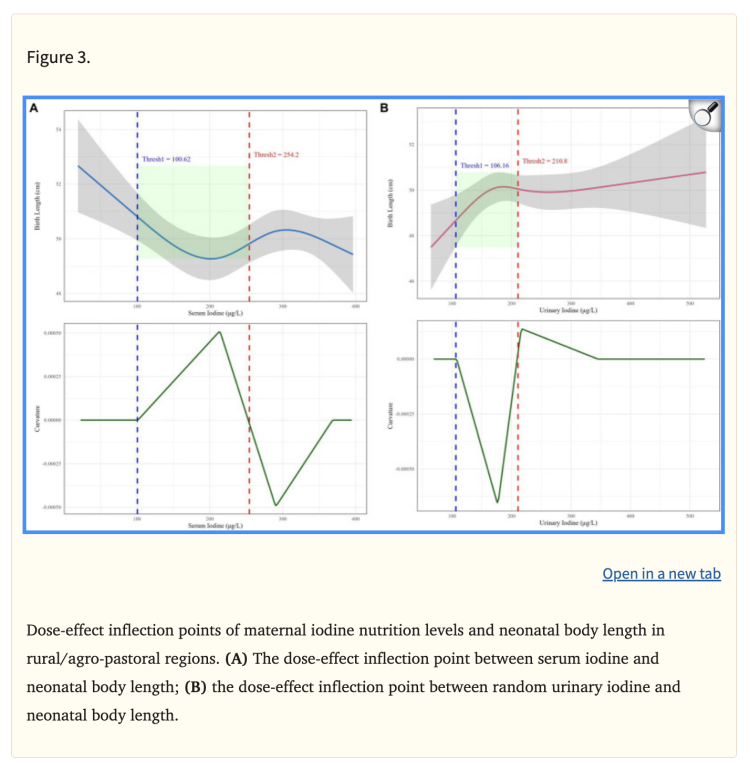
Zimmermann MB - "Iodine deficiency in pregnancy and the effects of maternal iodine supplementation on the offspring: a review" Am J Clin Nutr 89(2):668S-72S (2009) doi: 10.3945/ajcn.2008.26811C
https://www.sciencedirect.com/science/a ... 6523239829
Zimmermann MB, Andersson M - “Assessment of iodine nutrition in populations: past, present, and future” Nutr Rev 70:553–70 (2012)
https://academic.oup.com/nutritionrevie ... 53/1879576
Zimmermann MB, Aeberli I, Andersson M, Assey V, Yorg JA, Jooste P, Jukić T, Kartono D, Kusić Z, Pretell E, San Luis TO Jr, Untoro J, Timmer A - “Thyroglobulin is a sensitive measure of both deficient and excess iodine intakes in children and indicates no adverse effects on thyroid function in the UIC range of 100-299 μg/L: a UNICEF/ICCIDD study group report” J Clin Endocrinol Metab 98(3):1271-80 (2013) doi: 10.1210/jc.2012-3952
https://academic.oup.com/jcem/article/98/3/1271/2536830
Zohouri FV, Swinbank CM, Maguire A, Moynihan PJ - "Is the fluoride/creatinine ratio of a spot urine sample indicative of 24-h urinary fluoride?" Community Dent Oral Epidemiol 34(2):130-8 (2006) doi: 10.1111/j.1600-0528.2006.00269.x
https://onlinelibrary.wiley.com/doi/10. ... 06.00269.x
Zois C, Stavrou I, Kalogera C, Svarna E, Dimoliatis I, Seferiadis K, Tsatsoulis A - "High prevalence of autoimmune thyroiditis in schoolchildren after elimination of iodine deficiency in northwestern Greece" Thyroid 13(5):485-489 (2003)
https://doi.org/10.1089/105072503322021151
"In comparison to data from our previous survey 7 years ago, there has been a threefold increase in the prevalence of autoimmune thyroiditis among schoolchildren. In conclusion, silent iodine prophylaxis has resulted in the elimination of iodine deficiency in Greece, and this has been accompanied by an increase in the prevalence of autoimmune thyroiditis."
Related PFPC Member Forums
Excess Iodine & IQ | Neurodevelopment
viewtopic.php?f=101&t=4263
UIC > 250 ug/L
viewtopic.php?f=95&t=4751
UIC in Pregnancy | Thyroid Hormones
viewtopic.php?f=95&t=4732
Fluoride & Iodine
viewtopic.php?f=95&t=3889
Gipuzkoa
viewforum.php?f=103
Gender/Sex
viewforum.php?f=96
The Wistar Rat Model | Fluorosis Animal Models
viewforum.php?f=94
The Chicken Model | Fluorosis Animal Models
viewtopic.php?p=2656#p2656
Iodine Deficiency | Excess | Thyroid Disorders
viewforum.php?f=95
Thyroid Status & eGFR
viewtopic.php?p=5105
Thyroid Antibodies
viewtopic.php?f=100&t=4232
Selenium, Fluoride & Iodine
viewforum.php?f=102
Creatinine - Specific Gravity - Thyroid Function - UIC/Cr - UIC - GFR
viewtopic.php?p=5105#p5105
Tianjin Notes
viewtopic.php?f=30&t=4378&p=5155#p5155
TPO and TPOAb
viewtopic.php?f=30&t=5253
Press Releases published in February 2023 on the study by Hall et al.
- York University Press Release: https://www.yorku.ca/news/2023/02/09/fl ... udy-finds/
- FAN Press Release: https://www.prnewswire.com/news-release ... 47789.html
- FAN Article on Website: https://fluoridealert.org/articles/new- ... pregnancy/
Press Releases published in October 2023 on the study by Grandjean et al.
SDU PRESS Release on the 2023 study by Grandjean, Till, Goodman, et al.:
"Danish data support fluoride being toxic to brain development" October 10, 2023
https://www.sdu.dk/en/om_sdu/fakulteter ... elligensen
(False claim. Danish data does NOT support fluoride being toxic to brain development at the fluoride levels indicated)
- FAN Facebook Post, October 12, 2023 (NOTE: Grandjean is an 'expert' witness on behalf of FAN in lawsuit vs EPA)

Link to FAQ (PFPC Members): viewforum.php?f=106