More questionable work from the Tianjin gang....
Other studies involving/overlapping this cohort:
Duan Y, Wang Y, Li F, Li W, Zhang D, Cui Y - "Roles of External Factors and Polygenic Susceptibility in Thyroid Nodules and Goiter Among Children Aged 8-10 Years in Iodine-adequate Areas of Northern China" Biol Trace Elem Res (2026)
https://doi.org/10.1007/s12011-026-05302-3
"Multiple external factors are associated with thyroid nodules and goiter in children. Polymorphisms in TSHR rs2268458, TTF1 rs2076735, and PDE8B rs4704397 may modulate the effects of various external factors on childhood thyroid nodules and goiter..Notably, among children with specific genotypes, certain factors that were not statistically significant in the full multivariable model, including urinary iodine with thyroid nodules and stress and anxiety with goiter, showed substantially strengthened associations. ."
Duan Y, Wang Y, Cui Y, Zhang D, Li W, Li F, Hou C - "Analysis of factors influencing thyroid volume in school-aged children aged 8-10 years in Tianjin" J Public Health Prev Med 35(3):59-62 (2024)
https://doi.org/10.3969/j.issn.1006-2483.2024.03.014
Li W, Wang Y, Zhang D, Li F, Duan Y, Cui Y - "Establishment of reference ranges for thyroid function indices in school-aged children aged 8 to 10 years in Tianjin, China" J Environ Hyg 15(2) (2025)
https://www.sinomed.ac.cn/article.do?ui=2025182570
Wang Y, Cui Y, Zhang D, Chen C, Hou C, Cao L - "Moderating Role of TSHR and PTPN22 Gene Polymorphisms in Effects of Excessive Fluoride on Thyroid: a School-Based Cross-Sectional Study" Biol Trace Elem Res 200(3):1104-1116 (2022)
https://doi.org/10.1007/s12011-021-02753-8
"Children over 9 years old with dental fluorosis have lower FT4 and TGAb levels and thyroid volume and higher TPOAb levels."
- SEE ALSO:
Wang Y, Li F, Cui Y, Zhang D, Li W, Duan Y, Hou C, Liu H - "Analysis of iodine nutrition survey in Tianjin population before and after adjustment of salt iodine content" J Public Health Prev Med 31(1) (2020)
https://doi.org/10.3969/j.issn.1006-2483.2020.01.014
Wang Y, Duan Y, Cui Y, Zhang D, Li W, Li F, Hou C, Liu H - "Analysis of iodine nutrition and thyroid status in children with different iodized salt exposure" Journal of Public Health and Preventive Medicine 30(5):84-87 (2019)
https://doi.org/10.3969/j.issn.1006-2483.2019.05.021
The non-iodized-salt group had a numerically higher median UIC, 168.3 versus 164.9 μg/L.
Previous work in an overlapping Tianjin child population reported that fluoride-associated thyroid changes differed by age, with children over 9 years old who had dental fluorosis showing lower FT4, lower TGAb, reduced thyroid volume and higher TPOAb
(Wang et al., 2022). The 2026 study included children aged 8-10 years, but did not report age-stratified fluoride analyses or fluoride-by-age interaction tests for the thyroid hormone outcomes. This matters because age may modify the fluoride-thyroid relationship rather than simply act as a confounder. Adjusting for age in selected models does not determine whether the association between fluoride and thyroid function differs by age. The omission of TPOAb and TGAb is also notable, given that thyroid antibody differences had previously been reported in older children from this research population.
Adequate Iodine?
The description of the children as being from "iodine-adequate areas" is a population-level characterization and does not establish that individual children were iodine adequate. The cohort had a very broad UIC distribution. Median UIC was 148.1 μg/L and the 75th percentile was already 234.5 μg/L. Therefore, approximately one quarter of the 751 children, about 188, had UIC around or above 234.5 μg/L, and the proportion above 200 μg/L must have been greater than 25%. The exact proportion cannot be determined because the distribution between the median and 75th percentile was not reported.
The 2022 Wang et al. study in an overlapping Tianjin child population showed a similarly broad iodine distribution. Among 413 children, those without dental fluorosis had a median UIC of 167.0 μg/L with an IQR of 106.55-257.30 μg/L, while those with dental fluorosis had a median of 159.2 μg/L with an IQR of 106.50-255.90 μg/L. The age-stratified groups were similar, with upper quartiles ranging from approximately 247.6 to 269.9 μg/L. Again, more than 25% of the children must have had UIC above 200 μg/L, although the exact proportion cannot be calculated from the published summary statistics.
This is important because iodine has a well-established U-shaped relationship with thyroid function: both insufficient and excessive iodine exposure can adversely affect thyroid physiology. A population median within the "adequate" range therefore does not mean that thyroid risk is uniform across the cohort. Children at both the lower and upper ends of the UIC distribution may differ from those in the middle of the distribution.
Duan et al. did not model this established non-linear iodine-thyroid relationship. Instead, UIC was treated as a candidate covariate and was omitted from some adjusted models when it failed their univariable screening criterion, including the FT3 and FT4 models. [UIC was included in the adjusted continuous TSH model, but not in the FT3 or FT4 continuous models. It was also omitted from the categorical FT3, FT4 and TSH models. Only some thyroid outcomes had iodine adjustment at all.] This is particularly problematic for a U-shaped exposure. Opposing effects at the lower and upper ends of the iodine distribution can produce little or no overall monotonic association even when iodine is biologically important. Failure of UIC to satisfy a univariable screening criterion therefore does not establish that iodine was irrelevant as a confounder or effect modifier.
The contrast with the treatment of fluoride is striking. Duan et al. explicitly investigated non-linear associations between urinary fluoride and thyroid outcomes using restricted cubic splines, but did not perform corresponding non-linear modelling of iodine despite the established U-shaped relationship between iodine and thyroid function. This matters because the apparent shape of a fluoride-thyroid association cannot necessarily be interpreted independently of iodine. If iodine is associated with fluoride exposure, inadequate modelling of its non-linear relationship with thyroid outcomes can leave residual confounding. If iodine modifies the thyroid response to fluoride, pooling children across different iodine states can also alter or generate an apparent non-linear fluoride-response pattern.
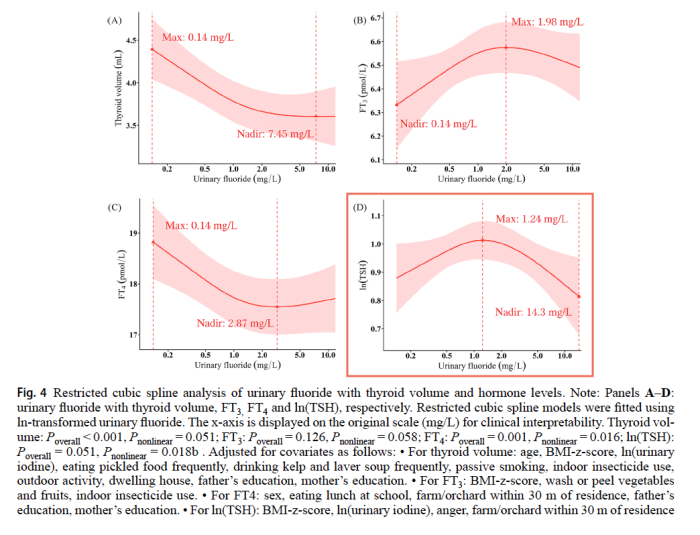
This concern is also relevant to the sensitivity analysis. After excluding children with UIC below 20 or above 500 μg/L, the overall urinary-fluoride associations with thyroid volume and FT4 remained statistically significant, but the evidence for non-linearity in FT4 did not: P-nonlinear changed from 0.016 in the primary analysis to 0.237 after restriction. For the categorical goiter, FT3 and TSH outcomes included in the sensitivity RCS analysis, the corresponding overall spline associations were no longer statistically significant. Importantly, however, the supplement did not report a corresponding sensitivity RCS analysis for continuous ln(TSH). The robustness of the inverse-U relationship shown in Fig. 4D to restriction of the iodine distribution therefore remains unknown. The retained UIC range of 20-500 μg/L was also still extremely broad and did not resolve the problem of iodine's U-shaped relationship with thyroid function.
Fluoride & TSH: Inverse U - a picture worth 1000 words:
- The continuous TSH result is particularly striking. In Fig. 4D, adjusted ln(TSH) rises from 0.88 at urinary fluoride of 0.14 mg/L to a maximum of 1.01 at 1.24 mg/L, then falls to 0.81 at 14.30 mg/L. The authors describe this as a "weak inverted U-shaped" relationship because the confidence intervals overlap substantially. Nevertheless, the inverse-U pattern is visually obvious, and the formal test for non-linearity was statistically significant (P-nonlinear = 0.018), although the overall spline test was borderline (P-overall = 0.051).
Different Exposure Periods
The study also used two fundamentally different indicators of fluoride exposure: dental fluorosis and current urinary fluoride. These should not be treated as though they represent the same exposure period.
Dental fluorosis reflects fluoride exposure during enamel development and therefore provides information about an earlier developmental exposure period. Urinary fluoride, by contrast, was measured in a current random urine sample and principally reflects much more recent fluoride exposure. UIC was measured in the same random urine sample, while FT3, FT4, TSH, thyroid volume and goiter were assessed at the time of examination.
The exposure-window problem is therefore most pronounced in the dental-fluorosis analyses. A current UIC cannot reconstruct a child's iodine exposure during the earlier developmental period in which dental fluorosis formed. This is particularly important in Tianjin because the investigators' own surveillance showed that childhood iodine exposure changed over the relevant period. Median UIC in children fell from 210.10 μg/L, classified as more-than-adequate, before adjustment of salt iodine content in 2012 to 172.08 μg/L, classified as adequate, afterwards, while the proportion of children with UIC below 100 μg/L increased. Children recruited at ages 8-10 between 2018 and 2023 therefore passed through early childhood during a period in which population iodine exposure was changing.
For the urinary-fluoride analyses, the temporal problem is different. UF and UIC were measured on the same sampling occasion and both provide information about recent exposure, but each was based on a single random urine sample. Neither measurement establishes habitual or long-term exposure. More importantly, although UIC was included in some adjusted models, it was entered only as ln(UIC). That treatment cannot represent iodine's U-shaped relationship with thyroid function. Thus, even where iodine was included as a covariate, the analysis did not model the biologically relevant non-linear iodine-thyroid relationship.
Summary
Consequently, the study cannot establish that the reported fluoride-thyroid associations, whether based on dental fluorosis, urinary fluoride or their combined classification, are independent of iodine status. The difficulty is not simply that iodine was measured imperfectly. The investigators characterized the study population as being from "iodine-adequate areas" despite a broad individual UIC distribution, failed to model iodine's established U-shaped relationship with thyroid function, omitted UIC from some adjusted hormone models, and did not test fluoride-by-iodine interaction. Their sensitivity analysis also did not resolve these concerns: restriction of UIC to 20-500 μg/L eliminated the statistically significant non-linearity previously observed for FT4 and rendered the categorical spline associations non-significant, while no corresponding sensitivity RCS analysis was reported for continuous ln(TSH). The robustness of the obvious inverse-U fluoride-TSH relationship to restriction of the iodine distribution therefore remains unknown.