https://www.sciencedirect.com/science/a ... 0025000824
Abstract
Fluoride pollution in freshwater bodies is becoming alarming because it interferes with the endocrine system of water-dwelling organisms. In this study, we evaluated the effects of sublethal fluoride levels on thyroid hormone levels and histological alterations in Cyprinus carpio, a popular model fish species used in ecotoxicity experiments. The low, medium, and high fluoride groups received 1, 5, and 10 mg/L fluoride, respectively, and thyroxine plasma levels (T4) and triiodothyronine plasma levels (T3) were assessed at 7, 14, 21, and 35 days. The findings revealed that both T4 and T3 levels significantly decreased with increasing dose and ranged from to 10-41% lower than controls in the 10 mg/L fluoride group. On day 35, T4 levels were reduced by 42% and T3 levels were reduced by 50% in the high fluoride exposure group compared to those in the control group. Changes in the thyroid gland were observed under a light microscope that included, but were not limited to, small follicle size, epithelial hypertrophy, and epithelial hyperplasia, especially in the high-fluoride group. These results suggest that elevated fluoride exposure causes a hormonal imbalance in Cyprinus carpio by affecting thyroid hormone biosynthesis and functionality, which may result in growth and reproductive failure. The eminent dose-response data on fluoride concentration and the degree of thyroid disruption clearly emphasise the severe endocrine-disruptive effects of fluoride at increased concentrations. The results of the present study agree with those of other studies that have described the inhibitory effect of fluoride on thyroid function in different fish species. Therefore, we conclude that fluoride may be a potent endocrine disruptor in the environment. As thyroid hormones play significant roles in metabolic and physiological functions in fish, these findings underscore the importance of improving fluoride standards in freshwater habitats. Research on the molecular pathways that lead to thyroid dysfunction when exposed to fluoride and other effects of this chemical substance on the environment.
NOTE: The tables do NOT support the author's conclusions.
Authors claim:
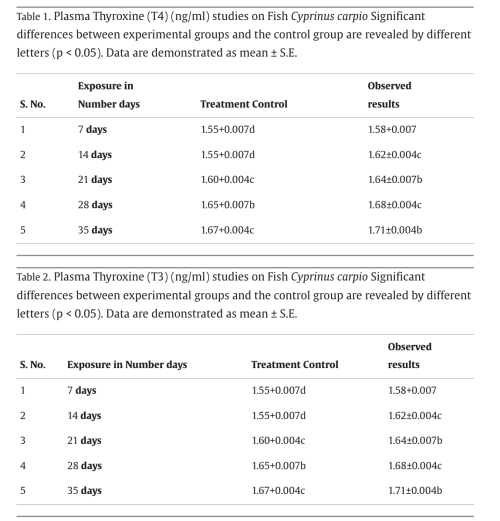
Table 1 shows the changes in T4 and T3 concentrations with different concentrations of fluoride in drinking water, which suggests a direct dose-response relationship. The most significant decrease in thyroid hormones was observed in the high fluoride group (10 ppm fluoride) and the medium fluoride group (5 ppm fluoride). The fluoride content in the water had a direct effect on the control group, and 1 mg/L fluoride had the least impact on disruptions, showing reductions in T4 and T3 on day 14 in the medium and high groups. These decreases were significantly different from those in the control group at day 35 as follows: the high fluoride group decreased by 42% in T4 and 50% in T3; the medium fluoride group decreased by 28% in T4 and 35% in T3.
1. Mismatch Between Tables and Text Description
The text describes dose-dependent effects of fluoride (1 ppm, 5 ppm, 10 ppm) on T3 and T4 levels, but the tables show only time points (days) with no indication of fluoride concentrations or groupings (e.g., low, medium, high fluoride). No percentage changes are reported, and the observed hormone levels increase over time - contradicting the claim of significant decreases.
2. Identical Tables for T3 and T4
Table 1 (T4) and Table 2 (T3) present identical data for both treatment control and observed values across all time points. This is scientifically implausible and strongly suggests a copy-paste or labeling error.
3. Missing Fluoride Dose Groups
Although the text refers to animals exposed to 1, 5, and 10 ppm fluoride, the tables do not reflect this. Without clear assignment of dose groups, the assertion of a dose-response relationship cannot be substantiated.
4. Mislabeling of Hormone in Table Title
Table 2 is titled "Plasma Thyroxine (T3)," which is incorrect. Thyroxine refers to T4, not T3 (triiodothyronine). This fundamental error in terminology suggests a lack of understanding of basic thyroid physiology or careless editing.
It certainly appears that rigorous peer review was lacking or bypassed in this case. Such errors would normally be caught during even a basic editorial or peer review process.