2026: Association of fluoride exposure with thyroid morphology and function in children from iodine-adequate areas
Posted: Sat Sep 19, 2026 7:04 am
Duan Y, Wang Y, Li F, Li W, Zhang D, Cui Y - "Association of fluoride exposure with thyroid morphology and function in children from iodine-adequate areas: a cross-sectional study in Tianjin, China" Environmental Health, article in press (2026)
https://doi.org/10.1186/s12940-026-01337-0
https://doi.org/10.1186/s12940-026-01337-0
Abstract
Background
Epidemiological evidence has shown directionally consistent associations between fluoride exposure and thyroid dysfunction in children. However, the dose-response characteristics, combined effects of cumulative and recent total exposure, and multidimensional thyroid outcomes remain incompletely characterized. This study investigated associations of fluoride exposure with thyroid morphology and function in children from Tianjin, China.
Methods
A cross-sectional study was conducted in iodine-adequate areas of Tianjin, China, including 751 children aged 8–10 years. Urinary fluoride (a biomarker of recent total intake) and urinary iodine were measured. Dental fluorosis (a marker of cumulative exposure during tooth development) was clinically assessed. Thyroid volume was measured by ultrasound, and serum free triiodothyronine (FT3), free thyroxine (FT4), and thyroid-stimulating hormone (TSH) were measured and classified as low, normal, or elevated. Multiple linear and logistic regression models evaluated associations between fluoride exposure and thyroid outcomes, adjusting for 33 confounders. Restricted cubic spline (RCS) models analyzed nonlinear dose-response relationships.
Results
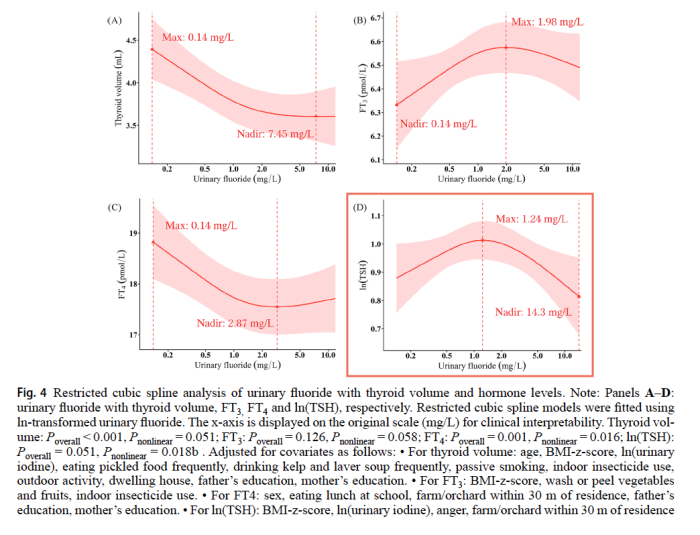
In adjusted models, both dental fluorosis and urinary fluoride were associated with reduced thyroid volume (β = −0.57, 95% CI: −0.75, − 0.39; and β = −0.18, 95% CI: −0.25, − 0.10, respectively) and lower goiter risk (OR = 0.14, 95% CI: 0.05, 0.39; and OR = 0.70, 95% CI: 0.55, 0.90, respectively). Urinary fluoride was associated with lower FT4 (β = −0.20, 95% CI: −0.33, − 0.06), reduced risk of elevated TSH (OR = 0.71, 95% CI: 0.54, 0.92), and increased risk of low FT3 (OR = 1.63, 95% CI: 1.21, 2.20). RCS analyses showed thyroid volume declined with increasing urinary fluoride, plateauing at approximately 7.45 mg/L. FT4 decreased rapidly at lower levels and plateaued at approximately 2.87 mg/L. For categorical outcomes, goiter and elevated TSH risks decreased monotonically, crossing OR = 1.0 at approximately 1.1 mg/L, whereas low FT3 risk increased progressively, also crossing OR = 1.0 at approximately 1.1 mg/L. Combined classification of dental fluorosis and urinary fluoride showed that children with both indicators positive had the most pronounced reductions in FT4 and goiter risk. Sensitivity analyses confirmed robust continuous findings (thyroid volume and FT4) after excluding children with extreme iodine nutrition.
Conclusion
Childhood fluoride exposure in iodine-adequate areas is associated with altered thyroid morphology and function, including reduced thyroid volume, lower goiter risk, lower FT4, reduced risk of elevated TSH, and increased risk of low FT3. Evaluating fluoride health risks requires considering multiple thyroid indicators and complementary exposure biomarkers.
"FT3 is more active than FT4 and is mostly derived from FT4 through deiodinase conversion in peripheral tissues such as the liver and kidneys [36, 37]. The increase in low FT3 risk, alongside decreased FT4, suggests that peripheral compensatory conversion may be insufficient to maintain active T3 levels under higher fluoride exposure. This mechanism is commonly observed in iodine deficiency or thyroid dysfunction. However, elevated FT3 showed a weak and imprecise trend, indicating that fluoride-induced FT3 disruption is primarily directional toward deficiency rather than excess. These findings suggest that evaluating fluoride's thyroid toxicity requires focusing on T4, T3, and TSH simultaneously; relying solely on TSH may not fully capture its complex effects."