Like all fluoride compounds - inorganic or organic - florfenicol affects thyroid hormone metabolism.
Guo R, Zhang Y, Zhang X, Zhang Q, Cheng R, Mostafizur RM, Liu Y – "Effects of florfenicol exposure on growth, development and antioxidant capacity of flounder Paralichthys olivaceus larvae at different developmental stages" J Oceanol Limnol 38:550-559 (2020)
https://doi.org/10.1007/s00343-019-9023-y
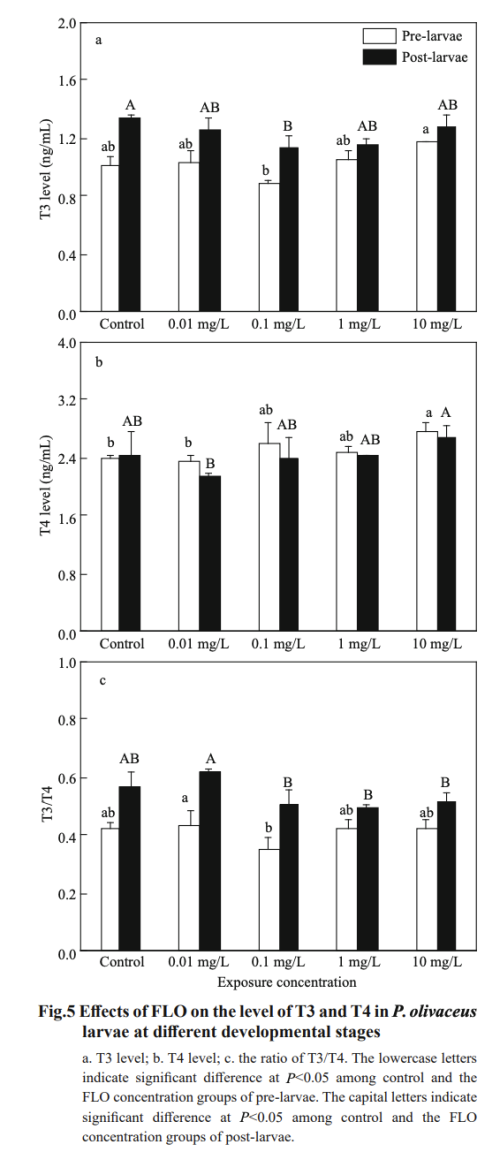
T4 is the main thyroid hormone produced by the hypothalamic pituitary thyroid (HPT) axis; T3 is transformed from T4 via three deiodinases and exerts biological activity by binding thyroid hormone receptors. In our study, the post larvae at 20 dpf exposed to FLO for 7 d were in an important stage of metamorphosis, and the ratio of T3/T4 was significantly higher than that of the pre larvae. In addition, we found that the T3/T4 ratio decreased with increasing FLO dosage in both pre and post larvae, suggesting that FLO may inhibit the conversion from T4 to T3. However, the ratio of T3/T4 in the 0.01 mg/L exposed group did not change, indicating that FLO may promote the growth and development of larvae at a moderate concentration.
Gut Dysbiosis
Florfenicol affects the gut microbiota and may promote dysbiosis, which in turn can alter thyroid hormone metabolism.
- Ma Z, Gao X, Yang X, Lin L, Wei X, Wang S, Li Y, Peng X, Zhao C, Chen J, Xiao H, Yuan Y, Dai J - "Low-dose florfenicol and copper combined exposure during early life induced health risks by affecting gut microbiota and metabolome in SD rats" Ecotoxicol Environ Saf 245:114120 (2022)
https://doi.org/10.1016/j.ecoenv.2022.114120
Mei X, Ma B, Zhai X, Zhang A, Lei C, Zuo L, Yang X, Zhou C, Wang H - "Florfenicol Enhances Colonization of a Salmonella enterica Serovar Enteritidis floR Mutant with Major Alterations to the Intestinal Microbiota and Metabolome in Neonatal Chickens" Appl Environ Microbiol 87(24):e0168121 (2021)
https://doi.org/10.1128/AEM.01681-21
Xiang LJ, Song JH, Zhang YR, Xu DD, Gu ZQ, Hu WH, Chen RY, Li HD - "Effects of two antibiotics on liver and intestinal tissue structure, antioxidant capacity, and gut microbiota of yellow croaker" Acta Hydrobiologica Sinica 49(6):146-159 (2025)
https://doi.org/10.7541/2025.2024.0410
Yun X, Zhou J, Wang J, Li Q, Wang Y, Zhang W, Fan Z - "Biological toxicity effects of florfenicol on antioxidant, immunity and intestinal flora of zebrafish (Danio rerio)" Ecotoxicol Environ Saf 265:115520 (2023)
https://doi.org/10.1016/j.ecoenv.2023.115520
Adverse Birth Effects
In children, prenatal exposure to florfenicol was associated with reduced birth weight, and ciprofloxacin, a fluoroquinolone, showed a similar dose–response pattern (Zhang et al., 2022).
- Zhang WX, Zeng XX, Chen Q, Yu K, Zheng H, Yu XG, Zhang YJ, Zhang J, Huang HY, Huang LS - "Prenatal environmental antibiotics and fetal and postnatal growth: A biomonitoring-based prospective study in Eastern China" Chemosphere 288(Pt 3):132657 (2022)
https://doi.org/10.1016/j.chemosphere.2021.132657
Emotional and Behaviour Problems
Maternal exposure to florfenicol, ciprofloxacin and ofloxacin (all fluorinated antibiotics) was associated with behavioural problems and attention disorders in 4 year-old children (Xiong et al., 2024).
- Xiong W, Wang B, Han F, Tong J, Gao H, Ding P, Liu K, Wu X, Huang K, Geng M, Tao F - "Association between maternal antibiotic exposure and emotional and behavioural problems in children at four years of age: A biomonitoring-based prospective study" Ecotoxicol Environ Saf 284:116949 (2024)
https://doi.org/10.1016/j.ecoenv.2024.116949
Maternal exposure to trimethoprime, ciprofloxacin, florfenicol, other antibiotics and PVA exposure during the first trimester was positively associated with emotional problems in children. Second-trimester trimethoprime concentrations and third-trimester ciprofloxacin concentrations were positively associated with hyperactivity-inattention. Third-trimester veterinary antibiotic (VA) exposure was negatively associated with hyperactivity-inattention, and second-trimester VA and PVA exposure was negatively associated with peer problems.
Antibiotic Resistance
The floR gene is the earliest discovered and currently the most widespread florfenicol resistance gene. Once it spreads into the human body through the food chain, it may pose a huge threat to human public health.
- Kim E, Aoki T - "Sequence analysis of the florfenicol resistance gene encoded in the transferable R-plasmid of a fish pathogen, Pasteurella piscicida" Microbiol Immunol 40(9):665-669 (1996)
https://doi.org/10.1111/j.1348-0421.1996.tb01125.x
Li P, Wu D, Liu K, Suolang S, He T, Song J, Sun Y - "Analysis of resistance to florfenicol and the related mechanism of dissemination in different animal-derived bacteria" Front Cell Infect Microbiol 10:369 (2020)
https://doi.org/10.3389/fcimb.2020.00369
Lu J, Zhang J, Xu L, Liu Y, Li P, Zhu T, Cheng C, Lu S - "Spread of the florfenicol resistance floR gene among clinical Klebsiella pneumoniae isolates in China" Antimicrob Resist Infect Control 7:73 (2018)
https://doi.org/10.1186/s13756-018-0415-0
Ma W, Wang L, Xu X, Huo M, Zhou K, Mi K, Tian X, Cheng G, Huang L - "Fate and exposure risk of florfenicol, thiamphenicol, and antibiotic resistance genes during composting of swine manure" Sci Total Environ 839:156243 (2022)
https://doi.org/10.1016/j.scitotenv.2022.156243
Ortiz-Severín J, Hojas I, Redin F, Serón E, Santana J, Maass A, Cambiazo V - "From metagenomes to functional expression of resistance: floR gene diversity in bacteria from salmon farms" Antibiotics 14(2):122 (2025)
https://doi.org/10.3390/antibiotics14020122
Use in China
In April 1999, the Chinese Ministry of Agriculture approved forfenicol as a “class II new veterinary drug” for animals, including cattle, pigs, chickens and fish. Florfenicol is one of the most widely used antibiotics in aquaculture globally and the amount used in China is as high as 10 000 tons per year, with measurable residues reported in the Yangtze River basin, Three Gorges Reservoir, Songhua River basin and around Dalian Bay aquaculture farms. In the Dalian Bay, concentrations of up to 11 mg/L have been found (Guo et al., 2024).
- Guo X, Chen H, Tong Y, Wu X, Tang C, Qin X, Guo J, Li P, Wang Z, Liu W, Mo J - "A review on the antibiotic florfenicol: Occurrence, environmental fate, effects, and health risks" Environ Res 244:117934 (2024)
https://doi.org/10.1016/j.envres.2023.117934
Zhang T, Ding Y, Peng J, Dai Y, Luo S, Liu W, Ma Y – "Effects of Broad-Spectrum Antibiotic (Florfenicol) on Resistance Genes and Bacterial Community Structure of Water and Sediments in an Aquatic Microcosm Model" Antibiotics 11(10):1299 (2022)
https://doi.org/10.3390/antibiotics11101299
Defluorination
Florfenicol is not fully stable in the environment and can undergo defluorination during degradation, releasing inorganic fluoride (F⁻).
- Cao Z, Liu X, Xu J, Zhang J, Yang Y, Zhou J, Xu X, Lowry GV - "Removal of antibiotic florfenicol by sulfide-modified nanoscale zero-valent iron" Environ Sci Technol 51(19):11269-11277 (2017)
https://doi.org/10.1021/acs.est.7b02480
Chen Z, Chen J, Tan S, Yang Z, Zhang Y - "Dechlorination helps defluorination: insights into the defluorination mechanism of florfenicol by S-nZVI and DFT calculations on the reaction pathways" Environ Sci Technol 58(5):2542-2553 (2024)
https://doi.org/10.1021/acs.est.3c07435
Tang Z, Kong Y, Qin Y, Chen X, Liu M, Shen L, Kang Y, Gao P - "Performance and degradation pathway of florfenicol antibiotic by nitrogen-doped biochar supported zero-valent iron and zero-valent copper: a combined experimental and DFT study" J Hazard Mater 459:132172 (2023)
https://doi.org/10.1016/j.jhazmat.2023.132172
Mundhenke TF, Bhat AP, Pomerantz WCK, Arnold WA - "Photolysis products of fluorinated pharmaceuticals: a combined fluorine nuclear magnetic resonance spectroscopy and mass spectrometry approach" Environ Toxicol Chem 43(11):2285-2296 (2024)
https://doi.org/10.1002/etc.5773
Yu P, Zhou L, Wang J, Pei C, Tan L, Duan P, Chen J - "Highly efficient florfenicol removal via nitrogen-doped zero-valent iron/carbon composites activated with peroxodisulfate: mechanisms and pathways" Eng Sci 35:1535 (2025)
https://doi.org/10.30919/es1535
Enhancement of florfenicol uptake by endotoxin (LPS)
Pérez-Fernández R, Cazanga V, Jeldres JA, Silva PP, Riquelme J, Quiroz F, Palma C, Carretta MD, Burgos RA - "Plasma and tissue disposition of florfenicol in Escherichia coli lipopolysaccharide-induced endotoxaemic sheep" Xenobiotica 47(5):408-415 (2017)
https://doi.org/10.1080/00498254.2016.1195522
In experimentally endotoxaemic sheep given florfenicol, LPS markedly altered drug disposition, with changes in plasma clearance and tissue penetration that imply sepsis can significantly modify florfenicol pharmacokinetics and may require dose adjustments under inflammatory conditions.
Pérez R, Palma C, Burgos R, Jeldres JA, Espinoza A, Peñailillo AK - "The acute phase response induced by Escherichia coli lipopolysaccharide modifies the pharmacokinetics and metabolism of florfenicol in rabbits" J Vet Pharmacol Ther 39(2):183-190 (2016)
https://doi.org/10.1111/jvp.12244
In LPS-challenged rabbits, the acute phase response significantly altered florfenicol disposition, including changes in clearance and biotransformation, indicating that systemic inflammation can modify both pharmacokinetics and metabolism of florfenicol and may necessitate different dosing under septic conditions.
NOTE: Endotoxin acts on the same pathway as is regulated by Gq/11.
================
Patent Info:
US4235892 – “1-Aryl-2-acylamido-3-fluoro-1-propanols, methods for their use as antibacterial agents and compositions useful therefor”
Priority date: 1979-02-05
https://patents.google.com/patent/US4235892A/en
Assignee: Schering Corporation, now Merck Sharp and Dohme LLC.