https://link.springer.com/article/10.10 ... 25-03617-w
NOTE: The 711 children in this study are the exact same cohort evaluated for the relationship between fluoride and IQ in Xia's 2023 study -> https://link.springer.com/article/10.10 ... 23-00597-2. In that study - evaluated by the NTP, FAN etc. - no mention is made of the high iodine intake.
Abstract
Background: Excessive intake of both fluorine and iodine can lead to various health effects. The potential influence of excessive fluorine and iodine intake on the intelligence of school-age children has become a notable concern.
Objectives: To investigate the relationship between urinary fluoride (UF) levels, urinary iodine (UI) levels, and intelligence quotient (IQ).
Methods: This study involved 711 children aged 8 to 12 from rural Jiangsu, China. Water iodine levels were measured using As3+-Ce4+ catalytic spectrophotometry, while UI levels were determined using inductively coupled plasma mass spectrometry. Fluoride levels in urine and drinking water were measured using the ion-selective electrode method. Children's cognitive function, evaluated through IQ scores, was assessed using the Combined Raven's Test. The results were considered significant at the P < 0.05 level.
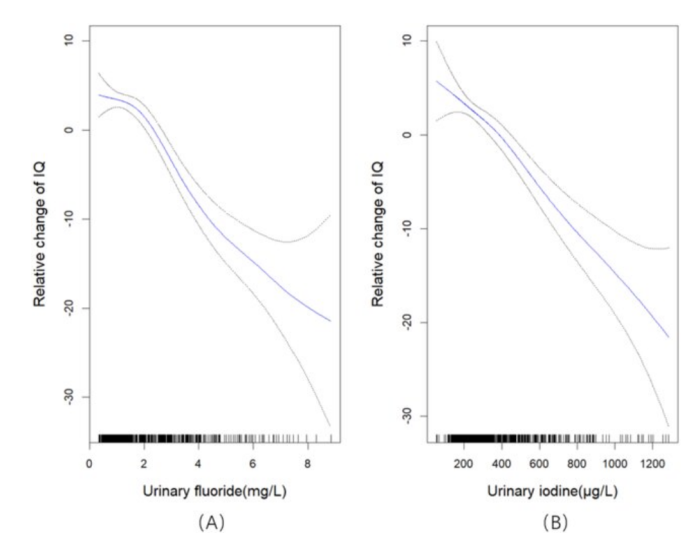
Results: The average IQ score was 107.6, the median UF was 281 µg/L, and the median UI was 1.39 mg/L [Ed. This is obviously wrong - median UI was 281 µg/L, - not UF; UF was 1.39 mg/L]. The correlation coefficient (β) and confidence interval (95%CI) for UF and UI on IQ were - 3.34 (-4.14, -2.43) and - 3.31 (-4.19, -2.41), respectively (P < 0.001, P < 0.001). UF > 1.4 mg/L and UI ≥ 300 µg/L were negatively correlated with IQ scores in all school-age children (P < 0.001, P < 0.001), with β and 95% CIs of -3.59 (-5.45, -1.74), -4.06 (-5.91, -2.21), respectively. The interaction term (UF > 1.4 mg/L: UI ≥ 300 µg/L) was negatively correlated with IQ scores in all (P = 0.041) and female school-age children (P = 0.007), with β and 95%CIs of -4.43 (-8.66, -0.19) and - 8.87 (-15.16, -2.40), respectively.
Conclusions: High levels of both fluoride and iodine intake negatively affect the IQ of school-age children. Monitoring and regulating these elements in children's diets is essential to prevent cognitive impairment.
COMMENTARY: What is driving the IQ loss - fluoride or iodine?