2022: Interaction of fluoride exposure and CREB1 gene polymorphisms on thyroid function in school-age children
Posted: Mon Feb 19, 2024 8:57 am
Xu K, Feng Z, Afrim FK, Ma J, Yang S, Zhang X, Niu Z, An N, Du Y, Yu F, Zhou G, Ba Y - "Interaction of fluoride exposure and CREB1 gene polymorphisms on thyroid function in school-age children" Chemosphere 303(Pt 2):135156 (2022) doi: 10.1016/j.chemosphere.2022.135156
https://www.sciencedirect.com/science/a ... 3522016496
Abstract
Objectives
To evaluate the effects of CREB1 gene polymorphisms and long-term exposure to fluoride on thyroid function of children.
Study design
A total of 424 children (including 226 boys and 198 girls) aged 7–12 years old were enrolled in Kaifeng, China by cross-sectional study in 2017. The concentrations of urinary fluoride (UF) and creatinine (UCr) were measured using fluoride ion-selective electrode assay and creatinine assay kit (picric acid method), respectively. The concentration of UCr-adjusted UF (CUF) was calculated. Children were divided into high fluoride exposure group (HFG, CUF >1.41 mg/L) and low fluoride exposure group (LFG, CUF ≤1.41 mg/L) according to the median concentration of CUF (1.41 mg/L). The serum thyroid-stimulating hormone (TSH), total triiodothyronine (TT3) and total thyronine (TT4) levels were detected by the radiation immunoassay. The B-mode ultrasound was performed to test the thyroid volume (Tvol). Genotyping of CREB1 gene was conducted by a custom-by-design 48-plex SNPscan™ Kit. Associations between CUF concentration, CREB1 single nucleotide polymorphisms (SNPs) and thyroid function were assessed by multiple linear regression models.
Results
Negative and positive associations between serum TT4 level (β = −0.721, 95%CI: −1.209, −0.234) and Tvol (β = 0.031, 95%CI: 0.011, 0.050) and CUF concentration were observed respectively. Children carrying CREB1 rs11904814 TG and rs2254137 AC genotypes had lower TT3 levels (P < 0.05). Children in HFG carrying rs11904814 TT, rs2253206 GG genotypes and rs6740584 C allele easily manifested lower serum TT4 levels (P < 0.05). Moreover, interactions between excessive fluoride exposure and CREB1 SNPs on Tvol were observed, and the interaction among different loci of CREB1 gene could modify serum TT3 level (P < 0.05, respectively).
Conclusions
Fluoride could alter children's serum TT4 levels and Tvol. Interactions between fluoride exposure and CREB1 polymorphisms may modify thyroid volume of children.
PFPC Commentary
This is yet another study on the Kaifeng cohort. Again, the authors conduct a faulty investigation, and fail to account for iodine intake appropriately.
Here, the authors claim:
https://www.sciencedirect.com/science/a ... 3522016496
Abstract
Objectives
To evaluate the effects of CREB1 gene polymorphisms and long-term exposure to fluoride on thyroid function of children.
Study design
A total of 424 children (including 226 boys and 198 girls) aged 7–12 years old were enrolled in Kaifeng, China by cross-sectional study in 2017. The concentrations of urinary fluoride (UF) and creatinine (UCr) were measured using fluoride ion-selective electrode assay and creatinine assay kit (picric acid method), respectively. The concentration of UCr-adjusted UF (CUF) was calculated. Children were divided into high fluoride exposure group (HFG, CUF >1.41 mg/L) and low fluoride exposure group (LFG, CUF ≤1.41 mg/L) according to the median concentration of CUF (1.41 mg/L). The serum thyroid-stimulating hormone (TSH), total triiodothyronine (TT3) and total thyronine (TT4) levels were detected by the radiation immunoassay. The B-mode ultrasound was performed to test the thyroid volume (Tvol). Genotyping of CREB1 gene was conducted by a custom-by-design 48-plex SNPscan™ Kit. Associations between CUF concentration, CREB1 single nucleotide polymorphisms (SNPs) and thyroid function were assessed by multiple linear regression models.
Results
Negative and positive associations between serum TT4 level (β = −0.721, 95%CI: −1.209, −0.234) and Tvol (β = 0.031, 95%CI: 0.011, 0.050) and CUF concentration were observed respectively. Children carrying CREB1 rs11904814 TG and rs2254137 AC genotypes had lower TT3 levels (P < 0.05). Children in HFG carrying rs11904814 TT, rs2253206 GG genotypes and rs6740584 C allele easily manifested lower serum TT4 levels (P < 0.05). Moreover, interactions between excessive fluoride exposure and CREB1 SNPs on Tvol were observed, and the interaction among different loci of CREB1 gene could modify serum TT3 level (P < 0.05, respectively).
Conclusions
Fluoride could alter children's serum TT4 levels and Tvol. Interactions between fluoride exposure and CREB1 polymorphisms may modify thyroid volume of children.
PFPC Commentary
This is yet another study on the Kaifeng cohort. Again, the authors conduct a faulty investigation, and fail to account for iodine intake appropriately.
Here, the authors claim:
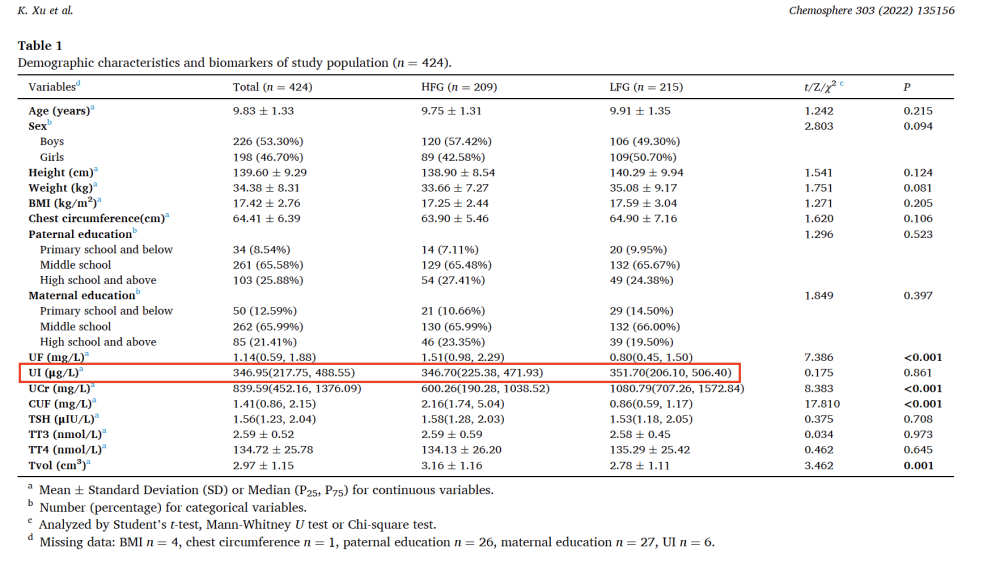
However, table 1 shows that the children had excessive iodine intake. Mean UIC was 346.95 μg/L- according to WHO guidelines indicative of excessive iodine consumption."Almost all children had appropriate iodine intake, which may be due to the diversity of food and the implementation of iodized salt policy."